Bibelen er Guds ord, som leder vores skridt og rådgiver os i de beslutninger, vi skal træffe hver dag. Som skrevet i denne salme, kan hans ord være en lygte for vores fødder og i vores beslutninger.
Bibelen er et åbent brev skrevet til mænd, kvinder og børn, inspireret af Gud. Han er nådig; han ønsker vores lykke. Ved at læse Ordsprogenes Bog, Prædikerens Bog eller Bjergprædikenen (i Matthæus, kapitel 5 til 7), finder vi råd fra Kristus til at have et godt forhold til Gud og til vores næste, som kan være en far, en mor, et barn eller andre mennesker. Ved at lære disse råd, der er skrevet i de bibelske bøger og breve, såsom apostlen Paulus, Peter, Johannes og disciplene Jakob og Judas (Jesu halvbrødre), som skrevet i Ordsprogenes Bog, vil vi fortsætte med at vokse i visdom både for Gud og blandt mennesker, ved at sætte den i praksis.
Denne salme siger, at Guds ord, Bibelen, kan være et lys på vores vej, det vil sige for de store åndelige retninger i vores liv. Jesus Kristus viste den vigtigste retning med hensyn til håb, nemlig at opnå evigt liv: « Dette er det evige liv: at de kender dig, den eneste sande Gud, og ham, du har udsendt, Jesus Kristus » (Johannes 17:3). Guds søn talte om håbet om opstandelsen og oprejste endda adskillige mennesker under sin tjenestegerning. Den mest spektakulære opstandelse var hans ven Lazarus’, som havde været død i tre dage, som det fortælles i Johannesevangeliet (11:34-44).
Denne bibelhjemmeside indeholder adskillige bibelartikler på det sprog, du ønsker. Der er dog snesevis af lærerige bibelartikler, der er designet til at opmuntre dig til at læse Bibelen, forstå den og sætte den i praksis, med det mål at have (eller fortsætte med at have) et lykkeligt liv med tro på håbet om evigt liv (Johannes 3:16, 36). Du har en online bibel, og linkene til disse artikler er nederst på siden (skrevet på engelsk. For automatisk oversættelse kan du bruge Google Translate).
Læs Bibelen dagligt. Dette indhold indeholder lærerige bibelartikler på engelsk, fransk, spansk og portugisisk (brug Google Translate til at vælge et af disse sprog samt dit foretrukne sprog for at forstå indholdet af disse artikler).
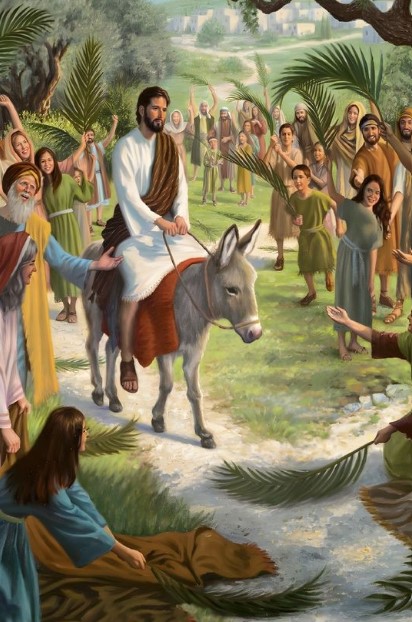
“Be very joyful, O daughter of Zion. Shout in triumph, O daughter of Jerusalem. Look! Your king himself comes to you. He is righteous, yes, saved; humble, and riding upon an ass, even upon a full-grown animal the son of a she-ass”
(Zechariah 9:9)
This prophecy, according to the Gospel accounts, was fulfilled when Jesus Christ entered Jerusalem on Nisan 10, 33 AD:
“So the disciples went and did just as Jesus had instructed them. 7 They brought the donkey and its colt, and they put their outer garments on them, and he sat on them. 8 Most of the crowd spread their outer garments on the road, while others were cutting down branches from the trees and spreading them on the road. 9 Moreover, the crowds going ahead of him and those following him kept shouting: “Save, we pray, the Son of David! Blessed is the one who comes in Jehovah’s name! Save him, we pray, in the heights above!”
10 And when he entered Jerusalem, the whole city was in an uproar, saying: “Who is this?” 11 The crowds kept saying: “This is the prophet Jesus, from Nazareth of Galilee!”” (Matthew 21:6-11).
When Jesus Christ entered Jerusalem, was he really a king?
The biblical account shows that the investiture of a king at the head of a kingdom occurs in two stages. The first step is the anointing process, or designation by God, of the human who will be king. It may be that at the time of God’s appointment, there is already another king, so that the new anointed king is not necessarily vested with the kingdom. Let us take the example of King David, to better understand when Jesus Christ has been anointed as King and then invested with this kingship, this time at the head of the Heavenly Kingdom of God.
King David has been anointed and made King while king Saul reigned: « So Samuel took the horn of oil and anointed him in the presence of his brothers. And the spirit of Jehovah began to empower David from that day forward. Samuel later rose and went his way to Ramah” (1 Samuel 16:13). It was not until the death of king Saul that he began to reign, in Hebron, among his enemies, because one of Saul’s sons, Ish-bosheth, claimed succession to the throne in Jerusalem (2 Samuel chapters 2, 3 and 4). Finally, two men cowardly murdered Ish-Bosheth while he slept. The two assassins, thinking that they would be rewarded for this despicable act, beheaded Ish-Bosheth to bring his head to King David. However, he was outraged at this assassination and had these two assassins executed on the spot (2 Samuel 4:9-12). After the death of Ish-Bosheth, David began to reign in Jerusalem (1 Samuel chapter 5). The historical account of King David allows us to better understand the different stages of the kingship of Christ, at the head of the Heavenly Kingdom of God.
Jesus Christ has been anointed as King by his Heavenly Father, Jehovah God, at his baptism in 29 CE. Before the birth of the child Jesus, the angel Gabriel told Mary, his future mother, that her son would become king: « He will rule as King over the house of Jacob forever, and there will be no end to his Kingdom » (Luke 1:33). Thus, Jesus Christ became King anointed by his Father, at the beginning of his first visible presence on earth, in the year 29 CE. Toward the end of His first earthly presence, on Nisan 10, 33 CE, Jesus Christ returned to Jerusalem as the appointed and anointed king of His Heavenly Father, in fulfillment of the prophecy of Zechariah 9:9: « Rejoice greatly, O daughter of Zion. Shout in triumph, O daughter of Jerusalem. Look! Your king is coming to you. He is righteous, bringing salvation, Humble and riding on a donkey, On a colt, the foal of a female donkey” (Matthew 21:1-10).
Jesus Christ, in front of the Roman governor Pilate, made it clear that he was king:
« So Pilate entered the governor’s residence again and called Jesus and said to him: “Are you the King of the Jews?” 34 Jesus answered: “Are you asking this of your own originality, or did others tell you about me?” 35 Pilate replied: “I am not a Jew, am I? Your own nation and the chief priests handed you over to me. What did you do?” 36 Jesus answered: “My Kingdom is no part of this world. If my Kingdom were part of this world, my attendants would have fought that I should not be handed over to the Jews. But as it is, my Kingdom is not from this source.” 37 So Pilate said to him: “Well, then, are you a king?” Jesus answered: “You yourself are saying that I am a king. For this I have been born, and for this I have come into the world, that I should bear witness to the truth. Everyone who is on the side of the truth listens to my voice.” 38 Pilate said to him: “What is truth?” » (John 18:33-38).
When he ascended into Heaven to join his Heavenly Father, according to Psalms 110, he sat at the right hand of the Father expecting to receive the inheritance of the Kingdom of God, or the governance both in Heaven and on Earth: « Jehovah declared to my Lord: “Sit at my right hand Until I place your enemies as a stool for your feet »” (Psalms 110, compare with Luke 19:12).
In 1914, according to the prophecy of Daniel chapter 4, and the book of Apocalypse, it would appear that King Jesus Christ was invested with this kingship with a kingdom. According to Psalms 2, it was on this date that he began to reign among his enemies, a bit like king David during his seven years of reign in Hebron. It is interesting to note in the prophecy of Apocalypse chapter 6, describing the beginning of the woes of humanity, Jesus Christ is already described as being invested with this Kingship, in the midst of his enemies and in adverse circumstances, particularly for mankind (Apocalypse 6:1-8, compare 11:15-18, 12:10-12). It is as King that Jesus Christ will come to judge humanity, shortly before the great tribulation, putting an end to the reign of his enemies (Apocalypse 19:11-21).
1914, really?
By this question, it should be said that this date is absolutely not unanimous among Christians who are interested in the prophecy of Jesus Christ regarding the end of this system of things. This is why initially, there will be a simplified explanation of how this date is obtained. And then, out of intellectual honesty, we will examine what could be considered as interpretative weaknesses in the calculation of this date. And thirdly, the reasons why this year of 1914 was retained in the editorial line of this biblical site. Some information will be in the conditional as possibilities or probabilities while being open to any need for readjustments.
1914 would be the beginning of Christ’s invisible presence as King
and the beginning of the end of this system of things mentioned
in Matthew 24 and 25, Mark 13 and Luke 21
The determination of this date is based on the prophecy of Daniel (4:10-25), which you can read in your copy of the Bible. In 607 BCE, when Jerusalem has been conquered by the Babylonians, “the Davidic throne” representing Jehovah’s earthly sovereignty, has been found vacant, and no longer representing it (2 Kings 25:1-26). In the prophecy of Ezekiel, it is written that this reign of the Davidic dynasty would be restored: “This is what the Sovereign Lord Jehovah says: ‘Remove the turban, and take off the crown. This will not remain the same. Raise up the low one, and bring low the high one. A ruin, a ruin, a ruin I will make it. And it will not belong to anyone until the one who has the legal right comes, and I will give it to him” (Ezekiel 21:26, 27). The one who would have “the legal right” to the Davidic crown, is Christ Jesus (Luke 1:32, 33).
The prophecy of Daniel, chapter 4, indicates the duration of this temporary interruption of the reign of the Davidic dynasty: 7 times, that are, 7 prophetic years of 360 days. Which are 2520 days or 7 prophetic years. The historical and prophetic context, of the events after the beginning of the temporary overthrow of the Davidic dynasty, in 607 BCE, allows to understand that these 2520 days, are in fact 2520 years. Adding 7 years, to the year 607 BCE, nothing historically important has happened: which makes it possible to discern that it is indeed the biblical correspondence, of « a day for a year », 2520 years (Ezekiel 4:6). Adding the 2520 years, to 607 BCE, we get to the year 1914 CE. In 1 Kings 25:25,26, it is written that Jerusalem has been completely uninhabited from the seventh month of the year 607 BCE, that is, from the month of Tishri (Ethanim).
The weaknesses of this interpretation leading to 1914
Many Christians have serious doubts about this interpretation and calculation. Here are four major objections: The first simple objection is that in the immediate context of Daniel chapter 4, there is no information that would indicate that this dream would have a second fulfillment. The second objection is that, assuming that there was another accomplishment, the date of 607 BCE for the first destruction of Jerusalem is not consistent with the date held by historians, which would be 586 BCE. The third objection is that nothing indicates, in the immediate context, that the seven times are 7 prophetic years. The fourth objection is that there is no indication, in the immediate context of chapter 4, that the 2520 days should be converted into 2520 years, according to Ezekiel 4:6. These four entirely admissible objections show that this interpretive date must be considered with caution and not with dogmatism. Now, taking into account these objections, here is why this date and its chronological calculation were retained in the editorial line of this biblical site, as a historical marker recognized by many historians.
Those who contest the validity of the calculation of this date, say that they are basing themselves on an exegetical study of the biblical text. However, it is appropriate to go to the end of this exegesis by admitting that the original biblical texts were not divided into chapters and verses. Thus, while remaining in the general context of the book of Daniel, it is not appropriate to reason only on the basis of the context of the single « chapter 4 », when it obviously does not directly give its meaning. Without necessarily going to another biblical book, looking at the whole context of the book of Daniel, can be usually enough. Let us see how.
Concerning the first objection, which shows that nothing indicates, in chapter 4, that there would be a second fulfillment. In any case, in the Bible, there is never any direct or written indication that there would be two fulfillments. It is only the context that allows us to understand it (see above the reasoning on the expression « great tribulation »). Furthermore, sometimes there are historical biblical narratives that have, at first glance, no prophetic dimension, and yet, it exists. Let us take two examples. The story of manna falling from heaven (Exodus 16:31-36). Nothing in the historical context of this passage shows the prophetic dimension of this story. However, Jesus Christ considered that it did indeed have a prophetic dimension (John 6:31-58). The historical account of the making of the copper serpent (Numbers 21:7-9). Nothing in the historical context of this passage shows the prophetic dimension of this narrative. However, Jesus Christ considered that it did indeed have a prophetic dimension (John 3:14,15).
Let us look at the story of Nebuchadnezzar’s dream in Daniel chapter 4. First of all, it should be noted that it is his second dream sent by God to this king (Daniel 2). In his first dream, Daniel says that God has revealed to him (through the interpretation of this dream) « what is to happen in the final part of the days ». Thus, the historical account of Daniel 2 has more than a simple anecdotal value, but also a prophetic value, concerning our time. The question that arises is: should we expect less from the story of the second dream given by God to King Nebuchadnezzar? Namely, that the scope of this second prophetic dream would concern « the final part of the days ». Basing ourselves, this time on the whole context of the book of Daniel, if we were to consider the second dream of King Nebuchadnezzar as applying only to his time, and to his person alone, then it would be the only prophetic vision which would not concern our time, while the whole of this book is directly related to « the final part of the days » (Daniel 12:9). Therefore, it would be rather the failure to not admit that there would be a second fulfillment of this dream, concerning the last days, which would not respect the entire context of the prophetic book of Daniel.
The second objection is about the date of 607 BCE, which would correspond to the first destruction of Jerusalem by the Babylonian armies. However, all historians consider that this event happened around 20 years later, that is to say in 586 BCE. Furthermore, there is no known historical written record today regarding this date of 607 BCE. Why, on a biblical level, would this date be chosen as a starting point? Because the date of Cyrus’ edict allowing the Jews to return to Jerusalem, recognized by historians, was promulgated in 539 BCE. The Jews arrived in Jerusalem in 537 BCE, ending the 70 years of desolation of that city, according to the prophecy of Jeremiah (Jeremiah 25:11,12): « In the first year of his reign I, Daniel, discerned by the books the number of years mentioned in the word of Jehovah to Jeremiah the prophet to fulfill the desolation of Jerusalem, namely, 70 years” (Daniel 9:2). If we go back 70 years, from 537 BCE, we arrive at 607 BCE.
The third objection is about the seven times, translated into 7 prophetic years of 360 days. It is in chapter 12 that we have confirmation that this correspondence is correct: « It will be for an appointed time, appointed times, and half a time » (Daniel 12:7). This period would correspond to 3 and a half times, or three and a half prophetic years, or 1260 days. Then, the angel mentions two other periods which would begin with the 1260 days, that is, 1290 days (1260 days plus 30 days) (verse 11), 1335 days (1260 days plus 75 days) (verse 12). Which demonstrates that the three and a half times correspond to the 1260 days, and that the 7 times represent seven prophetic years, or 2520 days.
The fourth objection is about the conversion of the 2520 days, the seven times, into 2520 years. This conversion exists in the book of Daniel chapter 9, regarding the seventy weeks of years in Daniel 9:24-27. What is interesting is that at no time is the word « week » written accompanied by the word « year ». And yet, depending on the context, in this prophecy, the seven days of the week are automatically translated into weeks of years. Therefore, converting the 2520 days into 2520 years, to arrive at the last days period mentioned in Daniel’s prophecy, also respects its context.
Therefore, we can consider that the year 1914 would be the beginning of the reign of King Jesus Christ in heaven, among his enemies (Psalms 2). He is present in the sense that since this period, his attention has been turned to the earth to act on behalf of the people of God (Daniel 12:1). If his presence is currently invisible, his coming, shortly before the great tribulation, will be visible (Matthew 24:30; 25:31-33; Revelation 1:7). It was also during this year, it seems, according to the Apocalypse, that the Devil and the demons were expelled to the neighborhood of the earth, plunging the world into a process of self-destruction and collective suicide against the all peoples, which we can observe particularly today: « Woe for the earth and for the sea, because the Devil has come down to you, having great anger, knowing that he has a short period of time » (Apocalypse 12:12). However, a little farther on, we will see what the year 1914 does not represent.
Jesus Christ told to his faithful apostles that they would reign with him in the heaven, to rule over the earth where the future humanity will be the « Twelve Tribes of Israel » (see Matthew 19:28). This idea that humans who will have the privilege of living in heaven, will rule over the Earth, is written in the book of Revelation: “you made them to be a kingdom and priests to our God, and they are to rule as kings over the earth” (Revelation 5:10). Nevertheless, the book of Revelation repeatedly shows that the number of those who will live in heaven will be only 144,000, taken the humanity: “Then I saw, and look! the Lamb standing on Mount Zion, and with him 144,000 who have his name and the name of his Father written on their foreheads” (Revelation 14:1-5). The context of the book of Revelation confirms that it is a literal and not a symbolic number. For example, this number is found for the first time in Revelation 7: 4-8: “And I heard the number of those who were sealed, 144,000, sealed out of every tribe of the sons of Israel” (Revelation 7:4-8).
And the context of this important information makes us understand that this is a real and not a symbolic number. Indeed, after Revelation 7: 4-8, the prophecy continues in verses 7: 9-17 describing thegreat crowd that will survive the great tribulation. This time, regarding this group, the prophecy gives this detail: “After this I saw, and look! a great crowd, which no man was able to number, out of all nations and tribes and peoples and tongues, standing before the throne and before the Lamb, dressed in white robes; and there were palm branches in their hands” (Revelation 7:9). A “great crowd which no man was able to number” in this case the number of people is not known. We therefore understand that the information before, regarding the precise number of 144,000 humans who will live in heaven is to be taken literally.
It is written in The book of Revelation that 7000 humans will complete the 144000 in the heavens just before the Great Tribulation: “In that hour there was a great earthquake, and a tenth of the city fell; and 7,000 persons were killed by the earthquake, and the rest became frightened and gave glory to the God of heaven” (Revelation 11:13). The « tenth of the city » that falls, represents all of the 144,000 who died on earth to live in heaven, while the 7,000 people « killed » (just before the great tribulation) represent those who will complete the 144000, with their heavenly resurrection: “Afterward we the living who are surviving will, together with them, be caught away in clouds to meet the Lord in the air; and thus we will always be with the Lord” (1 Thessalonians 4:17).
This group of humans will be the New Jerusalem, the Bride of Christ: “And I saw a new heaven and a new earth; for the former heaven and the former earth had passed away, and the sea is no more. I also saw the holy city, New Jerusalem, coming down out of heaven from God and prepared as a bride adorned for her husband. With that I heard a loud voice from the throne say: “Look! The tent of God is with mankind, and he will reside with them, and they will be his people. And God himself will be with them. And he will wipe out every tear from their eyes, and death will be no more, neither will mourning nor outcry nor pain be anymore. The former things have passed away” » (Revelation 21:1-4).
For those who disagree with this explanation and understanding, it is important to clarify that this is not a dogmatic teaching. Indeed, it is the Heavenly Father, through his son Jesus Christ, who will ultimately decide the number of faithful Christians who will join his son in heaven—whether only 144,000, or millions, if this number is to be taken symbolically. These two perspectives do not alter the meaning of the explanations that follow.
When will the heavenly resurrection take place?
First, according to what it is written in 2 Timothy (2:16-18), it did not begin in the time of the apostles: “These men have deviated from the truth, saying that the resurrection has already occurred, and they are subverting the faith of some” (2 Timothy 2:18). Some believe that the heavenly resurrection began in 1918. This interpretation has absolutely no biblical basis and is not consistent with the context of the entire book of Apocalypse, which mentions it.
Indeed, it is written in the book of Apocalypse the time when this heavenly resurrection will take place: « And I saw thrones, and those who sat on them were given authority to judge. Yes, I saw the souls of those executed for the witness they gave about Jesus and for speaking about God, and those who had not worshipped the wild beast or its image and had not received the mark on their forehead and on their hand. And they came to life and ruled as kings with the Christ for 1,000 years. 5 (The rest of the dead did not come to life until the 1,000 years were ended.) This is the first resurrection. 6 Happy and holy is anyone having part in the first resurrection; over these the second death has no authority, but they will be priests of God and of the Christ, and they will rule as kings with him for the 1,000 years » (Apocalypse 20:4-6).
The heavenly resurrection of all the 144,000 will take place at the beginning of Christ’s millennial reign, specifically just before the great tribulation. Two other passages in the Book of Apocalypse help us to understand that this heavenly resurrection will occur shortly before the beginning of the great tribulation. It is written in The book of Revelation (Apocalypse) that 7000 humans will complete the 144000 in the heavens just before the Great Tribulation: “In that hour there was a great earthquake, and a tenth of the city fell; and 7,000 persons were killed by the earthquake, and the rest became frightened and gave glory to the God of heaven” (Apocalypse 11:13). The « tenth of the city » that falls, represents all of the 144,000 who died on earth to live in heaven, while the 7,000 people « killed » (just before the great tribulation) represent those who will complete the 144000, with their heavenly resurrection.
In the First Letter to the Thessalonians there are more details concerning the heavenly resurrection of the 7,000:
« Because the Lord himself will descend from heaven with a commanding call, with an archangel’s voice and with God’s trumpet, and those who are dead in union with Christ will rise first. 17 Afterward we the living who are surviving will, together with them, be caught away in clouds to meet the Lord in the air; and thus we will always be with the Lord » (1 Thessalonians 4:16-17).
The heavenly resurrection will begin with those who have died in union with Christ, and then « we the living who are surviving « —that is, faithful Christians living on earth—will be caught up to heaven to be with Christ (1 Thessalonians 4:15). In his first letter to the Corinthians, the apostle Paul seems to explain how the rapture of Christians will unfold: « Look! I tell you a sacred secret: We will not all fall asleep in death, but we will all be changed, 52 in a moment, in the blink of an eye, during the last trumpet. For the trumpet will sound, and the dead will be raised up incorruptible, and we will be changed » (1 Corinthians 15:51,52).
This complete heavenly resurrection will represent the marriage of the Lamb, which is mentioned in Revelation (Apocalypse) just before the great tribulation: “And I heard what sounded like a voice of a great crowd and like the sound of many waters and like the sound of heavy thunders. They said: “Praise Jah, because Jehovah our God, the Almighty, has begun to rule as king! 7 Let us rejoice and be overjoyed and give him glory, because the marriage of the Lamb has arrived and his wife has prepared herself. 8 Yes, it has been granted to her to be clothed with bright, clean, fine linen—for the fine linen stands for the righteous acts of the holy ones.” 9 And he tells me, “Write: Happy are those invited to the evening meal of the Lamb’s marriage.” Also, he tells me: “These are the true sayings of God.”” (Apocalypse 19:6-9). And after this joyful description of the marriage of the Lamb, representing the heavenly resurrection of those who will be with Christ in heaven, there is then the dramatic description of the great tribulation in Revelation (19:11-21).
The marriage of the Lamb is also described in Psalm 45; here is part of that description:
« My heart is stirred by something good. I say: “My song is about a king.” May my tongue be the stylus of a skilled copyist. 2 You are the most handsome of the sons of men. Gracious speech flows from your lips. That is why God has blessed you forever. 3 Strap your sword on your side, O mighty one, In your dignity and your splendor. 4 And in your splendor go on to victory; Ride in the cause of truth and humility and righteousness, And your right hand will accomplish awe-inspiring things. 5 Your arrows are sharp, making peoples fall before you; They pierce the hearts of the king’s enemies. 6 God is your throne forever and ever; The scepter of your kingdom is a scepter of uprightness. 7 You loved righteousness, and you hated wickedness. That is why God, your God, has anointed you with the oil of exultation more than your companions. 8 All your garments are scented with myrrh and aloeswood and cassia; From the grand ivory palace, stringed instruments make you rejoice. 9 The daughters of kings are among your ladies of honor. The royal consort has taken her stand at your right hand, adorned in gold of Oʹphir » (Psalms 45:1-9).
This group of humans will be the New Jerusalem, the Bride of Christ: “And I saw a new heaven and a new earth; for the former heaven and the former earth had passed away, and the sea is no more. I also saw the holy city, New Jerusalem, coming down out of heaven from God and prepared as a bride adorned for her husband. With that I heard a loud voice from the throne say: “Look! The tent of God is with mankind, and he will reside with them, and they will be his people. And God himself will be with them. And he will wipe out every tear from their eyes, and death will be no more, neither will mourning nor outcry nor pain be anymore. The former things have passed away” » (Apocalypse 21 :1-4).
The Greek word translated as « to preach » is « κηρύσσω » ((kēryssō) (Strong’s Concordance (G2784)), « to herald as public screaming ». Preaching is a public proclamation. Even though preaching is a simple teaching, it is not to be confused with the pedagogical basic teaching of the Bible, mentioned in Matthew 28:20: « teaching them to observe all the things I have commanded you » (Matthew 28:20) (« teaching »: (διδάσκω (disdasko) (Strong’s Concordance « To teach » (G1321)). We can take two examples that show the simplicity of a message preached, often by a simple sentence, and a detailed teaching in the form of a public speech:
Preaching: « From that time on, Jesus began preaching (kēryssō) and saying: “Repent, for the Kingdom of the heavens has drawn near » » (Matthew 4:17). In Luke 10:9, as Jesus Christ sends 70 of his disciples to preach ahead of him. He gives them exactly the same simple theme of proclamation: « The Kingdom of God has come near to you ».
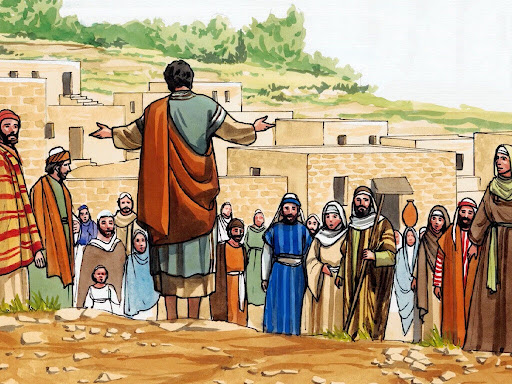
The more detailed biblical teaching in the form of a speech: « When he saw the crowds, he went up on the mountain; and after he sat down, his disciples came to him. Then he opened his mouth and began teaching them (disdasko), saying » (Matthew 5:1,2). Thus, the Sermon on the Mount is not a mere public proclamation, but a detailed biblical teaching in the form of a public speech of about half an hour (in that case).
Jesus Christ sends his disciples to preach
Preaching is much easier to do than teaching the Bible. This is the advice that Jesus Christ gave to a group of disciples that he was sending to preach ahead of him: “These 12 Jesus sent out, giving them these instructions: “Do not go off into the road of the nations, and do not enter any Sa·marʹi·tan city; but instead, go continually to the lost sheep of the house of Israel. As you go, preach, saying: ‘The Kingdom of the heavens has drawn near.’ (…). You received free, give free. Do not acquire gold or silver or copper for your money belts, or a food pouch for the trip, or two garments, or sandals, or a staff, for the worker deserves his food. “Into whatever city or village you enter, search out who in it is deserving, and stay there until you leave. When you enter the house, greet the household. If the house is deserving, let the peace you wish it come upon it; but if it is not deserving, let the peace from you return upon you. Wherever anyone does not receive you or listen to your words, on going out of that house or that city, shake the dust off your feet” (Matthew 10:5-14).
In the simple « instructions » that Jesus Christ gave to his disciples, there are five main instructions:
– Jesus Christ sets the territory or the area to be covered for preaching (Verses 5 and 6).
– Jesus Christ sets the theme of the proclamation, which will eventually spark conversations (verse 7): « The Kingdom of the heavens has drawn near ».
– Jesus Christ especially asks that this preaching is not to be used for a financial or commercial purpose: « You received free, give free » (Verse 8).
– Jesus Christ then gives more material and behavioral instructions, linked with the hospitality of the people who will welcome them (Verses 9-13).
– Jesus Christ explains that in case of refusal, it is advisable not to insist but rather « shake the dust off your feet », leaving the house or the city, putting the judgment in the hands of God: « Really I tell you, it will be more bearable for the land of Sodom and Gomorrah on the Day of Judgment than for this city » (Matthew 4:15).
How to do ?
This is a concluding question: Let us imitate Jesus Christ, like his disciples, but also the Samaritan woman: « Many of the Sa·marʹi·tans from that city put faith in him because of the word of the woman who bore witness, saying: “He told me all the things I did.” So when the Sa·marʹi·tans came to him, they asked him to stay with them, and he stayed there two days. As a result, many more believed because of what he said, and they said to the woman: “We no longer believe just because of what you said; for we have heard for ourselves, and we know that this man really is the savior of the world » (John 4:39-42).
The Samaritan woman preached, and her simple preaching has been so powerful that thanks to God’s blessing, a whole village came out to meet Jesus Christ and began to have faith in him. Do like the Samaritan woman, preach to your family members, your friends and especially those who do not have internet. Preach the Good News with the most possible means of communication, that the « Day of Jehovah is near » (Joel 2: 1,2). Feel free to use the Bible to support your statements, either by quoting biblical texts from memory or in essence, or by reading directly. In addition to preaching to those who do not have Internet, do not hesitate to use the social networks, creations of Biblical sites, blogs, Twitter, Facebook… To preach the Good News to all the nations before the end comes ( Matthew 24:14). By doing the best that you can, Jehovah God will not fail to bless your preaching activity, and will grant you everlasting life in the future earthly paradise: « For God is not unrighteous so as to forget your work and the love you showed for his name by ministering and continuing to minister to the holy ones » (Hebrews 6:10). May God bless your preaching activity through Christ.
To have a more precise idea of what can be said in the context of preaching, let us see how Jesus Christ informally preached to a Samaritan woman:
« A woman of Sa·marʹi·a came to draw water. Jesus said to her: “Give me a drink.” 8 (For his disciples had gone off into the city to buy food.) 9 So the Sa·marʹi·tan woman said to him: “How is it that you, despite being a Jew, ask me for a drink even though I am a Sa·marʹi·tan woman?” (For Jews have no dealings with Sa·marʹi·tans.) 10 In answer Jesus said to her: “If you had known of the free gift of God and who it is who says to you, ‘Give me a drink,’ you would have asked him, and he would have given you living water.” 11 She said to him: “Sir, you do not even have a bucket for drawing water, and the well is deep. From what source, then, do you have this living water? 12 You are not greater than our forefather Jacob, who gave us the well and who together with his sons and his cattle drank out of it, are you?” 13 In answer Jesus said to her: “Everyone drinking from this water will get thirsty again. 14 Whoever drinks from the water that I will give him will never get thirsty at all, but the water that I will give him will become in him a spring of water bubbling up to impart everlasting life.” 15 The woman said to him: “Sir, give me this water, so that I may neither thirst nor keep coming over to this place to draw water.” 16 He said to her: “Go, call your husband and come to this place.” 17 The woman replied: “I do not have a husband.” Jesus said to her: “You are right in saying, ‘I do not have a husband.’ 18 For you have had five husbands, and the man you now have is not your husband. This you have said truthfully.” 19 The woman said to him: “Sir, I see that you are a prophet. 20 Our forefathers worshipped on this mountain, but you people say that in Jerusalem is the place where people must worship.” 21 Jesus said to her: “Believe me, woman, the hour is coming when neither on this mountain nor in Jerusalem will you worship the Father. 22 You worship what you do not know; we worship what we know, because salvation begins with the Jews. 23 Nevertheless, the hour is coming, and it is now, when the true worshippers will worship the Father with spirit and truth, for indeed, the Father is looking for ones like these to worship him. 24 God is a Spirit, and those worshipping him must worship with spirit and truth.” 25 The woman said to him: “I know that Mes·siʹah is coming, who is called Christ. Whenever that one comes, he will declare all things to us openly.” 26 Jesus said to her: “I am he, the one speaking to you » (John 4:7-26. For the study of this text, the numbers marking the verses were voluntarily left).
– Jesus Christ aroused an unusual double situation (verses 7-9): He was Jewish and spoke in public to a Samaritan woman. Jews and Samaritans hated each other so much that at the time, to insult one of their compatriot, they sometimes called him a « Samaritan » (see John 8:48, it is interesting to note that the illustration of « Good Samaritan », clearly fits in Christ’s purpose, to subtly denounce this anti-Samaritan Jewish religious racism (Luke 10:25-37)). Moreover, Jesus Christ spoke in public to a woman, which was not the uses. In John 4:27, it is written that even his disciples were astonished at this situation. Be that as it may, in verse 16, Jesus Christ asked the woman to bring her husband for to continue the conversation. While Jesus Christ always had a chaste attitude towards women, he respected the customs regarding the relationship between men and women, and of course, of biblical morals.
Therefore, it is important not to have prejudices on the people to whom we are preaching the Good News. Jehovah God and Jesus Christ love all peoples and humans of all races, both men and women (Acts 10:34 « God is not partial »).
– Jesus Christ continued after the first surprise effect, adding something strange (verses 10-15): He can give her water, while he has no bucket (verse 10) . Of course, it was a spiritual way. Without necessarily thinking that the Samaritan woman lacked shrewdness, because she did not know that he was Jesus Christ who spoke to her, she pointed out to him that he had no bucket. Nevertheless, without pointing her the lack of discernment, Jesus Christ added a third surprising idea, completely aberrant from a human point of view: he can give her water which she will not be thirsty anymore. One can easily imagine the Samaritan woman looking at Jesus Christ, wide-eyed replying: « Sir, give me this water, so that I may neither thirst nor keep coming over to this place to draw water ». Clearly, the woman had not yet understood that Jesus Christ was speaking symbolically. He did not point out to her his lack of insight, because the goal he had set for himself was reached: to draw her attention.
First, to draw attention, use simple, (maybe, if possible) hard-hitting phrases that are out of the ordinary. It is necessary to arouse this innate curiosity to human beings, so that they can react and thus provoke spiritually interesting conversations. The second point is that Jesus Christ did not take back the Samaritan woman when she did not understand anything, he pursued his goal, he aroused her attention by creating a common ground between him and her.
– Jesus Christ refused to argue (Verse 20-22): The Samaritan woman opens a controversy over the different places of worship of Jews and Samaritans (verse 20). Jesus Christ did not enter into controversy by telling her that henceforth true worship would no longer depend on a particular holy place (verse 21). Having dismissed this pointless controversy, Jesus Christ nonetheless exposed the truth (Verse 22): « You worship what you do not know; we worship what we know, because salvation begins with the Jews ». Salvation comes from the Jews because from this people (and not from the Samaritan people) would come the main means of everlasting salvation: Jesus Christ (John 14:6).
It is important to balance the fact of avoiding unnecessarily entering into pointless controversy, but also of the absolute necessity of exposing the biblical truth, as did Jesus Christ in this case.
– Jesus Christ spoke of « true worshipers » (Verses 23 and 24): The expression « true worshipers » has the advantage of its great simplicity: either we are, or we are not. Just as Jesus Christ said, there are only two alternatives, one that leads to life and the other to destruction (Matthew 7:13,14,21-23). Likewise, there are only two categories of worshipers: the true and the false. The true worshipers have been appointed by divine providence: Christians: « After he found him, he brought him to Antioch. So for a whole year they assembled with them in the congregation and taught quite a crowd, and it was first in Antioch that the disciples were by divine providence called Christians » (Acts 11:26). It is shortly before the Great Tribulation that Jesus Christ will make the difference between « true Christians » and « false Christians » (Matthew 7:21-23). Which means that if one were to replace the word « worshippers » or « to worship » with the non-biblical words « religion » or « religious », the situation will become (and it is) more complex: Indeed, how to recognize the « true religion » « among the millions of other religions that all call themselves « true »? It is better to remain on the simplicity of the term « true worshipers », used by Christ, or « Christian » used in the biblical book Acts (by divine providence). Clearly, Jesus Christ preached a message, the good news, rather than a « religion » (non-biblical generic word).
On the other hand, Jesus Christ has shown that his « Father is looking for ones like these to worship him », by means of human preaching, He is the One who is building up His Own People: « At that time those who fear Jehovah spoke with one another, each one with his companion, and Jehovah kept paying attention and listening. And a book of remembrance was written before him for those fearing Jehovah and for those meditating on his name » (Matthew 24:14, Malachi 3:16). Let us preach to the future great crowd that will survive to the great tribulation, the Day of Jehovah (Joel 2:1,2).
It is important to know the biblical information about the devil to fully understand the reasons for God’s permission of evil and the current sad condition of humanity.
Jesus Christ described the devil very concisely: “That one was a murderer when he began, and he did not stand fast in the truth, because truth is not in him. When he speaks the lie, he speaks according to his own disposition, because he is a liar and the father of the lie » (John 8:44). Satan the devil is not the abstraction of evil, but a real spiritual person (Matthew 4:1-11). Likewise, the demons are also angels who have become rebels who have followed the example of the devil (Genesis 6:1-3, to compare with the letter of Jude verse 6: « And the angels who did not keep their original position but forsook their own proper dwelling place, he has reserved with eternal bonds in dense darkness for the judgment of the great day »).
When it is written, « he did not stand fast in the truth », it shows that God created this angel without sin and without any trace of wickedness in his heart. This angel, at the beginning of his life had a « beautiful name » (Ecclesiastes 7:1a). However, « he did not stand fast » in his integrity, he cultivated pride in his heart, and over time he became « devil », which means slanderer, and Satan, opponent; his old beautiful name, his good reputation, has been replaced by one of the everlasting disgraces. In the prophecy of Ezekiel (chapter 28), against the proud king of Tyre, it is clearly alluded to the pride of the angel who became « devil » and « Satan »: « This is what the Sovereign Lord Jehovah says: “You were the model of perfection, Full of wisdom and perfect in beauty. You were in Eʹden, the garden of God. You were adorned with every precious stone —Ruby, topaz, and jasper; chrysʹo·lite, onyx, and jade; sapphire, turquoise, and emerald; And their settings and mountings were made of gold. They were prepared on the day you were created. I assigned you as the anointed covering cherub. You were on the holy mountain of God, and you walked about among fiery stones. You were faultless in your ways from the day you were created Until unrighteousness was found in you » (Ezekiel 28:12-15). Through his act of unrighteousness in Eden, he became a « liar » who caused the death of all of Adam’s offspring (Genesis 3; Romans 5:12). Currently, it is Satan the devil who rules the world: « Now there is a judging of this world; now the ruler of this world will be cast out » (John 12:31; Ephesians 2:2; 1 John 5:19) .
in Revelation 12: 1-6 (to read), the “woman” of God is described as being about to give birth to a “child » as a symbol of the Kingdom of God, with the King Jesus Christ. However, verse 4 shows that Satan the dragon stood before the “woman”, ready to devour the child. Thus, the logic is to think that the “dragon” has been removed from to protect the “mother” who was giving birth to the “child”.
The heavenly war that expelled Satan and the demons from the heaven, took place before the coronation of the King Jesus Christ. This is confirmed by the repetition of the same sequence of events in Revelation 12: 7-14 (read): it is a repetition of the prophetic vision of Revelation 12: 1-6 (compare the repetition of Revelation 12: 6 and 12:14). In this biblical text, the verses12:7 to 9, it is the description of the heavenly war for to expel Satan and the demons from the heavens.
The verses 12:10-12, it is the description of the victory of Mikael and his angels over Satan and the demons. This heavenly victory has been celebrated by the official establishment of the Kingdom of God in heaven. Thus, it took place the purification of the heavens from the unclean presence of Satan and the demons, and the formal establishment of the Kingdom of God in heaven.
Most Western calendars are solar, with 365 days (Wikipedia Gregorian Calendar), while others use the lunar calendar (Wikipedia Lunar Calendars). The lunar year has between 354 and 355 days. There is therefore a difference of approximately 11 days between the solar calendar (365 days) and the lunar calendar (354 days). Lunar months have approximately 29.5 days. The Hebrew calendar alternates between a 30-day month, followed by a 29-day month, and so on. However, the Hebrew calendar also takes into account the 365-day solar cycle, making it a « lunisolar » calendar (Wikipedia Hebrew Calendar) (Hebrew Calendar – Chiourim).
The key points to know about the biblical calendar, which is similar to the Hebrew calendar, are as follows:
The months of the Hebrew and Biblical lunisolar calendar:
First month: Nisan or Abib (in the Bible) (March-April) (30 days)
Second month: Iyyar or Ziv (in the Bible) (April-May) (29 days)
Third month: Sivan (May-June) (30 days)
Fourth month: Tammuz (June-July) (29 days)
Fifth month: Ab (July-August) (30 days)
Sixth month: Eloul (August-September) (29 days)
Seventh month: Tishri or Ethanim (in the Bible) (September-October) (30 days)
Eighth month: Hesvan or Bul (in the Bible) (October-November) (29 or 30 days)
Ninth month: Chislev (November-December) (29 or 30 days)
Twelfth month: Adar (February-March) (29 or 30 days)
Thirteenth month: Adar II or Veadar (29 days)
In the Hebrew lunisolar calendar, an intercalary month is regularly added to compensate for the 11-day difference between the lunar year (354 days) and the solar year (365 days). In this case, this year exceptionally has 13 months; it is a « lunisolar » year. Currently, the adjustment system used by the Hebrew calendar is made according to a Metonic cycle, which is a series of 7 adjustments over a period of 19 years (7 lunisolar years of 13 months), in order to synchronize the lunar years of 354 days, with the solar year of 365 days, over a period of 19 years. The thirteenth month is added in the 3rd year, the 6th year, the 8th year, the 11th year, the 14th year, the 17th year and the 19th year.
In the Bible, days begin in the evening, after sunset. For example, in Genesis 1:5, regarding the symbolic first day of creation, it is written: « And there was evening and there was morning, a first day ».
Months begin at the « new moon » (Psalm 81:3). They have either 30 or 29 days. However, at this stage of the study, there is a significant difficulty regarding the biblical definition of the new moon.
Normally the new moon « is the lunar phase during which the Moon, during its synodic revolution which lasts approximately 29.53 days, is between the Earth and the Sun » (Wikipedia New Moon). This is the astronomical new moon.
Others think that this is the first crescent of the moon , it is the religious new moon, the option chosen by the current Jewish calendar (See the link to the Hebrew calendar – Chiourim).
However, the Bible, based on Psalms 81:3, seems to designate the new moon as the opposite of the full moon, that is, when it is completely invisible (the astronomical new moon) (without the appearance of the first crescent).
In Psalm 81 it is written: « Blow the horn on the new moon, On the full moon, for the day of our festival » (Psalm 81:3). According to the context of this statement, it refers to the blowing of the trumpet on Ethanim (Tishri), 1, the new moon (the seventh month of the year) (Numbers 29:1) and the full moon on 15 Ethanim (Tishri) (Exodus 23:16).
The « day of our festival », seems to poetically indicate according to the context of Psalm 81, the Festival of Booths, being a time of great rejoicing (Psalm 81:1,2): « You should celebrate the Festival of Booths for seven days when you make an ingathering from your threshing floor and from your press for oil and wine. Rejoice during your festival, you and your son, your daughter, your male slave, your female slave, the Levite, the foreign resident, the fatherless child, and the widow, who are inside your cities. Seven days you will celebrate the festival to Jehovah your God in the place that Jehovah chooses, for Jehovah your God will bless all your produce and all that you do, and you will become nothing but joyful » (Deuteronomy 16:13-15).
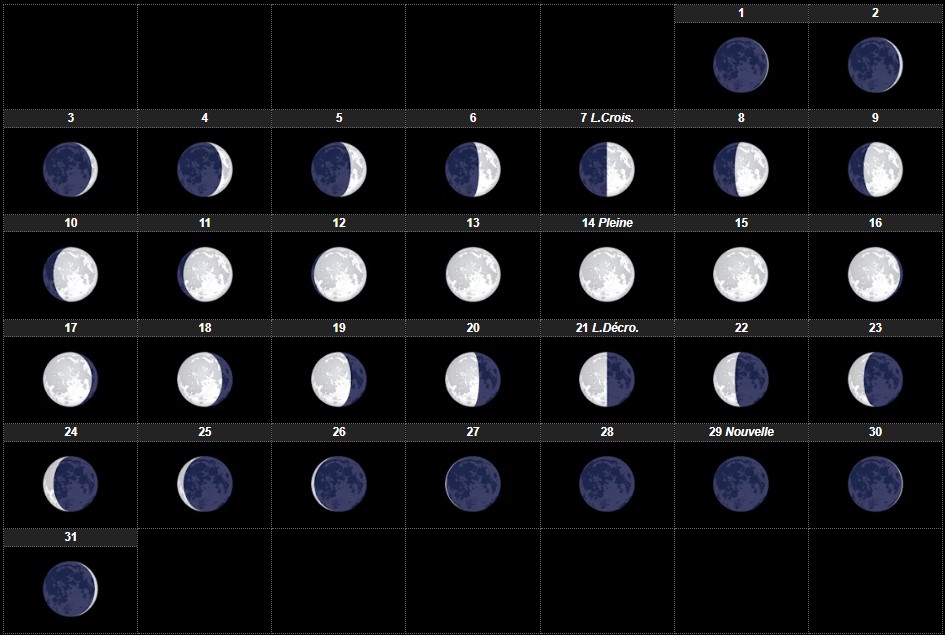
To know which new moon it is on a biblical point of view, it is enough to consider that the first observable full moon (and even the astronomical full moon) corresponds to the 15th of the lunar month. Then, we must go back 15 days to see, on a lunar astronomical table, which new moon it is (astronomical or religious). (See photo of the lunar table for the month of March 2025).
Based on the lunar astronomical table for March 2025 (see above), the astronomical full moon is March 14. Considering that this day corresponds to the 15th of the lunar month, according to the Bible (Psalms 81:3), we just have to go back 15 days from that day (the 15th), and we arrive at February 28, 2025 (which does not appear in the photo above) which corresponds to the astronomical new moon (a completely invisible moon).
As a second example, in April 2025, the observable full moons are on April 11 and 12, while the astronomical full moon is on April 13. Based on the observable full moons (on the 11th and 12th), we are in the phase of complete invisibility of the moon (on March 28 and 29, 2025), and based on the astronomical full moon, it is the day after the astronomical new moon (March 30, 2025).
As a third example, in May 2025, the observable full moon is on May 11, 2025, while the astronomical full moon is on May 12, 2025. Going back 15 days, we arrive either at the astronomical new moon on May 27, 2025, or in its phase of complete invisibility, on May 28, 2025. Thus, simply by these three examples, we understand that on the biblical basis, the new moon corresponds to the astronomical (non-religious) one.
Is it so important?
« Therefore, do not let anyone judge you about what you eat and drink or about the observance of a festival or of the new moon or of a sabbath » (Colossians 2:16). This text could imply that the issue related to the new moon is not so important to a Christian. According to the context of the Apostle Paul’s letters, Christians are no longer subject to the divine requirements of the Mosaic Law, such as the observance of a mandatory Sabbath or a new moon marking a new month. Indeed, Christians are no longer under the authority of the Law: « For Christ is the end of the Law, so that everyone exercising faith may have righteousness » (Romans 10:4). Thus, the above explanations regarding the two kinds of new moon are not to be understood in the context of the application of the Law.
The importance of the matter about the new moon depends on the purpose of this information. If the question is how to determine the date of the next commemoration of Christ’s death on a biblical basis, some will base their calculations on the astronomical new moon, while others will simply rely on the classical Hebrew calendars, which take into account the religious new moon. There is usually a difference of one or two days.
As for the date of the commemoration of Christ’s death, it is all a matter of discernment (Hebrews 5:14 « Their powers of discernment trained to distinguish both right and wrong »). Based on the discernment of the biblical context, we understand that the commemoration should be celebrated once a year (and not every Sunday): « Christ our Passover lamb has been sacrificed » (1 Corinthians 5:7). This text shows that the celebration of the commemoration replaced the celebration of the Jewish Passover, which was celebrated, in biblical times, between the two evenings of Nisan 13 and 14 (after sunset on Nisan 13 and before sunrise on Nisan 14).
Nevertheless, the matter of the type of new moon can be very important, even vital. We are currently awaiting the return of Christ to judge all of humanity shortly before the Great Tribulation (Matthew 25:31-42). Regarding this day, in an early statement, Jesus Christ said, no one knows the day or the hour: « Concerning that day and hour nobody knows, neither the angels of the heavens nor the Son, but only the Father » (Matthew 24:36). This statement was made in 33 C.E.
Was such ignorance going to be permanent? Regarding Jesus Christ, it is obvious that it was not, because shortly before ascending into heaven, this is what he declared: « Jesus approached and spoke to them, saying: “All authority has been given me in heaven and on the earth » » (Matthew 28:18). Furthermore, in the book of Apocalypse Jesus Christ is described as a king and high priest who will bring about the great tribulation (Apocalypse 19). How can we imagine that, as a king who has all power, he would have been kept in ignorance by his Heavenly Father of such a Day?
Furthermore, concerning his disciples, here is what we can read in the book of Apocalypse, in his message addressed to the congregation of Sardis, more than sixty years after his first declaration on the ignorance of the day and hour: « Certainly unless you wake up, I will come as a thief, and you will not know at all at what hour I will come upon you » (Apocalypse 3:3). This text implies that the spiritually awakened disciples would end up at the time chosen by God, knowing the exact day and hour of the coming of Christ: « For the Sovereign Lord Jehovah will not do a thing Unless he has revealed his confidential matter to his servants the prophets » (Amos 3:7).
Returning to the theme of what kind of new moon it is, we are faced with a real dilemma. While Jesus Christ declared that his coming, foreseen by God, would be on a specific day and time, how can we know this when the astronomical new moon is one to two days ahead of the religious new moon. Which one should we choose? The logic is to choose the new moon that is two days ahead (the astronomical new moon), rather than choosing a new moon that is two days behind (the religious new moon). If we have a vital appointment, it is better to be early and, on the lookout, rather than to be late. Moreover, Jesus Christ clearly showed that any delay would have a fatal outcome:
« Then the Kingdom of the heavens may be likened to ten virgins who took their lamps and went out to meet the bridegroom. 2 Five of them were foolish, and five were discreet. 3 For the foolish took their lamps but took no oil with them, 4 whereas the discreet took oil in their flasks along with their lamps. 5 While the bridegroom was delaying, they all became drowsy and fell asleep. 6 Right in the middle of the night there was a shout: ‘Here is the bridegroom! Go out to meet him.’ 7 Then all those virgins got up and put their lamps in order. 8 The foolish said to the discreet, ‘Give us some of your oil, because our lamps are about to go out.’ 9 The discreet answered, saying: ‘Perhaps there may not be enough for both us and you. Go instead to those who sell it, and buy some for yourselves.’ 10 While they were going off to buy it, the bridegroom came. The virgins who were ready went in with him to the marriage feast, and the door was shut. 11 Afterward, the rest of the virgins also came, saying, ‘Sir, Sir, open to us!’ 12 In answer he said, ‘I tell you the truth, I do not know you’ » (Matthew 25:1-12).
Jesus Christ concluded his illustration by saying, « Keep on the watch, therefore, because you know neither the day nor the hour » (Matthew 25:13). This text shows that even if we have solid indications of the day and hour, there is no absolute certainty based on our personal understanding. We must remain vigilant in waiting for this moment so as not to be surprised by the coming of King Jesus Christ to judge humanity (Matthew chapters 24 and 25; Apocalypse 3:3).
The book of Ezekiel mentions that the year in which the Great Tribulation will occur should be lunisolar, with 13 months, according to the Jewish calendar…
This period of 2300 evenings and mornings refers to a period of time lasting several years, which describes a behavior that goes directly against the sacred service rendered to God, in the holy place of the Spiritual Temple Sanctuary…
This study will focus primarily on the 1335 days related to Ethanim (Tishri), 10, beginning the calculation with the latter date and working backward to the original date of the Hebrew biblical calendar…
“And I heard a holy one speaking, and another holy one said to the one speaking: “How long will the vision of the constant feature and of the transgression causing desolation continue, to make both the holy place and the army things to trample on?” So he said to me: “Until 2,300 evenings and mornings; and the holy place will certainly be restored to its right condition »”
(Daniel 8:13,14)
The 2300 evenings and mornings represent 6 years (6 x 360 = 2160 days), 4 months (4 x 30 = 120 days), and 20 days: 2160 + 120 + 20 = 2300 days (evenings and mornings).
The time of the 2300 evenings and mornings, refers to a period describing a behavior that goes directly against the sacred service rendered to God, in the holy place of the Spiritual Temple Sanctuary. And the restoration, at the end of the 2300 evenings and mornings, to its right condition. The understanding of the context of Daniel’s prophecies will allow to know more concretely what situation this may be, as well as the geographical part of the world where this prophecy is being fulfilled. The chronological structure of these 2300 evenings and mornings, will allow to understand when it could begin and when it could end.
It is at the very end of this very concise prophecy that there is a very important information that allows to understand when this period will end: « And the holy place will certainly be restored to its right condition » (Daniel 8:14). When will the holy place be definitively restored to its right condition? It is easy to understand at the end of this system of things, during the Day of Jehovah, the great tribulation or during the time of distress mentioned in the prophecy of Daniel (Daniel 12:1). According to several biblical information, the great tribulation should take place on Ethanim (Tishri), 10, in the worldwide fulfillment of the Day of Atonement (Yom Kippur) (Leviticus chapter 16; Hebrews 10:1 « For since the Law has a shadow of the good things to come »). It is the book of Apocalypse that enigmatically reveals that the great tribulation, or the end of this system of things, will take place on of Ethanim (Tishri), 10th: « And the temple sanctuary of God in heaven was opened, and the ark of his covenant was seen in his temple sanctuary. And there were flashes of lightning and voices and thunders and an earthquake and a great hail » (Apocalypse 11:19).
The first part of verse 19 describes the vision of the Ark of the Covenant, which God required to be visible to the high priest only on the tenth day of the seventh month of the year, that is, on the Ethanim (Tishri), 10th: « It will serve as a lasting statute for you: In the seventh month, on the tenth of the month » (Leviticus 16:29).
The second part of verse 19 is an enigmatic and concise description of the Great Tribulation, symbolically evoking the destruction of Sodom and Gomorrah (Apocalypse 11:8, compare with the account in Genesis chapter 19).
What is the biblical evidence that the period of 2300 evenings and mornings ends on the Ethanim, 10th? Starting from the initial hypothesis that the 2300 evenings and mornings end on the Ethanim (Tishri), 10th and going back to the source or the beginning of this period, we arrive at a biblically significant date, linked to the holy place, the 20th of Ziv (Iyar): « Now in the second year, in the second month, on the 20th day of the month, the cloud lifted from over the tabernacle of the Testimony. (…) This was the first time they departed following the order of Jehovah through Moses » (Numbers 10:11).
This date of Ziv (Iyar), 20, is the official moment of the establishment of the holy place in its right condition, symbolized by the tabernacle of the Testimony (see (online) the article in English of Lehrhaus Review of May 3, 2018, entitled « On the importance of the Twentieth of Iyar », written by Ezra Zivan). Starting from 20 Ziv (Iyar), and adding 2300 evenings and mornings, then we arrive at the date of Tishri (Ethanim), 10 (see details of the calculation, below). It is at the end of the 2300 evenings and mornings, that is to say on Tishri (Ethanim), 10, that the holy place will be restored to its right condition (Daniel 8:14). This proves (in another way (than that of Apocalypse 11:18,19)), biblically speaking, that the great tribulation will take place on a Ethanim (Tishri), 10. The demonstration of these two dates is below (from Iyar (Ziz), 20, to Ethanim (Tishri), 10 = 2300 evenings and mornings).
The second point, very strange, but worth mentioning, is the comparison of this period of 2300 days with another period of 2520 days, or 7 prophetic years of 360 days (these two periods appear in different prophecies in the book of Daniel (chapter 4; 8:13,14)). By making the arithmetical difference between the 2520 days and the 2300 days, we obtain the result of 220 days. Now, 220 days represent 7 prophetic months of 30 days and 10 days ((7 x 30 = 210) + 10 = 220) in cardinal numbers). This is, it seems, a cryptic expression of the date of the seventh month and the tenth day (in ordinal numbers), or the date of the 10th of Tishri (Ethanim). This could be a further enigmatic indication that the end of the 2300 evenings and mornings would be the 10th of Tishri (Ethanim).
This date of the Day of Atonement (Yom Kippur) is the celebration of the Holiness of Jehovah God, the Heavenly Father (Leviticus chapter 16), while the date of Ethanim (Tishri), 15, is the celebration of the Kingship of Jehovah God (Zechariah 14:16,17). Thus, the 2300 evenings and mornings represent an abnormal time that goes against the worship of the Heavenly Father in the Holy Place, it will end with the Day of Jehovah which will celebrate His Holiness and which will set in the right condition, the Holy Place of the Temple Sanctuary.
***
The Calculation of the 2300 Evenings and Mornings
(Daniel 8:14)
The Biblical Method of Calculation
The 2300 evenings and mornings represent 6 years (6 x 360 = 2160 days), 4 months (4 x 30 = 120 days), and 20 days: 2160 + 120 + 20 = 2300 days (evenings and mornings).
The calculation of the 2300 evenings and mornings allows us to place this time very precisely between the 20th of Ziv (Iyar) and the 10th of Ethanim (Tishri) (the end of the 2300 evenings and mornings). First, here are the simple calculation rule (for better understanding, there is a biblical calendar below):
– The calculation is based on the biblical (Hebrew) calendar, with the corresponding biblical names of the months (see the Hebrew calendar below).
– The biblical method of calculation considers, empirically, complete years of 360 prophetic days, and months of 30 prophetic days. Thus, the 1260 days empirically correspond to 3.5 years (compare the two verses of Apocalypse 12:6, 14 (3 x 360 days) + (6 x 30 days) = 1080 + 180 = 1260 days) and the 42 months of Apocalypse 11:2 (42 prophetic months: 42 x 30 = 1260 days)).
– Complete years of 360 prophetic days run from date to date. Dates are expressed as ordinal (not cardinal) numbers. For example, if the calculation begins on the 1st of Nisan of the year « n » (month of the Hebrew calendar), the years will go from 1 Nisan, 1, « n » (year 1) to Nisan, 1, « n + 1 » (year 2), for each complete prophetic year (This simple system of calculation of the number of prophetic years and the number of prophetic months is lunisolar, meaning that these years are synchronized, in fact, with the solar years).
– The same is true for prophetic months; they are counted on the empirical basis of thirty days, from date to date, even if the lunar month has only 29 days and the next 30 (see the calendar below) (Apocalypse 11:2, 3; 42 months of 30 days = 1260 days).
– For the number of days less than a month, or thirty days, this is the case in the prophecy of the 1335 days (15 days) and 2300 days (20 days), the count is done day by day, taking into account, this time, the alternation between the month of 29 days and the month of thirty days (Reminder: dates are expressed as ordinal numbers; the day counted as first, or ordinal, is the day of departure). Regarding the 2300 evenings and mornings, it is the month of Elul which has only 29 days (see the Hebrew calendar, below). It is therefore necessary to take this into account in the last 20 days, of the 2300 evenings and mornings.
Here is the Hebrew and biblical lunisolar calendar, so that you can follow and understand the calculation. In the Hebrew and Biblical lunisolar calendar, years have 12 lunar months of 29 or 30 days. Here are the months of the Hebrew and Biblical calendar to facilitate understanding of the (very technical) explanations that follow:
The biblical Hebrew lunisolar calendar
First month: Nisan or Abib (in the Bible) (March-April) (30 days)
Second month: Iyyar or Ziv (in the Bible) (April-May) (29 days)
Third month: Sivan (May-June) (30 days)
Fourth month: Tammuz (June-July) (29 days)
Fifth month: Ab (July-August) (30 days)
Sixth month: Eloul (August-September) (29 days)
Seventh month: Tishri or Ethanim (in the Bible) (September-October) (30 days)
Eighth month: Hesvan or Bul (in the Bible) (October-November) (29 or 30 days)
Ninth month: Chislev (November-December) (29 or 30 days)
Twelfth month: Adar (February-March) (29 or 30 days)
Thirteenth month: Adar II or Veadar (29 days)
In the Hebrew lunisolar calendar, an intercalary month is regularly added to compensate for the 11-day difference between the lunar year (354 days) and the solar year (365 days). In this case, this year exceptionally has 13 months; it is a « lunisolar » year.
The 2300 evenings and mornings are 6 years (6 x 360 = 2160 days), 4 months (4 x 30 = 120 days), 20 days: 2160 + 120 + 20 = 2300 days (evenings and mornings).
The 2300 evenings and mornings also represent 7 years, minus 7 months and 10 days, as the date ending the period of 2300 evenings and mornings (2520 days – 2300 days = 220 days (cardinal numbers)) (A cryptic expression of the date of Ethanim (Tishri), 10 (tenth day of the seventh month (ordinal numbers)).
Calculation from the 20th of Ziv mentioned in Numbers 10:11-13
Starting point of the 20th of Ziv
6 years: Ziv, 20 (plus 6 years).
Plus 4 months:
from Ziv (Iyyar), 20 to Sivan, 20 (1 month).
Sivan, 20 to Tammuz, 20 (2 months).
Tammuz, 20 to Ab, 20 (3 months).
Ab, 20 to Elul, 20 (4 months).
The last 20 days are counted ordinally (and not cardinally because dates are expressed in ordinal numbers) starting from the date of the first day, in this case, the 20th of Elul. The way of counting the 20 days, this time takes into account the precise number of days in each month (see the calendar above). Looking at the Hebrew calendar, the month of Elul has only 29 days. Here is the count of the remaining 20 days:
This calculation is a further confirmation that the Day of Jehovah or the great tribulation will take place on the date of the 10th of Tishri (Ethanim) (Apocalypse 11:19). However, although very interesting, it is necessary to understand the concrete meaning of this prophecy of Daniel (8:14), namely to what kind of current situation, the prophecy refers, which would precede the great tribulation.
The answer is in the whole context of Daniel’s prophecy, which is literally centered on the dramatic events in the Middle East, particularly in the prophecy of the king of the north and the king of the south, in Daniel chapters 11 and 12. The symbolic meaning of the 20th of Iyyar (Ziv), could allow us to focus on an important date for Palestine, and particularly for the present state of Israel. For example, concerning what constitutes the dramatic conclusion of the conflict between the king of the north and the king of the south, here is what is written: « During that time Michael will stand up, the great prince who is standing in behalf of your people. And there will occur a time of distress such as has not occurred since there came to be a nation until that time » (Daniel 12:1a). This time of distress seems to have the Middle East, particularly the state of Israel, as its epicenter.
***
What could be the significance
of the 2300 evenings and mornings today?
To obtain a precise answer, it is necessary to research the current date of the beginning of this 2300-day period. This research is crucial to fully understanding the meaning of this prophecy. The important indication regarding the beginning of this period is that it alludes to the founding of the nation of Israel, through the establishment of the holy place in its right condition, represented by the Tabernacle, on the 20th of Ziv (Numbers 10:11-13).
This date has either a literal and temporal value, or a more symbolic and simply event-related value.
Therefore, it will be appropriate to start from the current estimates of the date (there are currently two (see below)) and empirically apply (without detailed calculation) the 2300 days, going back 6 years earlier, to make it correspond directly (or empirically) to the 20th of Ziv (Iyar) of the year in question and translate it into a date of the Gregorian solar calendar, to see if we arrive at a significant date concerning current events linked to the state of Israel, making at the same time, the direct connection with this event of the past mentioned in Numbers (10:11-13).
Doing this experiment, in a completely empirical way, from date to date (without calculation) from Tishri,10, and going back 6 years earlier, to Iyyar (Ziv), 20, (converting it at the same time, into a date of the Gregorian calendar), there is absolutely no determining event, in Israel, or in Palestine, linked to the statement of the prophecy of Daniel (8:13,14).
What is the solution? It would be appropriate to look for a significant historical date for the current state of Israel, similar to the 20th of Ziv (Iyyar) (Numbers 10:11-13). The reasoning in terms of significant dates for the current state of Israel, is that they are in fact expressed on the basis of the Gregorian calendar when it comes to a historical event and then commemorated on the basis of the Hebrew calendar.
Now, an important date for the current state of Israel is that of its independence: May 14, 1948. For information, by converting this date, it corresponds to the 5th of Ziv (Iyar) 1948. The reminder of the importance of the 20th of Ziv is that this date represented the founding of the nation of Israel, by the institution of the holy place in its true condition, represented by the Tabernacle (Numbers 10:11). These two dates are similar in their symbolism: the establishment of the nation of Israel, as representative of God’s people on earth (in appearance (for the current state of Israel)).
Regarding the calculation methods for the 2300 evenings and mornings described above, they are based on the biblical calendar, arriving precisely from the 20th of Ziv (the beginning of the 2300 evenings and mornings), plus 6 years, to the 10th of Tishri (the end of this period).
By slightly changing the calculation method, this time starting with the date of the 10th of Tishri, converting it to a day in the Gregorian calendar of a specific year, and then working backward, this time based on months in the Gregorian calendar, by 6 years, 4 months, and 20 days, we arrive at the significant date of the 5th of Ziv, which corresponds to the anniversary of the creation of the State of Israel, which was May 14th in the year 1948.
And that is what we are going to do with the two hypothetical dates, below. By explaining in a very simplified way, we arrive at a surprising result: starting from the hypothetical date of Tishri, 10, converting it into a date from the solar calendar, and going back six years, 4 months and 20 days, with the biblical method of calculation, we arrive at the surprising date. By converting the date from the solar calendar, into a date from the Hebrew calendar, we obtain the result of the date of 5 Iyar (Ziv), 5, the anniversary date of Israel’s independence (Iyyar (Ziv), 5, May 14, 1948 (original date)).
This means that the biblical starting date of Ziv, 20, is an event-based (and not temporal) prophetic indication that announces a similar historical situation, namely the founding of the nation of Israel, by the inauguration of the holy place (established in its right condition, in accordance with the will of God (Numbers 10:11-13)), being replaced in our days by the celebration of the anniversary date of the independence of the current nation of Israel, this time Ziv (Iyyar), 5, which represents the holy place in an abnormal situation before God (Daniel 8:13,14).
According to Daniel’s prophecy (8:13,14), this situation is completely abnormal, from God’s point of view, because it suggests that the holy place is not in its right condition (or in accordance with his will), according to verse 13, because it causes desolation around it.
It is written in this verse 13, that it is a period of serious transgression which will result in a trampling, or a destruction, then restoring the holy place to its right condition, a condition in accordance with the will of God (in its right condition (mentioned in Numbers 10:11,13)), on the 10th of Ethanim (Tishri), during the Day of YHWH (Yehouah), the great tribulation, at the end of the 2300 evenings and mornings: « And I heard a holy one speaking, and another holy one said to the one speaking: “How long will the vision of the constant feature and of the transgression causing desolation continue, to make both the holy place and the army things to trample on?” So he said to me: “Until 2,300 evenings and mornings; and the holy place will certainly be restored to its right condition” (Daniel 8:13,14).
***
Calculation of the 2300 Evenings and Mornings in Our Time
(Daniel 8:13,14)
Before proceeding with the experiment, it should be noted that the estimated dates below were calculated before the current study of Daniel’s prophecy (8:13,14) of the 2300 evenings and mornings, and without knowing that this would result in the determination of the date of Iyyar (Ziv), 5 (the anniversary of the founding of the State of Israel on May 14 (5 Ziv (Iyyar) 1948). That is why, before calculating the 2300 days, there will be a detailed explanation of how the hypothetical date (for the year 2028) is obtained:
Currently estimated dates are Ethanim, 10, 2026 (September 19/20, 2026), and Ethanim, 10, 2028 (September 27/28, 2028). These two dates are calculated from the astronomical (not religious) new moon, which has a proven biblical basis (Psalm 81:3).However, the calculation will be only based on the estimated date of September 27/28, 2028 (10 Tishri 2028), because it is the most reliable (Read the article: The Great Tribulation and the Year of 13 Months (Ezekiel 39:12-14)).
Details of the calculation of the three hypothetical dates. The process is quite simple, for a specific month, such as September 2028, just do a quick search (online) on the precise dates of the astronomical new moon, to the nearest hour (this is very important). You should have an astronomical table of lunar months corresponding to the months of September in different years, in order to carry out a double check. There are some important things to take into account: the lunar astronomical tables are based on days that go from midnight to midnight, which is a difference between the way of counting days in the biblical and Hebrew systems, where the beginning of the day is counted from sunset (Genesis 1:5). The time of the astronomical new moon is generally in Universal Time (UTC). The time in Jerusalem is UTC plus three (UTC+3). This means that three hours must be added to UTC time (if UTC time is 8 p.m., in Jerusalem it will be 11 p.m. (8 p.m. + 3 p.m.)). To know in which lunar day the astronomical new moon is to be placed, you must know the time of sunset in Jerusalem.
– Ethanim 10, 2028 (September 27/28, 2028): Date and time of the new moon in September 2028: September 18, 2028 at 6:21 p.m. UTC (9:27 p.m. in Jerusalem UTC + 3). The new moon will occur *between the two evenings of September 18 and 19. Tishri 1 will be September 18/19, 2028, and Tishri 10 will be September 27/28, 2028.
* The expression « between two evenings » means between sunset and sunrise, the time when the moon is generally visible (with the exception of the new moon).
By checking the dates of the 10th of Tishri 2028, let us move on to the most difficult part, the verification of the dates, with the period of 2300 evenings and mornings (Daniel 8:13,14).
Verifying the date of Tishri 10, 2028 (September 27/28, 2028)
with the period of 2,300 evenings and mornings
(Daniel 8:13, 14)
Let’s start with the year 2028. Here’s the calculation method, starting from Iyyar 5, which, as a reminder, is the anniversary of the independence of the current state of Israel (reminder: 2,300 days = 6 years + 4 months + 20 days):
From the year 2028, we should go back 6 years: Iyyar 5 (Ziv), 2022, or May 5/6, 2022, as the starting date for calculating the 2,300 evenings and mornings, applying the biblical rules of counting: Iyyar 5 (Ziv), 2022 + 6 years = 5/6 May 2028.
Regarding the solar calendar’s month count, there is a small additional difficulty: an adjustment is required. Indeed, the biblical rule is that months have 30 days, not 31 days, for some months of the solar calendar. This means that counting the months from May to September 2028, there are three months with 31 days: May, July, and August have 31 days, or three additional days that affect the date of September and distort the result. Therefore, a three-day readjustment is required. How?
In the normal (biblical) count, months have thirty days. Regarding the month of May, if we apply day 31, this means that the following June 1st (taking into account the 1-day shift) should correspond to June 2nd (in the biblical count of a month of 30 days). Similarly, between the passage of July 31st and August 1st, taking into account the 1-day shift, it should correspond to August 2nd (in the biblical count of a month of 30 days). Similarly, between the passage of August 31st and September 1st, taking into account the 1-day shift, it should be September 2nd (in the biblical count of a month of 30 days). Thus, cumulatively, the regularization at the level of the month of September should be 3 additional days, to adjust the exact date at the level of the month of September, in order to correspond exactly to the four months of 30 days:
May 5/6, 2028 + 4 months = September 5/6, 2028.
September 5/6, 2028 + 20 days + 3 days (to adjust the three months by 1 extra day) = September 27/28, 2028 (Tishri 10, 2028). This corresponds perfectly.
That is, from Iyyar 5, 2022 (May 5/6, 2022) to Tishri 10 (Ethanim), 2028 (September 27/28, 2028) (astronomical new moon) = 2,300 evenings and mornings.
Verification of the date of Tishri 10, 2026 (September 19/20, 2026)with the period of 2300 evenings and mornings
(Daniel 8:13, 14)
Iyyar 5, 2020, corresponds to April 28/29, 2020 + 6 years = April 28/29, 2026.
April 28/29, 2026 + 4 months = August 28/29, 2026.
August 28/29, 2026 + 20 days + 3 days to adjust the three months by 1 additional day = September 19/20, 2026 (Tishri 10, 2026). This corresponds perfectly.
That is from 5 Iyar 2020 (April 28/29, 2020) to 10 Tishri (Ethanim) 2026 (September 19/20, 2026) (astronomical new moon) = 2300 evenings and mornings.
Incidentally, as for the year 2027/2028, it does not correspond to the period of 2300 evenings and mornings because there is the addition of the intercalary month (Adar II), in the spring of the year 2027.
The year 2028 offers the most reliable option, with its two perfect correspondences with the 2300 evenings and mornings and the 1335 days, and furthermore, it is not shifted (unlike the dates of the lunisolar years 2026 and 2029) (Read the article « The Great Tribulation and the Year of 13 Months (Ezekiel 39:12-14)« ):
September 27/28, 2028
***
Now we have a better idea of the meaning of this prophecy of the 2300 days, showing that the situation in the Middle East is completely abnormal from God’s point of view. He disapproves of all the murderous violence, all the destruction and transgression of God’s laws (written in the Bible), generated by present-day Israel. In due time, the Heavenly Father will put an end to this transgression and restore the spiritual holy place to its right condition, in a Ethanim (Tishri), 10: « And I heard a holy one speaking, and another holy one said to the one speaking: “How long will the vision of the constant feature and of the transgression causing desolation continue, to make both the holy place and the army things to trample on?” So he said to me: “Until 2,300 evenings and mornings; and the holy place will certainly be restored to its right condition” » (Daniel 8:13,14).
Jesus Christ taught well that the future worldwide Israel will be spiritual and symbolic, encompassing all nations and languages, respecting their ethnic differences. Jesus Christ designated the future twelve tribes of Israel as being, for the most part, the millions, even billions of future earthly resurrected ones: « Jesus said to them: “Truly I say to you, in the re-creation, when the Son of man sits down on his glorious throne, you who have followed me will sit on 12 thrones, judging the 12 tribes of Israel » (Matthew 19:28). The true Israel is the Israel of God: « Peace and mercy be upon them, yes, upon the Israel of God » (Galatians 6:16).
In Psalm 80, Israel is compared to a vine: « You made a vine depart from Egypt. You drove out the nations and planted it » (Psalms 80:8-11). Years later, during his earthly ministry, Jesus Christ referred to himself as the vine and his followers as the branches: “I am the true vine, and my Father is the cultivator. 2 He takes away every branch in me not bearing fruit, and he cleans every one bearing fruit, so that it may bear more fruit. 3 You are already clean because of the word that I have spoken to you. 4 Remain in union with me, and I will remain in union with you. Just as the branch cannot bear fruit by itself unless it remains in the vine, neither can you unless you remain in union with me. 5 I am the vine; you are the branches. Whoever remains in union with me and I in union with him, this one bears much fruit; for apart from me you can do nothing at all. 6 If anyone does not remain in union with me, he is thrown out like a branch and dries up. And men gather those branches and throw them into the fire, and they are burned. 7 If you remain in union with me and my sayings remain in you, ask whatever you wish and it will take place for you. 8 My Father is glorified in this, that you keep bearing much fruit and prove yourselves my disciples. 9 Just as the Father has loved me, so I have loved you; remain in my love. 10 If you observe my commandments, you will remain in my love, just as I have observed the commandments of the Father and remain in his love” (John 15:1–10).
From now on, this vineyard of God with its branches constitutes the Israel of God, the Christian congregation (Galatians 6:16; Acts 11:26). This congregation or church is made up of both Jews in the flesh and people of all nations, with the spiritual circumcision of the heart (which represents obedience to God and to Christ (Deuteronomy 10:16)): “For not all who descend from Israel are really “Israel”” (Read Romans chapter 9 and 11:17–24; John 10:16). It is in this sense that at the end of the 2300 evenings and mornings, on a Tishri (Ethanim), 10, the holy place will be restored to its right condition (Daniel 8:13,14).
***
Of course, the dates of the Tishri, 10, of previous years will be monitored. As Jesus Christ said, concerning the day and hour where there is no certainty. Therefore, it is appropriate to remain constantly spiritually vigilant (Revelation 3:3). The presentation of the chronological studies of the 2300 evenings and mornings, as well as the 1335 days, are part of the expression of this vigilance and it is an encouragement to remain so until the end: « But the one who has endured to the end will be saved » (Matthew 24:13). Further explanations will be given later, concerning the 1260, 1290 and 1335 days of Daniel’s prophecy, taking into account the current events (Daniel 12).
« Happy is the one who keeps in expectation and who arrives at the 1,335 days! »
(Daniel 12:12)
This study will be based primarily on the 1335 days associated with the 10th of Ethanim (Tishri) (September/October) (see the biblical calendar below), beginning the calculation with this date and working backward to arrive at the original date of the Hebrew biblical calendar. The aim is to determine whether the hypothetical date of the 10th of Tishri (Ethanim) can be accepted as the end of the prophecy of the 2300 evenings and mornings, which runs from the 20th of Ziv to the 10th of Tishri (6 years + 4 months + 20 days) (Daniel 8:13-14).
This period of 1335 days lasts three years plus six months (1260 days), plus 30 days (1290 days), and 45 days (1 month and 15 days) (1335 days). Thus, cumulatively, this period of 1335 days lasts three years, 8 months and 15 days.
There are three stages in the 1335-day period, as described in the prophecy of Daniel chapter 12:
The first intermediate period of the 1335 days: the end of the 1260 days.
“Then I, Daniel, looked and saw two others standing there, one on this bank of the stream and one on the other bank of the stream. 6 Then one said to the man clothed in linen, who was up above the waters of the stream: “How long will it be to the end of these marvelous things?” 7 Then I heard the man clothed in linen, who was up above the waters of the stream, as he raised his right hand and his left hand to the heavens and swore by the One who is alive forever: “It will be for an appointed time, appointed times, and half a time. As soon as the dashing to pieces of the power of the holy people comes to an end, all these things will come to their finish”” (Daniel 12:5-7).
“It will be for an appointed time, appointed times, and half a time” = 1260 days (Compare with Apocalypse 12:6 which mentions 1260 days in parallel with Apocalypse 12:14, which mentions the expression, a time, times and half a time. A time = a prophetic lunar year of 360 days).
The second intermediate period of the 1335 days: 1260 + 30 = 1290 days, or 30 days after the end of the 1260 days.
« And from the time that the constant feature has been removed and the disgusting thing that causes desolation has been put in place, there will be 1,290 days » (Daniel 12:11).
The last intermediate period leading to the 1335 days is 1335 – 1290 = 45 days.
Thus, according to the prophecy, at the end of the 1260 days, an extremely short but intense period of dismantling the strength of the people of holy ones will begin. To this end, starting at the end of the 1260 days, according to verse 11, the abomination that causes desolation will be established, lasting 30 days. The “disgusting thing that causes desolation” represents the armed forces and police forces that will impose a dictatorship by force upon the people. At the end of the 1290 days, this military and police dictatorship will be fully operational until the end of the 1335 days, that is, for 45 days, or a month and a half. Afterward, this military organization will disappear on the 10th of Ethanim (Tishri) (September/October), during the great tribulation, in only one day. This is a very simplified explanation, which will later be the subject of a very detailed study so that the insightful ones mentioned in Daniel’s prophecy may understand:
“And those having insight will shine as brightly as the expanse of heaven, and those bringing the many to righteousness like the stars, forever and ever. (…) Many will cleanse themselves and whiten themselves and will be refined. And the wicked ones will act wickedly, and none of the wicked will understand; but those having insight will understand” (Daniel 12:3,10).
This study of the end of the 1260 and 1290 days will be based on the estimated date of 10 Tishri (Ethanim), 2028 (astronomical new moon), which corresponds to September 27/28, 2028. For this year, the end of the 1260 days is particularly significant (whereas for the year 2026, this is not the case) (Read the article: « The Great Tribulation and the Year of 13 Months (Ezekiel 39:12-14)« ). This study will involve a comparative examination of the prophecy in Daniel chapter 12 and the Book of Apocalypse chapter 16…
***
The 1335 Days, from Tebeth, 25 to Tishri, 10
Here is the Hebrew and Biblical lunisolar calendar, to understand the calculation:
The biblical Hebrew lunisolar calendar
First month: Nisan or Abib (in the Bible) (March-April) (30 days)
Second month: Iyyar or Ziv (in the Bible) (April-May) (29 days)
Third month: Sivan (May-June) (30 days)
Fourth month: Tammuz (June-July) (29 days)
Fifth month: Ab (July-August) (30 days)
Sixth month: Eloul (August-September) (29 days)
Seventh month: Tishri or Ethanim (in the Bible) (September-October) (30 days)
Eighth month: Hesvan or Bul (in the Bible) (October-November) (29 or 30 days)
Ninth month: Chislev (November-December) (29 or 30 days)
Twelfth month: Adar (February-March) (29 or 30 days)
Thirteenth month: Adar II or Veadar (29 days)
In the Hebrew lunisolar calendar, an intercalary month is regularly added to compensate for the 11-day difference between the lunar year (354 days) and the solar year (365 days). In this case, this year exceptionally has 13 months; it is a « lunisolar » year.
Using the Hebrew calendar above, we will proceed with the chronological calculation, without necessarily going back three years, because what matters is the origin date of this period.
The Biblical Method of Calculation
Reminder: This period of 1335 days, lasts three years, plus six months (1260 days), plus 30 days (1290 days), and 45 days (1 month and 15 days) (1335 days). Thus, cumulatively, this period of 1335 days lasts three years, eight months, and 15 days.
– The calculation is based on the biblical (Hebrew) calendar, with the corresponding biblical names of the months (see the Hebrew calendar below).
– The biblical method of calculation considers, empirically, complete years of 360 prophetic days, and months of 30 prophetic days. Thus, the 1260 days empirically correspond to 3.5 years (compare the two verses of Apocalypse 12:6, 14 (3 x 360 days) + (6 x 30 days) = 1080 + 180 = 1260 days) and the 42 months of Apocalypse 11:2 (42 prophetic months: 42 x 30 = 1260 days)).
– Complete years of 360 prophetic days run from date to date. Dates are expressed as ordinal (not cardinal) numbers. For example, if the calculation begins on the 1st of Nisan of the year « n » (month of the Hebrew calendar), the years will go from 1 Nisan, 1, « n » (year 1) to Nisan, 1, « n + 1 » (year 2), for each complete prophetic year (This simple system of calculation of the number of prophetic years and the number of prophetic months is lunisolar, meaning that these years are synchronized, in fact, with the solar years).
– The same is true for prophetic months; they are counted on the empirical basis of thirty days, from date to date, even if the lunar month has only 29 days and the next 30 (see the calendar below) (Apocalypse 11:2, 3; 42 months of 30 days = 1260 days).
– For the number of days less than a month, or thirty days, this is the case in the prophecy of the 1335 days (15 days) and 2300 days (20 days), the count is done day by day, taking into account, this time, the alternation between the month of 29 days and the month of thirty days (Reminder: dates are expressed as ordinal numbers; the day counted as first, or ordinal, is the day of departure). Regarding the 2300 evenings and mornings, it is the month of Elul which has only 29 days (see the Hebrew calendar, below).
Using the Hebrew calendar above, we will perform a chronological calculation of 1335 days, without necessarily going back 3 years, because what is important is the starting date of this period, to see if it has significant biblical meaning: 1335 = 3 years + 8 months + 15 days. The calculation begins on the 10th of Tishri, and we work backward in time to see if this hypothetical date can be considered reliable.
Reminder regarding the chronological calculation: for the number of days less than one month, or thirty days, as is the case in the prophecy of the 1335 days (15 days) and the 2300 days (20 days), the count is done day by day, taking into account, this time, the alternation between the month of 29 days and the month of thirty days. Regarding the 1335 days, it is the month of Tebeth that is concerned because it has only 29 days (see the Hebrew calendar above).
10 Shebat, minus 15 days (the calculation is detailed day by day): Shebat, 10 (15), Shebat, 9 (14), Shebat, 8 (13), Shebat, 7 (12), Shebat, 6 (11), Shebat, 5 (10), Shebat, 4 (9), Shebat, 3 (8), Shebat, 2 (7), Shebat, 1 (6), Tebeth, 29 (the month of Tebeth has only 29 days) (5), Tebeth, 28 (4), Tebeth, 27 (3), Tebeth, 26 (2), Tebeth, 25 (1).
Therefore, Tebeth, 25 is the date of the beginning of the period of 1335 days, and ends three years, 8 months, and 15 days later, on the 10th of Tishri. Does this date have any biblical meaning or significance in Jewish religious customs? This full date does not appear in the Bible. The month of Tebeth is referred in the Bible as the tenth month. There was a fast in the tenth month, in the month of Tebeth (Zechariah 8:19). The fast was observed as a sign of mourning, perhaps, in this case, to commemorate the fall of Jerusalem at the hands of the Babylonian armies (2 Kings 25:1; Ezekiel 24:1,2; 33:21). Since this date does not appear directly in the Bible, it must be sought in Jewish religious tradition based both on the Bible (the Torah) and the Talmud (commentary on the Torah).
In this case, the date of Tebeth, 25, is a commemorative day, called Parsha Vaera, which celebrates the liberation of the people of Israel from slavery in Egypt (Exodus 6:2 to 9:35). Therefore, without being dogmatic, one could think that the Tebeth, 25, which celebrates the release of God’s people from slavery in Egypt, is entirely in line with the message of encouragement linked to the end of the 1,335 days: « Happy is the one who keeps in expectation and who arrives at the 1,335 days! » (Daniel 12:12).
Jesus Christ described the end of this system of things as a liberation: « But as these things start to occur, stand up straight and lift up your heads, because your deliverance is getting near » (Luke 21:28). The proclamation of the Jubilee and the liberation of slaves in Israel took place on the 10th of Tishri, the tenth day of the seventh month (Leviticus 25:8-12). Therefore, one could say that the date of the 10th of Tishri, the end of the 1335 days, echoes the date of the 25th of Tebeth, the beginning of this period of 1335 days, and which also celebrates a liberation. The date of the 25th of Tevet is accredited, that of the 10th of Tishri (Ethanim).
The calculation for our time will be done later, based only on the year 2028, as this is the date for which the estimate is most reliable (Read the article: « The Great Tribulation and the Year of 13 Months (Ezekiel 39:12-14)« ). This calculation will be done simultaneously with that of the end of the 1260 days, along with the corresponding dates and their meanings…
In the Hebrew and Biblical lunisolar calendar, years have 12 lunar months of 29 or 30 days. Here are the months of the Hebrew and Biblical calendar to facilitate understanding of the (very technical) explanations that follow:
The biblical Hebrew lunisolar calendar
First month: Nisan or Abib(in the Bible) (March-April)(30 days)
Second month: Iyyar or Ziv(in the Bible) (April-May)(29 days)
Third month: Sivan(May-June)(30 days)
Fourth month: Tammuz(June-July)(29 days)
Fifth month: Ab(July-August)(30 days)
Sixth month: Eloul(August-September)(29 days)
Seventh month: Tishri or Ethanim(in the Bible)(September-October) (30 days)
Eighth month: Hesvan or Bul(in the Bible) (October-November)(29 or 30 days)
Ninth month: Chislev(November-December)(29 or 30 days)
Tenth month: Tebeth(December-January)(29 days)
Eleventh month: Shebat(January-February)(30 days)
Twelfth month: Adar(February-March)(29 or 30 days)
Thirteenth month: Adar II or Veadar (29 days)
In the Hebrew lunisolar calendar, an intercalary month is regularly added to compensate for the 11-day difference between the lunar year (354 days) and the solar year (365 days). In this case, this year exceptionally has 13 months; it is a « lunisolar » year.
In the Bible there is no direct mention of the regular addition of this intercalary month in order to adjust the lunisolar calendar to the solar year. However, indirect evidence shows that this was indeed the case. For example, certain months regularly coincided with seasonal harvests, either spring (Abib (Nisan) and Sivan: spring) or autumn (Ethanim (Tishri): autumn) (Exodus 23:15). It is evident that the Israelites of biblical times made this adjustment by the addition of the intercalary month (Veadar (or Adar II)). The festivals celebrated in the spring months remained spring throughout the years. And all the autumn festivals of the month of Tishri remained autumnal throughout the years (Leviticus 23:37).
Currently, the adjustment system used by the Hebrew calendar is made according to a Metonic cycle, which is a series of 7 adjustments over a period of 19 years (7 lunisolar years of 13 months), in order to synchronize the lunar years of 354 days, with the solar year of 365 days, over a period of 19 years. The thirteenth month is added in the 3rd year, the 6th year, the 8th year, the 11th year, the 14th year, the 17th year and the 19th year. This system, although reliable, is completely empirical. So where is the problem?
Lunar cycles require adjustments based on observation. However, during these seven periods mentioned above, there is no verification to see if there is a shift from one year to the next, in order to know if it would be necessary to adjust the year which would be (on a biblical basis) lunisolar.
The Metonic empirical system is based on the need for a good adjustment of lunar years to solar years by the regular addition of the intercalary month and in this sense, it is completely reliable. It is an astronomical adjustment system which main objective is the synchronicity of the lunisolar calendar to the solar year (this is not a spiritual or timeless purpose). This explains why there is no verification by observation, because if there were to be a shift, it would be compensated the following year, within the same cycle (there will be examples to illustrate this abstract idea). Why should this be important?
The book of Ezekiel mentions that the year in which the Great Tribulation will occur should be lunisolar, with 13 months, according to the Jewish calendar. Therefore, it is necessary to check by comparison, to the nearest year, to know which is the correct lunisolar year. In doing so, it is appropriate not to rely on the empiricism of the Metonic system, which could be a year behind, but rather to check year by year, whether, for example, the years 2025, 2026, 2027 and 2028 would possibly be lunisolar years (It will be explained later why these four years are mentioned). Moreover, incidentally, the Metonic system has existed only since the 6th century BC, which means that patriarchs such as Noah, Abraham, Moses and so on under the administration of judges and kings in Israel, and up until the exile in Babylon, this empirical lunisolar system did not exist.
The Great Tribulation and the Thirteen-Month Year
Returning to the prophecy of Ezekiel chapters 38 and 39, we have the prophetic account of events before, during, and after the Great Tribulation. It is written that there will be a seven-month period of cleansing the Earth after the Great Tribulation: « The house of Israel will spend seven months burying them in order to cleanse the land » (Ezekiel 39:12-14). How would this simple information make us understand that it would be a lunisolar year of 13 months?
According to Revelation 11:19 the great tribulation will take place on the 10th of Tishri (Ethanim). Ezekiel chapters 38 and 39 also give the prophetic account of the Day of Jehovah or the great tribulation. Then, at the end of the seven months, mentioned in Ezekiel 39:12-14, it is written that the prophet had the vision of the Temple which represents the rule of the Kingdom of God on earth, on the 10th of Abib (Nisan): “In the 25th year of our exile, at the beginning of the year, on the tenth day of the month, in the 14th year after the city had fallen, on that very day the hand of Jehovah was upon me, and he took me to the city » (Ezekiel 40:1; the expression “beginning of the year” refers to the month of Abib (Nisan) because after the Exodus Jehovah God had decreed that this month would be the first of the year, while the month of Ethanim (Tishri) would be the seventh month (read Exodus 13:4-6)).
The simple cross-referencing of the information of the 7-month period with the fact that from Ethanim (Tishri), 10 (seventh month) to Abib (Nisan), 10 (first month) there are normally only 6 months, suggests that there will be the addition of the intercalary month Veadar (Adar II) (between the months of Adar and Nisan). This allows us to understand that the year in which the Day of Jehovah, the Great Tribulation, will occur should be luni-solar, of 13 months.
How was the addition of an extra month to be decided?
There is no direct indication in the Bible. To obtain a reliable answer, one must proceed by deduction. The fact that Ezekiel’s prophecy mentions that the addition of the intercalary month will take place before the month of Abib (Nisan), the beginning of the year, means that the adjustment must be made (and is made) based on the autumnal equinox (and not on the spring equinox). This deduction is supported by the expressions « the end of the year » and « the turn of the year », which took place during the seventh month of Ethanim (Tishri) at the end of summer and the beginning of autumn (Exodus 23:16; 34:22; Zechariah 14:8).
The adjustment was made with the autumn equinox, on September 22/23 (according to the solar calendar). At the time of the patriarchs, solar calendars were not used, therefore, it was an equinox observed, with natural landmarks or from constructions, in order to measure the length of days and nights or even knowing very precisely where East and West were.
It is likely that the benchmark date for the autumnal equinox according to the Jewish calendar would have been in the period between Ethanim, 1 and Ethanim, 15, to add the intercalary month, the following spring. Based on the information in the book of Exodus, Jehovah God required Ethanim (Tishri), 1 to be a special day, and then designated Ethanim (Tishri), 15 as the exit of the year or turning of the year. Thus, we have two important dates. The decision would normally have been based on the day of the observed autumnal equinox. If the autumnal equinox was between the 1st and the 15th of Ethanim, that is, the date of the of Ethanim (Tishri), 1, was before the observed autumnal equinox, then in the following spring there had to be the addition of the intercalary month Veadar, before the month of Abib (Nisan). If the 1st of Ethanim were to be after the day of the observed autumnal equinox, not being between the period of the 1st and the 15th of Ethanim (Tishri), then there was no need to add an intercalary month (in the following spring).
Let’s take an example: in 2022, the 1st of Tishri was September 26, 2022. The date was after the equinox (September 23), therefore there was logically no addition of the intercalary month in the spring of 2023. Around the fall of 2023, the 1st of Tishri corresponded to September 16 (the date was before the equinox (September 23)), therefore there was the addition of the thirteenth month, in the spring of 2024. So far, everything seems simple and logical.
However, in the two examples that follow, we will observe the (abnormal) one-year delay, which is caused by the empiricism of the Metonic system (without year-by-year verification).
Let’s take an example of the first (abnormal) shift that preceded the year 2022, still from the Chiourim calendar (French edition): the year 2019, the 1st of Tishri (Ethanim) of the lunar year, corresponded to September 30, 2019 of the solar year (the date was after that of the equinox, September 22/23, 2019), there was logically no addition of the intercalary month in the following spring. The following year, 2020, the 1st of Tishri corresponded to September 19, 2020 (the date of the 1st of Tishri was before that of the autumn equinox), and the intercalary month was not added in the spring of 2021, whereas it should have been added in the following spring. The following year, 2021, the 1st of Tishri corresponded to September 7, 2021 (inevitably, the date was well before that of the autumn equinox), therefore, in the spring of 2022 there was logically the addition of the thirteenth month (Adar II), which represented an (abnormal) shift of one year late. In this first example of (abnormal) shift, the lunisolar year should have been the year 2020/2021, and not that of 2021/2022 (according to the Metonic system).
The first observation is that generally (not always) the Metonic system has an (abnormal) shift of one year of delay concerning the exact lunisolar year (which is compensated the following year). This compensation from one year to the next does not alter in any way the Metonic system, in its astronomical purpose of synchronicity of the lunisolar calendar, with the solar calendar. However, it is sometimes inaccurate in certain years, which could lead to error, on the exact determination of a lunisolar year, of 13 months.
The second example, this time, from the years 2024 (autumn) to 2029 (spring). During this period of four and a half years, there should be only one lunisolar year according to the Chiourim calendar which empirically (or automatically) applies the Metonic system: it is the year 2026/2027 (from autumn to autumn). However, the observation is that there is, as in the first example, a shift repeated twice which highlights this famous year of delay of the lunisolar year of the Metonic cycle: in 2025, the 1st of Tishri will correspond exactly to the date of the autumn equinox, September 22/23, 2025. And if we apply the astronomical new moon, this date will be before the date of the autumn equinox (the 1st of Tishri would correspond to September 21/22, 2025 (the astronomical new moon occurs between these two evenings in Jerusalem (at 10:54 pm UTC+3)). This means that the year 2025/2026 should normally be lunisolar, whereas it is not mentioned as such, according to the empirical (automatic) Metonic system (and the Chiourim calendar).
Let’s continue further, until the year 2028 (in autumn): the 1st of Tishri 2028 will correspond to September 21, 2028 (September 18/19 according to the astronomical new moon (occurring between these two evenings in Jerusalem)), the date will be before that of the autumn equinox, but in the spring of 2029, there will not be the addition of the extra month of Adar II (whereas it should be). This means that the year 2028/2029 should also be lunisolar. These two examples are related (or compared) to the year 2023/2024, where Tishri, 1, was before the autumn equinox (like this last example) and in 2024 there was Adar II (while in spring 2029, Adar II is not there in the Metonic system (it is another one-year delay)).
Therefore, both 2025/2026 and 2028/2029 should be lunisolar. If nothing happens on Ethanim (Tishri), 10, 2025, then 2026/2027 could be a possible lunisolar year. This means, to summarize, that the date of Ethanim (Tishri), 10, 2025, Ethanim, 10, 2026 (if nothing happens in 2025) or Ethanim, 10, 2028 (if nothing happens in 2026 and 2027 (non-lunisolar years)), are lunisolar year dates.
Therefore, the estimates of the date are changing. The year 2025/2026 is worth watching because it should be lunisolar:
Ethanim (Tishri), 10, 2025:
September 30, 2025/October 1, 2025
(Astronomical new moon)
October 1/2, 2025
(Religious new moon)
If nothing happens in 2025, then the year 2026/2027 is worth watching because it is (potentially) lunisolar:
Ethanim (Tishri), 10, 2026:
September 19/20, 2026
(Astronomical new moon)
September 20/21, 2028
(Religious new moon)
If nothing happens in 2026, then it is the year 2028/2029, which is worth watching because it is logically lunisolar:
Ethanim (Tishri), 10, 2028:
September 27/28, 2028
(Astronomical new moon)
September 28/29, 2028
(Religious new moon)
What about the year 2027/2028? It is not lunisolar, however, as Jesus Christ said, regarding the knowledge of the day and the hour there is no certainty, therefore, it will be appropriate to remain spiritually vigilant (Revelation 3:3). Here are the dates for the year 2027/2028: Ethanim (Tishri), 10, 2027: October 9/10, 2027 (Astronomical new moon). October 10/11, 2027 (Religious new moon).
However, in the study of the Metonic cycles and lunisolar years, the observation is the following: there is a 1-year gap and delay between the empirical Metonic system and the year-by-year verification, based on the autumnal equinox (see the detailed explanations above). The observation is the following: based on this year-by-year verification, the year 2025/2026 (autumn to autumn), should be lunisolar, but in the Metonic system applied by the classical Jewish calendars, it is not. This is the reason why the date of Tishri 10, 2025, was included in the chronological calculations. According to the classical Jewish calendars, the year 2026/2027 is considered lunisolar (with a one-year delay). This is why the date of Tishri 10, 2026, was included in the chronological calculations. Finally, in classical Jewish calendars, which empirically apply the Metonic system, the next lunisolar year will be 2029/2030. However, based on the date of the autumnal equinox, it should rather be the year 2028/2029 (fall to fall), which should logically be lunisolar. This is why the date of 10 Tishri, 2028, was included in the chronological calculations.
Ultimately, the year 2028 offers the most reliable option, with its two perfect correspondences with the 2300 evenings and mornings and the 1335 days, and furthermore, it is not shifted (unlike the dates of the lunisolar years 2026 and 2029):
September 27/28, 2028
Of course, the dates of the Tishri, 10, of previous years will be monitored. As Jesus Christ said, regarding the knowledge of the day and the hour there is no certainty. Therefore, it is appropriate to remain constantly spiritually vigilant (Revelation 3:3). The presentation of the chronological studies of the 2300 evenings and mornings, as well as the 1335 days, are part of the expression of this vigilance and it is an encouragement to remain so until the end: « But the one who has endured to the end will be saved » (Matthew 24:13). Further explanations will be given later, concerning the 1260, 1290 and 1335 days of Daniel’s prophecy, taking into account the current events (Daniel 12).
Why should these years between fall 2025 and fall 2028
be particularly important?
This period is linked to the mandate of the one who could well represent the last king mentioned in Daniel’s prophecy: « And in the final part of their kingdom, as the transgressors act to a completion, a fierce-looking king who understands ambiguous sayings will stand up. 24 His power will become great, but not through his own power. He will bring ruin in an extraordinary way, and he will be successful and act effectively. He will bring mighty ones to ruin, also the people made up of the holy ones. 25 And by his cunning he will use deception to succeed; and in his heart he will exalt himself; and during a time of security he will bring many to ruin. He will even stand up against the Prince of princes, but he will be broken without human hand » (Daniel 8:23-25).
The term of office of the one who could be the last king of the last world power is from January 2025 to January 2029. During this period, there are potentially three lunisolar years (mentioned above), one of which could correspond to the year of the Day of Jehovah, the date of the Great Tribulation, a certain Tishri (Ethanim), 10. For more information on the fulfillment of this prophecy of Daniel, please click on the link on the following page entitled:
THE LAST KING (click on the link below to access the study article):
This period of 2300 evenings and mornings refers to a period of time lasting several years, which describes a behavior that goes directly against the sacred service rendered to God, in the holy place of the Spiritual Temple Sanctuary…
This study will focus primarily on the 1335 days related to Ethanim (Tishri), 10, beginning the calculation with the latter date and working backward to the original date of the Hebrew biblical calendar…