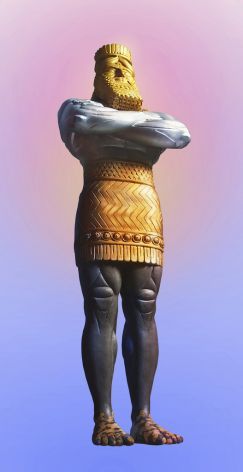
« You, O king, were watching, and you saw an immense image. That image, which was huge and extremely bright, was standing in front of you, and its appearance was terrifying. The head of that image was of fine gold, its chest and its arms were of silver, its abdomen and its thighs were of copper, its legs were of iron, and its feet were partly of iron and partly of clay. You looked on until a stone was cut out, not by hands, and it struck the image on its feet of iron and of clay and crushed them. At that time the iron, the clay, the copper, the silver, and the gold were, all together, crushed and became like the chaff from the summer threshing floor, and the wind carried them away so that not a trace of them could be found. But the stone that struck the image became a large mountain, and it filled the whole earth » (Daniel 2:31-35).
The interpretation of the dream
“This is the dream, and we will now tell the king its interpretation. You, O king—the king of kings to whom the God of heaven has given the kingdom, the might, the strength, and the glory, and into whose hand he has given men wherever they may dwell, as well as the beasts of the field and the birds of the heavens, and whom he has made ruler over all of them—you yourself are the head of gold. “But after you another kingdom will rise, inferior to you; then another kingdom, a third one, of copper, that will rule over the whole earth. “As for the fourth kingdom, it will be strong like iron. For just as iron crushes and pulverizes everything else, yes, like iron that shatters, it will crush and shatter all of these. “And just as you saw the feet and the toes to be partly of clay of a potter and partly of iron, the kingdom will be divided, but some of the hardness of iron will be in it, just as you saw the iron mixed with soft clay. And as the toes of the feet were partly of iron and partly of clay, so the kingdom will be partly strong and partly fragile. Just as you saw iron mixed with soft clay, they will be mixed with the people; but they will not stick together, one to the other, just as iron does not mix with clay. “In the days of those kings the God of heaven will set up a kingdom that will never be destroyed. And this kingdom will not be passed on to any other people. It will crush and put an end to all these kingdoms, and it alone will stand forever, just as you saw that out of the mountain a stone was cut not by hands, and that it crushed the iron, the copper, the clay, the silver, and the gold. The Grand God has made known to the king what will happen in the future. The dream is true, and its interpretation is trustworthy” (Daniel 2:36-45).
In this dream, it is prophetically described the succession of world powers, from the time of Daniel, when the kingdom of Babylon was the ruling world power, until the great tribulation, when the destruction of human sovereignty, followed by the establishment of the earthly administration of the kingdom of God. This statue is made of four metals:
1 – The golden head: the Babylonian empire, represented by the king Nebuchadnezzar, at the time of the prophet Daniel:
“You, O king—the king of kings to whom the God of heaven has given the kingdom, the might, the strength, and the glory, 38 and into whose hand he has given men wherever they may dwell, as well as the beasts of the field and the birds of the heavens, and whom he has made ruler over all of them—you yourself are the head of gold” (Daniel 2:37,38).
2 – The chest and arms in silver: the Medo-Persian empire (Daniel 2:39a).
The historical narrative of the transition from Babylonian power to Medo-Persian power is found in Daniel chapters 5 and 6.
3 – The abdomen and the thighs made of copper: the Greek empire (Daniel 2:39b).
The prophetic announcement of the transition from the Medo-Persian empire to the Greek empire, through Alexander the Great, is found in Daniel chapter 8 (this chapter will be studied later):
“It threw the ram to the ground and trampled it down, and there was no one to rescue it from its power. Then the male goat exalted itself exceedingly, but as soon as it became mighty, the great horn was broken; then four conspicuous horns came up instead of the one, toward the four winds of the heavens. (…) The two-horned ram that you saw stands for the kings of Media and Persia. The hairy male goat stands for the king of Greece; and the great horn that was between its eyes stands for the first king. As for the horn that was broken, so that four stood up instead of it, there are four kingdoms from his nation that will stand up, but not with his power” (Daniel 8:7,8,20-22).
Two hundred years in advance, this prophecy foretold the advent of Alexander, the Great (the great horn of the male goat) and his very fast conquests (the male goat without touching the ground). The book of Daniel has been completed around 536 BCE, in Babylon. Alexander the Great was born in 356 BCE. In 336, he began his reign. He died very young, in 323 BCE: “the horn was broken”.
4 – The Iron Legs: The Roman Empire (Rome (Western Empire) and Constantinople (Eastern Empire)) (Daniel 2:40).
The prophetic announcement of the transition from Greek to Roman power is detailed in the prophecy of Daniel chapter 7 (this chapter will be studied later):
“After this I kept watching in the visions of the night, and I saw a fourth beast, fearsome and terrifying and unusually strong, and it had large iron teeth. It was devouring and crushing, and what was left it trampled down with its feet. It was different from all the other beasts that were prior to it, and it had ten horns” (Daniel 7:7).
This fourth beast represents Roman imperial power; here is how the angel describes its destructive force:
“This is what he said: ‘As for the fourth beast, there is a fourth kingdom that will come to be on the earth. It will be different from all the other kingdoms, and it will devour all the earth and will trample it down and crush it” (Daniel 7:23).
In Chapter 2, the iron, symbolizing Roman power, extends to the feet and toes, signifying its continued existence to this day. This historical continuation is a late Romanization, reflected in its political, religious, and cultural system. Historically, and in a very simplified way, after the decline of the Western Roman Empire in 476, the Eastern Roman Empire continued until 1453.
These Germanic Peoples (as “Spearhead” of the Eastern Roman Empire), will install Royal dynasties, as Merovingian Dynasty, Carolingian Dynasty, in the Western part of Europe, and by means of the Holy Roman Empire, placing themselves under the influence of the Roman Catholic Church (representation of the extension of the Western Roman Empire, Roman Late Antiquity Influence).
Thus, the Western Roman Empire found its continuation through Rome and its extension to the present day, under the banner of Late Roman Antiquity, largely perpetuated by the Roman Catholic Church, which crowned the kings of Western Europe and also in its Germanic part in Eastern Europe. The continuation of Roman culture in the Eastern Roman Empire was achieved through the Orthodox Church in the Slavic countries of Eastern Europe and the Balkans.
The global expansion of this Roman culture occurred through voyages of exploration and research into new continents, followed by conquests and colonial wars that led to genocides of indigenous peoples (in the Americas (North, South, and Central), Asia, Australia, and Africa). The primary exporters of this Roman culture were Spain, Portugal, the Netherlands, Great Britain, and France. The United States of America is the result of wars of conquest waged by European nations of Roman origin. Thus, one could say that the United States of America is an extension of this Roman heritage.
On a political and governmental level, the « Caesars » were replaced by tsars, kaisers, kings, presidents, and prime ministers, with chambers of deputies or senates, as in the former Rome.
On a religious level, the Catholic Church fully embraces its Roman identity by identifying itself as Roman. Its teachings, fundamentally Christian (as well as those of the Orthodox Church), have been largely blended with Greco-Roman teachings, such as the Trinity, the concept of hell, the immortality of the soul, the veneration of saints, the cult of the Virgin Mary resembling the worship of the goddess Artemis of Ephesus, and the practice of venerating images, icons, and statues. The current general philosophy of Western nations is based on consumerism, pleasure, and the industrialized entertainment and tourism industries—the famous « bread and circuses » of ancient Rome (Panem et circenses)—to prevent any revolution or social unrest.
5 – The feet of iron mixed with clay (as well as the toes of iron mixed with clay)).
The presence of clay with the iron of the feet and toes, which in fact weaken the whole structure of the statue (world human sovereignty), represents the movements of uncontrolled crowds, in the forms of street, social and revolutionary, terrorist acts perpetrated by small groups, and alternative media outlets undermine the official propaganda of the authorities in power. This antagonism between iron and clay seriously weakens the authority of current governments. This counter-power seriously weakens the iron authority of current governments (Daniel 2:41-43).
« I kept watching in the visions of the night, and look! with the clouds of the heavens, someone like a son of man was coming; and he gained access to the Ancient of Days, and they brought him up close before that One. 14 And to him there were given rulership, honor, and a kingdom, that the peoples, nations, and language groups should all serve him. His rulership is an everlasting rulership that will not pass away, and his kingdom will not be destroyed »
(Daniel 7:13,14)
The main theme of the prophetic book of Daniel is the restoration of the sovereignty of God on earth, through the kingdom of God, whose kingship has been entrusted to the « son of man », Jesus Christ (Matthew 25:31-46). Based on the chronological basis of the prophecy of Daniel chapter 4:10-27, we can say that this heavenly enthronement took place in 1914 C.E.
The kingdom of God will establish its earthly administration through the New Jerusalem, made up of the 144,000 heavenly holy ones: “And the kingdom and the rulership and the grandeur of the kingdoms under all the heavens were given to the people who are the holy ones of the Supreme One. Their kingdom is an everlasting kingdom, and all rulerships will serve and obey them » (Daniel 7:27; Revelation 21:2-4). According to the prophecy of Ezekiel, the kingdom of God will have earthly holy ones, such as princes and priests (Ezekiel 40-48) (the expression « holy ones » found in the prophecy of Daniel, simply refers to the servants of God Jehovah and his son Jesus Christ).
The historical and prophetic narrative is based on these three main axes, mentioned above, the restoration of the sovereignty of God on earth, the disappearance of bestial human sovereignty, and the establishment of the earthly reign of the kingdom of God, of which the king is the « son of man », Jesus Christ and the 144,000 heavenly holy ones. Therefore, any historical event which does not have a direct link with these three aspects, is not mentioned.
For example, the book of Daniel there are mainly four World Powers, from the time of the writing of this biblical book of Daniel, to the present day: Babylon, the Medo-Persian Empire, Greek and Roman. It is obvious that there have been many other world empires. However, these four empires have had a direct connection with the prophetic narrative of the book of Daniel and even to the present days, regarding the last world power.
“Immediately after the tribulation of those days the sun will be darkened, and the moon will not give its light, and the stars will fall from heaven, and the powers of the heavens will be shaken. And then the sign of the Son of man will appear in heaven, and then all the tribes of the earth will beat themselves in lamentation, and they will see the Son of man coming on the clouds of heaven with power and great glory”
(Matthew 24:29,30)
The verse 29, describes the signs before the « coming, » not the « presence, » of the Son of Man. According to verse 30, it will be King Jesus Christ who will come, this time in a visible way, through a worldwide vision, to settle accounts with all of humanity (Matthew 25:31-46). The rest of this study provides specific indications that we are in this brief period of signs before the (visible), the sign of the Son of man in heaven.
« Immediately after the tribulation of those days, the sun will be darkened, and the moon will not give its light, and the stars will fall from heaven, and the powers of the heavens will be shaken » (Matthew 24:29): Since the biginning of this period, there have been exceptional heavenly and atmospheric phenomena that have brought humanity into a reality never observed since then. The expression « Immediately after the tribulation of those days », seems to indicate a break in the prophetic narrative of Jesus Christ, which this time describes events which would announce the nearness of the end and the great tribulation.
By reading Matthew 24:4-22, from the beginning of the presence of Christ, in 1914 CE (option retained by the editorial line of this biblical site), to the great tribulation (in the second fulfillment, at the global scale), this period is relatively long, it is currently more than 110 years.
Furthermore, when Jesus Christ begins his description, from verses 4 to 6, it is written: « For these things must take place, but the end is not yet ». So that an observer of the events at the beginning of the presence of Christ, during the first and then the second world war, even until the beginning of the cold war, he was relatively further from the imminence of the end (the great tribulation). It would be in the time described in verses 4 to 6, see 7 and 8, where again, Jesus Christ said: « All these things are a beginning of pangs of distress » (Matthew 24:8).
Then after the description of these dramatic events, which would demonstrate the beginning of the presence of Christ (reigning as King, in the midst of his enemies (Psalms 2)) and which would announce the end of this system of things, in Matthew 24:4-28, this time, Jesus Christ begins to describe world events which would announce the nearness of the end or the great tribulation. This time, in addition to quoting Matthew 24:29-31, there will be a presentation of parallel quotes to this same description, in Mark and Luke. The description in Mark’s Gospel is quite similar to Matthew’s; however, regarding Luke’s Gospel, there are other, complementary descriptive details:
“Immediately after the tribulation of those days the sun will be darkened, and the moon will not give its light, and the stars will fall from heaven, and the powers of the heavens will be shaken. And then the sign of the Son of man will appear in heaven, and then all the tribes of the earth will beat themselves in lamentation, and they will see the Son of man coming on the clouds of heaven with power and great glory. And he will send forth his angels with a great trumpet sound, and they will gather his chosen ones together from the four winds, from one extremity of the heavens to their other extremity” (Matthew 24:29-31).
“But in those days, after that tribulation, the sun will be darkened, and the moon will not give its light, and the stars will be falling out of heaven, and the powers that are in the heavens will be shaken. And then they will see the Son of man coming in the clouds with great power and glory. And then he will send out the angels and will gather his chosen ones together from the four winds, from earth’s extremity to heaven’s extremity” (Mark 13:24-27).
“Also, there will be signs in the sun and moon and stars, and on the earth anguish of nations not knowing the way out because of the roaring of the sea and its agitation. People will become faint out of fear and expectation of the things coming upon the inhabited earth, for the powers of the heavens will be shaken. And then they will see the Son of man coming in a cloud with power and great glory. But as these things start to occur, stand up straight and lift up your heads, because your deliverance is getting near” (Luke 21:25-28).
We have seen that in a way, the year 1914 is a historical landmark in time, showing that we are in the period announcing the end of this system of things. Therefore, what is the other historical landmark, that would allow us to understand that we have entered into the period mentioned by Jesus Christ, by the expression « Immediately after the tribulation of those days », of Matthew 24:29 or “But in those days, after that tribulation”, from Mark 13:24? (In the explanations that follow, the conditional tense is mentioned in the mind that the presentation is not made in a dogmatic spirit, to impose a single way of thinking).
Before giving an answer, it is appropriate to read what Jesus Christ said after describing this period, very close to the end (the sign of the Son of man and after, the great tribulation). In fact, he sets the limits in terms of length of time: « Now learn this illustration from the fig tree: Just as soon as its young branch grows tender and sprouts its leaves, you know that summer is near. Likewise, also you, when you see all these things, know that he is near at the doors. Truly I say to you that this generation will by no means pass away until all these things happen. Heaven and earth will pass away, but my words will by no means pass away” (Matthew 24:32-35).
The « generation » represents contemporaries who are currently seeing the signs before the vision of King Jesus Christ in the heavens, and not the people who lived through the early signs mentioned in Matthew 24:4-8, who are almost all dead.
In all of Christ’s statements that contain the word « generation, » it has no chronological value that would allow us to roughly estimate its duration. The word « generation, » as used by Jesus Christ, refers to the contemporaries who lived during his time. Moreover, when he used this word, it had a negative connotation. The word « generation, » in the teachings of Jesus Christ, means the contemporaries of wicked men:
“With whom will I compare this generation? It is like young children sitting in the marketplaces who call out to their playmates, 17 saying: ‘We played the flute for you, but you did not dance; we wailed, but you did not beat yourselves in grief.’ 18 Likewise, John came neither eating nor drinking, but people say, ‘He has a demon.’ 19 The Son of man did come eating and drinking, but people say, ‘Look! A man who is a glutton and is given to drinking wine, a friend of tax collectors and sinners.’ All the same, wisdom is proved righteous by its works” (Matthew 11:16-19; 12:38-45; 16:4; 17:17; 23:33-36, compared with 24:34).
There is no doubt that these prophetic words, of the wicked generation which would not pass away, were fulfilled in the destruction of Jerusalem in the year 70 C.E. The beginning of Christ’s first visible presence began in the year 29 CE. The destruction of Jerusalem took place in 70 CE. So that this period, at that time, was approximately 40 years. Thus, some of the Jews, of this wicked generation, maybe directly or indirectly responsible for the death of Jesus Christ, who lived in those days, experienced the judgment of the destruction of Jerusalem (Matthew 27:25). This valuable information allows us to understand that this short period, which would precede the great tribulation (from Matthew 24:29), which has already begun, should fall within this timeframe (time will tell)…
Regarding the historical moment of the entry into the period of Matthew 24:29, it could be the end of 1990 and the beginning of 1991, during the first Gulf War. It was during this period that the American president, George Bush (the father), proclaimed the beginning of the globalist era, the New World Order. It was during this same time that the UN issued Resolution 666 (along with other Resolutions related to the first Gulf War (660, 661, 662, 664, 665, 666, 667, 669, 670, 674, 677 and 678)). Resolution No. 666 legislates on how to proceed with the embargo decreed by Resolution 661, stipulating that the humanitarian needs of the countries concerned (Iraq-Kuwait) must be taken into account at the same time. Resolution 666 concerns the rules governing embargoes, quite similar to what is written in Apocalypse (Revelation) (13:16-18):
“It puts under compulsion all people—the small and the great, the rich and the poor, the free and the slaves—that these should be marked on their right hand or on their forehead, 17 and that nobody can buy or sell except a person having the mark, the name of the wild beast or the number of its name. 18 This is where it calls for wisdom: Let the one who has insight calculate the number of the wild beast, for it is a man’s number, and its number is 666” (Apocalypse 13:16-18).
The beginning of the period mentioned in First of all, the texts of Matthew and Luke have two distinct parts which concern two stages which will lead to the great tribulation:
1 – “Immediately after the tribulation of those days the sun will be darkened, and the moon will not give its light, and the stars will fall from heaven, and the powers of the heavens will be shaken” (Matthew 24:29).
2 – “And then the sign of the Son of man will appear in heaven, and then all the tribes of the earth will beat themselves in lamentation, and they will see the Son of man coming on the clouds of heaven with power and great glory. And he will send forth his angels with a great trumpet sound, and they will gather his chosen ones together from the four winds, from one extremity of the heavens to their other extremity” (Matthew 24:30,31).
1 – “Also, there will be signs in the sun and moon and stars, and on the earth anguish of nations not knowing the way out because of the roaring of the sea and its agitation. People will become faint out of fear and expectation of the things coming upon the inhabited earth, for the powers of the heavens will be shaken” (Luke 21:25,26).
2 – “And then they will see the Son of man coming in a cloud with power and great glory. But as these things start to occur, stand up straight and lift up your heads, because your deliverance is getting near” (Luke 21:27,28).
Description number 1 from Matthew and Luke would correspond to the period which began in 1990/1991, and from which the wicked generation would not pass away and which would culminate in events number 2, which would very shortly precede the great tribulation (Matthew 24:34). Let us focus on events number 1, from Matthew and Luke.
Description number 1
“Immediately after the tribulation of those days the sun will be darkened, and the moon will not give its light, and the stars will fall from heaven, and the powers of the heavens will be shaken” (Matthew 24:29).
“Also, there will be signs in the sun and moon and stars, and on the earth anguish of nations not knowing the way out because of the roaring of the sea and its agitation. People will become faint out of fear and expectation of the things coming upon the inhabited earth, for the powers of the heavens will be shaken” (Luke 21:25,26).
These descriptions are so aberrant that the first reaction might be to say that at no time since 1990/1991 has humanity witnessed such supernatural events, described prophetically by Jesus Christ. Still others would be tempted to give only a spiritual interpretation, seeing in this description only a symbolic aspect. If we read these two descriptions, seemingly surreal, at first glance, understanding that Jesus Christ describes events through the prism of human perception, then we can realize that currently, they are happening under our eyes. For example, when Jesus Christ said that « stars » would fall on the earth, it is obvious that these are not the stars or planets of the universe, but rather points of light, with the size of the luminosity of the stars which would penetrate our earthly atmosphere, and which for some would reach the ground. Likewise, for the luminosity of the sun and the moon, certain exceptional cataclysmic events occurring on earth could change the perception of the luminosity of these stellar bodies.
The sun will be darkened, and the moon will not give its light: the factors which could seriously obscure the luminosity of the sun, both day and night, for several days, are the very numerous cataclysmic fires, volcanic eruptions which have sometimes paralyzed air traffic, sandstorms, the increase in pollution of large cities which creates fog…
The stars will fall from heaven: it may be an increase in the number of meteorites falling on earth. Added to this, is a factor that did not exist at the time of Christ, the regular fall of thousands of pieces of space debris, and sometimes even old satellites…
The powers of the heavens will be shaken: these may be cataclysmic weather phenomena which would increase in number and intensity, due to global warming observed since the 1970s. This climatic warming causes extreme and opposite weather phenomena, in different places in the world, but sometimes in the same geographical location, such as droughts, followed by deadly floods, or even an increase in cyclones (or typhoons and hurricanes) and tornadoes…
On the earth anguish of nations not knowing the way out because of the roaring of the sea and its agitation: this may be an increase in particularly deadly tsunamis. For example, the tsunami of December 26, 2004, in Indonesia, left 250,000 people dead or missing in a dozen countries on different continents. March 11, 2011, the Fukushima tsunami, 18,000 dead. This tsunami worried all nations, because the waves and numerous debris blocked the cooling systems of the nuclear power plant reactors. This caused a major nuclear disaster, with hydrogen accumulation explosions damaging three reactors and causing major radioactive pollution.
People will become faint out of fear and expectation of the things coming upon the inhabited earth: given the many cataclysms mentioned above, people feel great anguish, seeing that the politicians of their respective countries do not find solutions to prevent and protect their people from these cataclysms. Added to the global spread of the military virus, from the P4 laboratories in the Chinese city of Wuhan, on November 16, 2019, and the lethal experimental injection, which followed and which plunged all of humanity into a great torpor.
Description number 2
“And then the sign of the Son of man will appear in heaven, and then all the tribes of the earth will beat themselves in lamentation, and they will see the Son of man coming on the clouds of heaven with power and great glory. And he will send forth his angels with a great trumpet sound, and they will gather his chosen ones together from the four winds, from one extremity of the heavens to their other extremity” (Matthew 24:30,31).
“And then they will see the Son of man coming in a cloud with power and great glory. But as these things start to occur, stand up straight and lift up your heads, because your deliverance is getting near” (Luke 21:27,28).
These are future events that will shortly precede the end or the great tribulation. This time, the coming of King Jesus Christ will be visible to the entire world population. It will shock many of them, as it is written: “All the tribes of the earth will beat themselves in lamentation”. While another part of humanity will lift up their heads, seeing their deliverance approaching. Matthew chapter 25 is much more explicit about what will happen. According to Matthew 25:1-30, King Jesus Christ will settle accounts with the members of the worldwide Christian congregation, both on an individual level and at the level of the Christian administrators. According to Matthew 25:31-46, Jesus Christ will come to judge humanity as a whole, shortly before the great tribulation. The gathering of chosen ones to survive the great tribulation concerns both the remnant of the 144,000 on earth, who will have everlasting life in heaven, which should number 7,000 people (number of the earthly remnant) according to Apocalypse 7:1-8 and 11:11-13, and the great crowd of all nations who will survive, for everlasting life on earth, according to Apocalypse 7:9-17.
The text of Matthew 24:36-44 shows that at the time of the end, of the great tribulation, there will be a selection between humans who will be « taken » and others who will be « abandoned »: « Concerning that day and hour nobody knows, neither the angels of the heavens nor the Son, but only the Father. For just as the days of Noah were, so the presence of the Son of man will be. For as they were in those days before the Flood, eating and drinking, men marrying and women being given in marriage, until the day that Noah entered into the ark, and they took no note until the Flood came and swept them all away, so the presence of the Son of man will be. Then two men will be in the field; one will be taken along and the other abandoned. Two women will be grinding at the hand mill; one will be taken along and the other abandoned. Keep on the watch, therefore, because you do not know on what day your Lord is coming. “But know one thing: If the householder had known in what watch the thief was coming, he would have kept awake and not allowed his house to be broken into. On this account, you too prove yourselves ready, because the Son of man is coming at an hour that you do not think to be it » (Matthew 24:36-44).
The Greek word translated as « presence, » mentioned in Matthew (24:3), is “πάρειμι”, “parousia” (Strong’s Concordance (G3952)): The primary meaning of « presence » for parousia is often translated by words like « the coming », « the arrival » or « the advent », which creates confusion. The words « the coming », « the arrival » and « the advent », suggest a much shorter space of time than the time of a « presence », which can be quite long in time. The translation of the Greek word parousia by, « the coming » or « advent », is all the more inaccurate as this word « coming » corresponds to another Greek word: « Then the sign of the Son of man will appear in heaven, and all the tribes of the earth will beat themselves in grief, and they will see the Son of man coming on the clouds of heaven with power and great glory » (Matthew 24:30). In this same chapter which answers the same question (in verse 3), the coming of the son of man is translated by the Greek verb « erchomai » (ἔρχομαι (G2064) Strong’s Concordance).
Matthew 24:23-28 is an important transition with the second part. This rather short passage answers the question concerning the sign of the « presence » of Christ: « Then if anyone says to you, ‘Look! Here is the Christ,’ or, ‘There!’ do not believe it. For false Christs and false prophets will arise and will perform great signs and wonders so as to mislead, if possible, even the chosen ones. Look! I have forewarned you. Therefore, if people say to you, ‘Look! He is in the wilderness,’ do not go out; ‘Look! He is in the inner rooms,’ do not believe it. For just as the lightning comes out of the east and shines over to the west, so the presence of the Son of man will be. Wherever the carcass is, there the eagles will be gathered together ».
We can also say that this passage would have two accomplishments (the biblical explanation in the conditional of caution, is presented as possibilities or probabilities while being open to any need for readjustments). Regarding the presence of Christ, there are two ways of understanding among those interested in this prophecy. The first, think that this presence would precede the great tribulation by many years and in addition that it would be invisible. This presence would be linked with another important event, the heavenly enthronement of King Jesus Christ in 1914 CE, reigning among his enemies ever since (Psalms 2).
Other Christians believe that this presence, is a visible coming or returning of Christ, particularly shortly before the great tribulation as the sign of the Son of man, as King judging the whole humanity (Matthew 24:30 and also 25:31-33). This understanding is entirely plausible. Even if the current editorial line of this biblical site, on the invisible presence of Christ and his enthronement in 1914, has been retained, the explanations will not be presented to discredit the faith of sincere Christians who think that his presence would only be visible, but rather with a possibility of complementarity of both understandings.
In Matthew 24:23-28, Jesus Christ speaks of the discernment of his presence which would only be understood by humans with the insight of spiritual eagles with high visual acuity (the Holy Ones) (acuity three times greater than that human).
The first visible presence of Christ
There was a first visible presence of Christ which preceded the destruction of Jerusalem in the 70 CE. This earthly, visible presence began at the time of Christ’s baptism and ended at his ascension into heaven (Acts 1:9). This first visible presence was mentioned in the prophecy of the 70 weeks of years and announced that its conclusion would result in the destruction of Jerusalem: « And the people of a leader who is coming will destroy the city and the holy place. And its end will be by the flood. And until the end there will be war; what is decided upon is desolations” (Daniel 9:24-26).
This first fulfillment is based on the prophecy of the 70 weeks (of years), in Daniel chapter 9:24-27, which foretold both the coming of Christ to earth and the end of God’s special covenant with earthly Israel (verse 27a). The last week of years (7 years) would begin with the anointing of Christ in the autumn of 29 CE, and his cutting off (his death) in the middle of the week (3 and a half years later), the spring of 33 CE (Daniel 9:26a and 27a): “And after the 62 weeks, Messiah will be cut off, with nothing for himself. (…) And he will keep the covenant in force for the many for one week; and at the half of the week, he will cause sacrifice and gift offering to cease” (Daniel 9:26a and 27a).
The second part of this last week of years, this period of 70 weeks of years, ended in the year 36 CE, with the baptism of the Roman officer Cornelius, at the moment when God turned his attention to all the nations. From then on, God’s special relationship with the earthly nation of Israel had definitively ceased (Acts 10).
The prophecy (of Daniel) of the 70 weeks of years foretold the first presence of Christ on earth and the imminent end of the special relationship with the former nation of Israel, culminating in its destruction, particularly its administrative structure, in the year 70 CE, through the destruction of Jerusalem by the Roman armies. This description of Jesus Christ in Matthew (24:15-20) is its first fulfillment.
The second presence of Christ
The second presence of Christ, concerning our time, announces the end of this system of things, during the great tribulation (Matthew 24:4-22).
Just after the ascension of Jesus Christ, two angels said this, to the apostles and disciples who were witnessing this supernatural spectacle: « And as they were gazing into the sky while he was on his way, suddenly two men in white garments stood beside them and said: “Men of Galʹilee, why do you stand looking into the sky? This Jesus who was taken up from you into the sky will come in the same manner as you have seen him going into the sky » » (Acts 1:10,11). The angels mention that he would return in the same way, quite visibly, as mentioned in Matthew 24:30 (the sign of the Son of man), comparing with Matthew 25:31-33, shortly before the great tribulation. Moreover, in the book of Apocalypse, there is also talk of his visible and spectacular coming: « Look! He is coming with the clouds, and every eye will see him, and those who pierced him; and all the tribes of the earth will beat themselves in grief because of him. Yes, Amen” (Apocalypse 1:7). Nevertheless, it is important to differentiate between the « coming » or return of Christ, shortly before the great tribulation mentioned in the three biblical texts, above and his « presence », this time mentioned in the written question in Matthew 24:3.
In the question of Matthew 24:3, there are three important words that allow us to understand its meaning and the answer of Christ: The « sign » (σημαίνω (sēmeion) (Strong’s Concordance (G4591)), which has the sense of indication by « things that will take place ». The « sign » refers to two groups of events, stated by Christ: events which show that Christ is present and that he has begun to reign in the heavens (since 1914) (Matthew 24:4-14 and 24:23- 28). The « sign » of the nearness of the end and the end itself (Matthew 24: 15-22 (« sign » focused on the city of Jerusalem) and Matthew 24:29 at 25:46).
Thus, the sign or indication of the presence of Christ, would be done over a long period of time, unlike his coming to judge the nations, shortly before the great tribulation, which will be brief: « When the Son of man comes in his glory, and all the angels with him, then he will sit down on his glorious throne » (Matthew 25:31 « comes » (erchomai)). The first presence of Christ took place during the three and a half years of his ministry, from the year 29 to the year 33 (C.E.), until the time of his death. This first presence was discerned by the « eagles », the disciples who were present especially at the time of his death (Matthew 24:23-28). The second presence of Christ began in 1914, and will end at the end of the thousand-year reign mentioned in Revelation 20:1-6 (Matthew 24:4-14 ; Daniel 12:3,10b). This second presence is discerned by « eagles, » a group of Christ’s disciples (Matthew 24:4-14; Daniel 12:3,10b).
As indicated by Jesus Christ, the first « eagles » were at the feet of the dead body of Jesus Christ, at the end of his first presence on earth, from the year 29 to the year 33 CE, at the time of his death: « Wherever the carcass is, there the eagles will be gathered together » (Matthew 27:55,56; John 19:25-27). Among these spiritual « eagles » was the apostle John who would write the book of Apocalypse. Jesus Christ says that from now on, they should no longer believe anyone who claims to be Christ or to have seen him somewhere: « Then if anyone says to you, ‘Look! Here is the Christ,’ or, ‘There!’ do not believe it” (Matthew 24:23-28).
And for good reason, because at the moment when the signs would be realized, Jesus Christ would have ascended to heaven, and during the years which would precede the great tribulation, he would not be more visible. He will only be visible by his return, at the very end of this system of things, just before the great tribulation (Matthew 24:30; 25:31-33; Revelation 1:7).
This is how Jesus Christ describes his future presence (as he was speaking): « For just as the lightning comes out of the east and shines over to the west, so the presence of the Son of man will be » (Matthew 24:27). By this enigmatic sentence, is Jesus Christ suggesting that his presence would be visible? To fully understand what he means, we must read the words which precede this declaration: « Therefore, if people say to you, ‘Look! He is in the wilderness,’ do not go out; ‘Look! He is in the inner rooms,’ do not believe it » (Matthew 24:26). In this verse, Jesus Christ designates specific places. When Jesus Christ describes his presence with the metaphor of lightning tearing the sky from east to west, he is only illustrating his presence on the entire earth. And according to verse 28, it would only be perceived by the spiritual eagles, as the ones having insight who were, at the end of his first presence, at the feet of his human dead body: « Wherever the carcass is, there the eagles will be gathered together » (Matthew 24:28).
The meaning of the current presence of Christ
How to define in a concrete way what the presence of Christ means? This is the moment when King Jesus Christ reigns among his enemies. This hostility of the nations towards this heavenly kingship is described in Psalm 110, when Christ sat down at the right hand of God, awaiting this heavenly kingdom:
“Jehovah declared to my Lord:
“Sit at my right hand
Until I place your enemies as a stool for your feet””
(Psalms 110:1).
And then Psalm 2 describes the hostile attitude of the nations towards the current kingship of Christ:
“Why are the nations agitated
And the peoples muttering an empty thing?
2 The kings of the earth take their stand
And high officials gather together as one
Against Jehovah and against his anointed one.
3 They say: “Let us tear off their shackles
And throw off their ropes!”
4 The One enthroned in the heavens will laugh;
Jehovah will scoff at them.
5 At that time he will speak to them in his anger
And terrify them in his burning anger,
6 Saying: “I myself have installed my king
On Zion, my holy mountain.”
7 Let me proclaim the decree of Jehovah;
He said to me: “You are my son;
Today I have become your father.
8 Ask of me, and I will give nations as your inheritance
And the ends of the earth as your possession.
9 You will break them with an iron scepter,
And you will smash them like a piece of pottery””
(Psalms 2:1-9).
During his first visible presence on earth, during his earthly ministry, Jesus Christ paid special attention to the earth in order to lay the foundation for the new Christian congregation, which would become the Spiritual Israel of God (Galatians 6:16). Likewise, when Jesus Christ, in Heaven, as King, was present a few years before his coming before the great tribulation, he would prepare a people, both heavenly and earthly, who would survive the great tribulation (Apocalypse chapter 7 (the 144,000 and the great crowd)).
According to Daniel’s prophecy, some insightful, spiritual eagles, have understood the moment his second presence, since 1914 and will discern in advance, his future coming for the world judgment, at the great tribulation (Matthew 25:31; Apocalypse 3:3): « Many will cleanse themselves and whiten themselves and will be refined. And the wicked ones will act wickedly, and none of the wicked will understand; but those having insight will understand » (Daniel 12:10).
« While he was sitting on the Mount of Olives, the disciples approached him privately, saying: “Tell us, when will these things be, and what will be the sign of your presence and of the conclusion of the system of things? » »
(Matthew 24:3)
In the question of Matthew 24:3, there are three important words that allow us to understand its meaning and the answer of Christ: The « sign » (σημαίνω (sēmeion) (Strong’s Concordance (G4591)), which has the sense of indication by « things that will take place ». The « sign » refers to two groups of events, stated by Christ: events which show that Christ is present and that he has begun to reign in the heavens (since 1914) (Matthew 24:4-14 and 24:23- 28). The « sign » of the nearness of the end and the end itself (Matthew 24: 15-22 (« sign » focused on the city of Jerusalem) and Matthew 24:29 at 25:46).
“In answer Jesus said to them: “Look out that nobody misleads you, 5 for many will come on the basis of my name, saying, ‘I am the Christ,’ and will mislead many. 6 You are going to hear of wars and reports of wars. See that you are not alarmed, for these things must take place, but the end is not yet. 7 “For nation will rise against nation and kingdom against kingdom, and there will be food shortages and earthquakes in one place after another. 8 All these things are a beginning of pangs of distress” (Matthew 24:4-8).
In his introduction, Christ indicates that there would be false Christ, that there would be a false presence of a self-proclaimed « Christ » who would lead many astray. He then describes the beginning of dramatic events. When he says, « but the end is not yet », he implies that the historical period in which these events would unfold would have a certain (indefinite) duration. This idea of »all these things are a beginning of pangs of distress », is repeated in the last verse (8).
“Then people will hand you over to tribulation and will kill you, and you will be hated by all the nations on account of my name. 10 Then, too, many will be stumbled and will betray one another and will hate one another. 11 Many false prophets will arise and mislead many; 12 and because of the increasing of lawlessness, the love of the greater number will grow cold. 13 But the one who has endured to the end will be saved. 14 And this good news of the Kingdom will be preached in all the inhabited earth for a witness to all the nations, and then the end will come” (Matthew 24:9-14).
Jesus Christ describes the extremely difficult living conditions of Christ’s disciples, marked by persecution with hatred, betrayal, and the presence of false prophets and teachers who spread religious lies. Within the context of this description, Jesus Christ states that the disciples who persevere to the end will be saved (13).
The Good News would be preached as a witness to all nations, implying that the spread of this message would occur on a national scale, and not just on the scale of an individual (or groups of individuals). This means that the end of this proclamation campaign (decided by God) would not be when the last person would be contacted, but rather when all nations would be sufficiently informed of the Good News, from the perspective of the Heavenly Father; then the end would come (14).
“Therefore, when you catch sight of the disgusting thing that causes desolation, as spoken about by Daniel the prophet, standing in a holy place (let the reader use discernment), 16 then let those in Judea begin fleeing to the mountains. 17 Let the man on the housetop not come down to take the goods out of his house, 18 and let the man in the field not return to pick up his outer garment. 19 Woe to the pregnant women and those nursing a baby in those days! 20 Keep praying that your flight may not occur in wintertime nor on the Sabbath day; 21 for then there will be great tribulation such as has not occurred since the world’s beginning until now, no, nor will occur again. 22 In fact, unless those days were cut short, no flesh would be saved; but on account of the chosen ones those days will be cut short” (Matthew 24:15-22).
This part of the description of Christ is not easy to understand, as the parenthetical phrase demonstrates: let the reader use discernment. To understand these explanations, in addition to God’s help through prayer, one must have read and understood the prophecy of Daniel, specifically the part in chapter nine, about « the disgusting thing that causes desolation » and the « great tribulation, » mentioned in chapter twelve of Daniel’s prophecy. There would be two fulfillments: one in the time of Christ’s contemporaries, and the other in our time, when we are experiencing the signs announcing the end of this system of things.
This first fulfillment is based on the prophecy of the 70 weeks (of years), in Daniel chapter 9:24-27, which foretold both the coming of Christ to earth and the end of God’s special covenant with earthly Israel (verse 27a). The last week of years (7 years) would begin with the anointing of Christ in the autumn of 29 CE, and his cutting off (his death) in the middle of the week (3 and a half years later), the spring of 33 CE (Daniel 9:26a and 27a): “And after the 62 weeks, Messiah will be cut off, with nothing for himself. (…) And he will keep the covenant in force for the many for one week; and at the half of the week, he will cause sacrifice and gift offering to cease” (Daniel 9:26a and 27a).
The second part of this last week of years, this period of 70 weeks of years, ended in the year 36 CE, with the baptism of the Roman officer Cornelius, at the moment when God turned his attention to all the nations. From then on, God’s special relationship with the earthly nation of Israel had definitively ceased (Acts 10).
The prophecy (of Daniel) of the 70 weeks of years foretold the first presence of Christ on earth and the imminent end of the special relationship with the former nation of Israel, culminating in its destruction, particularly its administrative structure, in the year 70 CE, through the destruction of Jerusalem by the Roman armies. This description of Jesus Christ in Matthew (24:15-20) is its first fulfillment.
“Therefore, when you catch sight of the disgusting thing that causes desolation, as spoken about by Daniel the prophet, standing in a holy place (let the reader use discernment)” (Matthew 24:15): This prophecy mentioned by Christ is in the book of Daniel 9:27b: « And on the wing of disgusting things there will be the one causing desolation; and until an extermination, what was decided on will be poured out also on the one lying desolate » (Daniel 9:27b).
The « the disgusting thing that causes desolation » represents the Roman armies, which carried out the execution of Christ (Matthew 27) and later, the destruction of Jerusalem. Thus, the « the disgusting thing that causes desolation » represents military forces causing great devastation. It represents a world power (in the time, Rome), primarily in its military power (and not only its political power).
The first fulfillment (not mentioned in the Bible), happened in the year 66 CE. The Roman general Cestius Gallus, during the first siege of Jerusalem, partially came into the city by destroying part of the outer wall of the great temple. However, for unexplained reasons Cestus Gallus left without completing this siege. This unprecedented situation allowed the Christians of Jerusalem (the chosen ones), to flee the city, before its destruction in the year 70 CE, by the Roman general Titus.
In Matthew 24:21, Jesus Christ mentions a great tribulation: “For then there will be great tribulation such as has not occurred since the world’s beginning until now, no, nor will occur again” (Matthew 24:21). This prophecy has not been fully fulfilled in 70 CE, with the destruction of Jerusalem, but it will be in our time.
Indeed, by this statement, Jesus Christ mentions a destruction (a tribulation), which is written in Daniel 9:27b, but its full fulfillment will be in our time (as the great tribulation). It is mentioned in Daniel 12:1: « During that time Michael will stand up, the great prince who is standing in behalf of your people. And there will occur a time of distress such as has not occurred since there came to be a nation until that time » (Daniel 12:1).
The second fulfillment of Christ’s signs
concerning the end of this system of things
What biblical evidence proves that the description in Matthew 24:4-20 would have a second fulfillment centuries later? It is the biblical book of Apocalypse (Revelation), written a little less than thirty years after the first fulfillment of the destruction of Jerusalem in 70 CE. In Matthew 24:7-8, it is written that there would be wars, food shortages, and great suffering. We can read similar information in Apocalypse (6:1-8), which precedes by a few years the great tribulation mentioned in Apocalypse 7:14, but also detailed in a terrifying description in Apocalypse 14:15-20 and 19:11-21.
Currently, the city of the former Jerusalem has been rebuilt, but it no longer biblically holds the status of the world capital of God’s worship (see Matthew 23:38, « Look! Your house is abandoned to you »). This former Jerusalem will be replaced by a heavenly « new Jerusalem » that will rule from heaven over the whole earth (Apocalypse 21:1-4).
The future destruction of present-day Jerusalem during the great tribulation, announced prophetically by Jesus Christ, is also confirmed in the prophecy of Zechariah: « Jehovah will go out and war against those nations as when he fights in the day of a battle. In that day his feet will stand on the Mount of Olives, which faces Jerusalem on the east; and the Mount of Olives will be split in half, from east to west, forming a very great valley; and half of the mountain will move to the north, and half of it to the south. You will flee to the valley of my mountains, for the valley of the mountains will extend all the way to Azel. You will have to flee, just as you fled because of the earthquake in the days of King Uzziah of Judah. And Jehovah my God will come, and all the holy ones will be with him » (Zechariah 14:3-5).
In the same way that this prophecy mentions that the holy ones would flee from Jerusalem to save their lives, so Jesus Christ has advised them, in our time, to flee the city before the coming the great tribulation (Matthew 24:15-21).
The second fulfillment of Daniel 9:27b and Matthew 24:15 (concerning the disgusting thing that causes desolation), takes place in our days, shortly before the future great tribulation, mentioned in Daniel 12:1 and Matthew 24:21.
An important reminder: The « the disgusting thing that causes desolation » represents the Roman armies, which carried out the execution of Christ (Matthew 27) and later, the destruction of Jerusalem. Thus, the « the disgusting thing that causes desolation » represents military forces causing great devastation. It represents a world power (in the time, Rome), primarily in its military power (and not only its political power).
Today, « the disgusting thing that causes desolation », represents an extension of the Roman power in our time (see Late Roman Antiquity). This extension of Late Roman Antiquity represents the United States of America (through its founding nations with Latin origin, primarily Spain, France, Portugal, and England (also occupied by Roman armies)), representing the current world power with its army possessing formidable destructive power.
In the prophecy of Daniel of the King of the North and the King of the South, it is written that the King of the South, the current American world power and its ally Israel (in the Middle East), would set up his « royal tents » in Jerusalem, a holy place, shortly before the great tribulation: « And he will plant his royal tents between the grand sea and the holy mountain of Decoration » (Daniel 11:45) (The following information is presented in the conditional tense, out of caution and as possibilities or probabilities, open to any necessary readjustments).
The fulfillment of this biblical prophecy took place on May 14, 2018, during the inauguration of the « royal tents » of the king of the south, the American embassy in Israel, located very exactly at the foot of the « holy mountain of Decoration » and between the « grand sea » ((South/south west of Mount Zion (Old City (East Jerusalem)), between the Karyat Moriah neighborhood (See Genesis 22:2 (Moriah), 14 (Jehovah Yireh)), to the east and the Arnona neighborhood to the west (direction « grand sea »)). It is in West Jerusalem (which did not exist when Daniel’s prophecy was written). Therefore, being slightly outside the Old City, the « Royal Tents » are between the « Old City » of Jerusalem (East Jerusalem) and the « Grand Sea », the Mediterranean Sea)).
The fulfillment of this prophecy is to be connected with the second fulfillment of the prophecy of Jesus Christ, regarding the proximity of the destruction of Jerusalem, in the future great tribulation: « Therefore, when you catch sight of the disgusting thing that causes desolation, as spoken about by Daniel the prophet, standing in a holy place (let the reader use discernment), then let those in Judea begin fleeing to the mountains » (Matthew 24:15,16).
This would be an indication that we are very close to the great tribulation, according to the end of the prophecy of Daniel, of the two kings, and also the converging end of the prophecy of Jesus Christ:
“During that time Michael will stand up, the great prince who is standing in behalf of your people. And there will occur a time of distress such as has not occurred since there came to be a nation until that time” (Daniel 12:1).
“For then there will be great tribulation such as has not occurred since the world’s beginning until now, no, nor will occur again. 22 In fact, unless those days were cut short, no flesh would be saved; but on account of the chosen ones those days will be cut short” (Matthew 24:21,22).
The very fact that Jesus Christ mentions the great tribulation from the geographical location of present-day Jerusalem shows that the day and hour of the beginning of this dramatic global event will be determined by his time zone (UTC+2) (Matthew 24:2, 21; Zechariah 14:3-5). Jerusalem is expected to be the epicenter of this future world-changing event.
Genesis chapter 2 informs us that God created man and put him in a « garden » called Eden of several thousand hectares, if not more. Adam was in ideal conditions. In this paradise setting, he enjoyed great freedom (John 8:32). However, God set a limit on this immense freedom: a tree: « Jehovah God took the man and settled him in the garden of Eʹden to cultivate it and to take care of it. Jehovah God also gave this command to the man: “From every tree of the garden you may eat to satisfaction. But as for the tree of the knowledge of good and bad, you must not eat from it, for in the day you eat from it you will certainly die » (Genesis 2:15-17). « The tree of knowledge of good and bad » was simply the concrete representation of the abstract concept of good and bad. Henceforth this real tree, represented for Adam, the concrete limit, a « (concrete) knowledge of the good and the bad », fixed by God, between the « good », to keep obeying Him and not to eat of it and the « bad », the disobedience.
It is clearly evident that this commandment of God was not « burdensome » (compare with Matthew 11:28-30 « For my yoke is kindly, and my load is light » and 1 John 5:3 « His commandments are not burdensome » (those of God)). By the way, some have said that the « forbidden fruit » stands for carnal relationships: this is wrong, because when God gave this commandment, Eve did not exist. God was not going to forbid something that Adam could not know (Compare the chronology of events Genesis 2:15-17 (the command of God) with 2:18-25 (the creation of Eve)).
« Now the serpent was the most cautious of all the wild animals of the field that Jehovah God had made. So it said to the woman: “Did God really say that you must not eat from every tree of the garden?” At this the woman said to the serpent: “We may eat of the fruit of the trees of the garden. But God has said about the fruit of the tree that is in the middle of the garden: ‘You must not eat from it, no, you must not touch it; otherwise you will die.’” At this the serpent said to the woman: “You certainly will not die. For God knows that in the very day you eat from it, your eyes will be opened and you will be like God, knowing good and bad.” Consequently, the woman saw that the tree was good for food and that it was something desirable to the eyes, yes, the tree was pleasing to look at. So she began taking of its fruit and eating it. Afterward, she also gave some to her husband when he was with her, and he began eating it » (Genesis 3:1-6).
The sovereignty of God has been openly attacked by the devil. Satan implied that God was withholding information for the purpose of harming his creatures: « For God knows » (implying that Adam and Eve did not know and that it was harming them). Nevertheless, God always remained in control of the situation.
Why did Satan speak to Eve rather than Adam? To use the inspired expression of the apostle Paul, to « deceive » her: « Also, Adam was not deceived, but the woman was thoroughly deceived and became a transgressor » (1 Timothy 2:14 ). In what way was Eve deceived? Because of her young age, because she had very few years of experience, while Adam was at least over forty. In fact, Eve was little surprised, at her young age, that a snake spoke to her. She normally continued this unusual conversation. Therefore, Satan took advantage of Eve’s inexperience to cause her to sin. However, Adam knew what he was doing, he made the decision to sin in a deliberate way. This first accusation of the devil was linked to God’s evident right to rule over his creatures, both invisible and visible (Revelation 4:11).
Shortly before the end of that day, before sunset, God judged the three culprits (Genesis 3:8-19). Before determining the guilt of Adam and Eve, Jehovah God asked them a question about their gesture. So they replied: « “The woman whom you gave to be with me, she gave me fruit from the tree, so I ate.” (…) “The serpent deceived me, so I ate.” » (Genesis 3:12,13). Far from admitting they were guilty, both Adam and Eve tried to justify themselves. Adam even indirectly reproached God for giving him a woman who made him sin: « The woman whom you gave to be with me ». In Genesis 3:14-19, we can read the judgment of God with a promise of the fulfillment of his purpose: « And I will put enmity between you and the woman and between your offspring and her offspring. He will crush your head, and you will strike him in the heel » (Genesis 3:15). By this promise, Jehovah God was particularly signifying that his purpose would inevitably come true, by informing Satan the devil that he would be destroyed. From that moment on, sin entered into the world, as well as its main consequence, death: « That is why, just as through one man sin entered into the world and death through sin, and so death spread to all men because they had all sinned » (Romans 5:12).
The devil hinted that there was a flaw in human nature. This is evident in the devil’s challenge regarding the integrity of faithful servant Job:
« Then Jehovah said to Satan: “Where have you come from?” Satan answered Jehovah: “From roving about on the earth and from walking about in it.” And Jehovah said to Satan: “Have you taken note of my servant Job? There is no one like him on the earth. He is an upright man of integrity, fearing God and shunning what is bad.” At that Satan answered Jehovah: “Is it for nothing that Job has feared God? Have you not put up a protective hedge around him and his house and everything he has? You have blessed the work of his hands, and his livestock has spread out in the land. But, for a change, stretch out your hand and strike everything he has, and he will surely curse you to your very face.” Then Jehovah said to Satan: “Look! Everything that he has is in your hand. Only do not lay your hand on the man himself!” So Satan went out from the presence of Jehovah. (…) Then Jehovah said to Satan: “Where have you come from?” Satan answered Jehovah: “From roving about on the earth and from walking about in it.” And Jehovah said to Satan: “Have you taken note of my servant Job? There is no one like him on the earth. He is an upright man of integrity, fearing God and shunning what is bad. He is still holding firmly to his integrity, even though you try to incite me against him to destroy him for no reason.” But Satan answered Jehovah: “Skin for skin. A man will give everything that he has for his life. But, for a change, stretch out your hand and strike his bone and flesh, and he will surely curse you to your very face.” Then Jehovah said to Satan: “Look! He is in your hand! Only do not take his life!” » (Job 1:7-12 ; 2:2-6).
The fault of human beings, according to Satan the devil, is that they serve God, not out of love for their Creator, but out of self-interest and opportunism. Under pressure, by the loss of his possessions and by fear of death, still according to Satan the devil, man could only depart from his loyalty to God. But Job demonstrated that Satan the devil is a liar: Job lost all his possessions, and he lost his 10 children and he came close to death with a « painful boil » (Job 1 and 2). Three false comforters took it upon themselves to psychologically torture Job, implying that all his misfortunes came from hidden sins on his part, and that therefore God was chastising him for his guilt and wickedness. Nevertheless, Job did not depart from his integrity and replied: « It is unthinkable for me to declare you men righteous! Until I die, I will not renounce my integrity! » (Job 27:5).
However, the most important defeat of the devil regarding the integrity of man until death, was connected with Jesus Christ, who has been obedient to his Father, until death:“More than that, when he came as a man, he humbled himself and became obedient to the point of death, yes, death on a torture stake » (Philippians 2:8). Jesus Christ, by his integrity even to death, offered his Father a very precious spiritual victory, that is why he has been rewarded: « For this very reason, God exalted him to a superior position and kindly gave him the name that is above every other name, so that in the name of Jesus every knee should bend—of those in heaven and those on earth and those under the ground— and every tongue should openly acknowledge that Jesus Christ is Lord to the glory of God the Father » (Philippians 2:9-11).
It is important to know the biblical information about the devil to fully understand the reasons for God’s permission of evil and the current sad condition of humanity.
Jesus Christ described the devil very concisely: “That one was a murderer when he began, and he did not stand fast in the truth, because truth is not in him. When he speaks the lie, he speaks according to his own disposition, because he is a liar and the father of the lie » (John 8:44). Satan the devil is not the abstraction of evil, but a real spiritual person (Matthew 4:1-11). Likewise, the demons are also angels who have become rebels who have followed the example of the devil (Genesis 6:1-3, to compare with the letter of Jude verse 6: « And the angels who did not keep their original position but forsook their own proper dwelling place, he has reserved with eternal bonds in dense darkness for the judgment of the great day »).
When it is written, « he did not stand fast in the truth », it shows that God created this angel without sin and without any trace of wickedness in his heart. This angel, at the beginning of his life had a « beautiful name » (Ecclesiastes 7:1a). However, « he did not stand fast » in his integrity, he cultivated pride in his heart, and over time he became « devil », which means slanderer, and Satan, opponent; his old beautiful name, his good reputation, has been replaced by one of the everlasting disgraces. In the prophecy of Ezekiel (chapter 28), against the proud king of Tyre, it is clearly alluded to the pride of the angel who became « devil » and « Satan »: « This is what the Sovereign Lord Jehovah says: “You were the model of perfection, Full of wisdom and perfect in beauty. You were in Eʹden, the garden of God. You were adorned with every precious stone —Ruby, topaz, and jasper; chrysʹo·lite, onyx, and jade; sapphire, turquoise, and emerald; And their settings and mountings were made of gold. They were prepared on the day you were created. I assigned you as the anointed covering cherub. You were on the holy mountain of God, and you walked about among fiery stones. You were faultless in your ways from the day you were created Until unrighteousness was found in you » (Ezekiel 28:12-15). Through his act of unrighteousness in Eden, he became a « liar » who caused the death of all of Adam’s offspring (Genesis 3; Romans 5:12). Currently, it is Satan the devil who rules the world: « Now there is a judging of this world; now the ruler of this world will be cast out » (John 12:31; Ephesians 2:2; 1 John 5:19) .
This meditation will be based on Job’s dialogue with his three accusers or his false friends, on Elihu’s speech and finally the intervention of Jehovah God, the Heavenly Father, in order to discipline Job on his words.
What is the message of this prophetic enigma? Jehovah God informs that his purpose to populate the earth with a righteous humanity will surely be fulfilled (Genesis 1:26-28). God will redeem the humanity through the « offspring of the woman » (Genesis 3:15).
This covenant has a spiritual meaning, which is spelled out in the farewell speech of Moses in the book of Deuteronomy: « You must now cleanse your hearts and stop being so stubborn » (Deuteronomy 10:16).
The purpose of the Law given to Israel was to prepare the people for the coming of the Messiah. The Law has taught the need for liberation from the sinful condition of humanity (represented by the people of Israel)…
« There are also, in fact, many other things that Jesus did, which if ever they were written in full detail, I suppose the world itself could not contain the scrolls written »
(John 21:25)
Jesus Christ and the first miracle written in the Gospel of John, he turns water into wine: « And on the third day a marriage feast took place in Caʹna of Galʹi·lee, and the mother of Jesus was there. Jesus and his disciples were also invited to the marriage feast. When the wine ran short, the mother of Jesus said to him: “They have no wine.” But Jesus said to her: “Woman, why is that of concern to me and to you? My hour has not yet come.” His mother said to those serving: “Do whatever he tells you.” Now there were six stone water jars sitting there as required by the purification rules of the Jews, each able to hold two or three liquid measures. Jesus said to them: “Fill the jars with water.” So they filled them to the brim. Then he said to them: “Now draw some out and take it to the director of the feast.” So they took it. When the director of the feast tasted the water that had now been turned into wine, not knowing where it came from (although the servants who had drawn out the water knew), the director of the feast called the bridegroom and said to him: “Everyone else puts out the fine wine first, and when people are intoxicated, the inferior. You have saved the fine wine until now.” Jesus did this in Caʹna of Galʹi·lee as the beginning of his signs, and he made his glory manifest, and his disciples put their faith in him » (John 2:1-11).
Jesus Christ heals the son of a royal official: « Then he came again to Caʹna of Galʹi·lee, where he had turned the water into wine. Now there was a royal official whose son was sick in Ca·perʹna·um. When this man heard that Jesus had come out of Ju·deʹa into Galʹi·lee, he went to him and asked him to come down and heal his son, for he was at the point of dying. But Jesus said to him: “Unless you people see signs and wonders, you will never believe.” The royal official said to him: “Lord, come down before my young child dies.” Jesus said to him: “Go your way; your son lives.” The man believed the word that Jesus spoke to him, and he left. 51 But while he was on his way down, his slaves met him to say that his boy was alive. So he asked them at what hour he got better. They replied to him: “The fever left him yesterday at the seventh hour.” The father then knew that it was in the very hour that Jesus had said to him: “Your son lives.” So he and his whole household believed. This was the second sign Jesus performed when he came from Ju·deʹa into Galʹi·lee » (John 4:46-54).
Jesus Christ heals a man possessed by a demon in Capernaum: « He then went down to Capernaum, a city of Galilee. And he was teaching them on the Sabbath, and they were astounded at his way of teaching, because he spoke with authority. Now in the synagogue there was a man with a spirit, an unclean demon, and he shouted with a loud voice: “Ah! What have we to do with you, Jesus the Naz·a·reneʹ?Did you come to destroy us? I know exactly who you are, the Holy One of God.” But Jesus rebuked it, saying: “Be silent, and come out of him.” So after throwing the man down in their midst, the demon came out of him without hurting him. At this they were all astonished and began to say to one another: “What kind of speech is this? For with authority and power he orders the unclean spirits, and out they come!” So the news about him kept spreading into every corner of the surrounding country » (Luke 4:31-37).
Jesus Christ casts out demons among the Gadarenes (present-day Jordania, eastern part of the Jordan river, near the Lake Tiberias): « When he came to the other side into the region of the Gad·a·renesʹ, two demon-possessed men coming out from among the tombs met him. They were unusually fierce, so nobody had the courage to pass by on that road. And look! they screamed, saying: “What have we to do with you, Son of God? Did you come here to torment us before the appointed time?” A long way off from them, a herd of many swine was feeding. So the demons began to plead with him, saying: “If you expel us, send us into the herd of swine.” And he said to them: “Go!” With that they came out and went off into the swine, and look! the entire herd rushed over the precipice into the sea and died in the waters. But the herders fled, and going into the city, they reported everything, including the account of the demon-possessed men. And look! all the city turned out to meet Jesus, and when they saw him, they urged him to depart from their region » (Matthew 8:28-34).
Jesus Christ heals the mother-in-law of the Apostle Peter: « And Jesus, on coming into Peter’s house, saw his mother-in-law lying down and sick with fever. So he touched her hand, and the fever left her, and she got up and began ministering to him » (Matthew 8:14,15).
Jesus Christ heals a man with paralyzed right hand: « On another sabbath he entered the synagogue and began teaching. And a man was there whose right hand was withered. The scribes and the Pharisees were now watching Jesus closely to see whether he would cure on the Sabbath, in order to find some way to accuse him. He, however, knew their reasoning, so he said to the man with the withered hand: “Get up and stand in the center.” And he rose and stood there. Then Jesus said to them: “I ask you men, Is it lawful on the Sabbath to do good or to do harm, to save a life or to destroy it?” After looking around at them all, he said to the man: “Stretch out your hand.” He did so, and his hand was restored. But they flew into a senseless rage, and they began to talk over with one another what they might do to Jesus » (Luke 6:6-11).
Jesus Christ heals a man with dropsy (edema, an excess buildup of fluid in the body): « On another occasion he went to eat a meal in the house of one of the leaders of the Pharisees on the Sabbath, and they were closely watching him. And look! a man who had dropsy was in front of him. So in response Jesus asked those versed in the Law and the Pharisees: “Is it lawful to cure on the Sabbath or not?” But they kept silent. With that he took hold of the man, healed him, and sent him away. Then he said to them: “Who of you, if his son or bull falls into a well, will not immediately pull him out on the Sabbath day?” And they were not able to reply to this » (Luke 14:1-6).
Jesus Christ heals a blind man: « Now as Jesus was getting near to Jerʹi·cho, a blind man was sitting beside the road begging. Because he heard a crowd passing by, he began to inquire what was going on. They reported to him: “Jesus the Naz·a·reneʹ is passing by!” At that he cried out: “Jesus, Son of David, have mercy on me!” And those who were in front began rebuking him, telling him to keep quiet, but all the more he kept shouting: “Son of David, have mercy on me!” Then Jesus stopped and commanded that the man be brought to him. After he came near, Jesus asked him: “What do you want me to do for you?” He said: “Lord, let me recover my sight.” So Jesus said to him: “Recover your sight; your faith has made you well.” And instantly he recovered his sight, and he began to follow him, glorifying God. Also, at seeing it, all the people gave praise to God » (Luke 18:35-43).
Jesus Christ heals two blind people: « As Jesus moved on from there, two blind men followed him, shouting out: “Have mercy on us, Son of David.” After he had gone into the house, the blind men came to him, and Jesus asked them: “Do you have faith that I can do this?” They answered him: “Yes, Lord.” Then he touched their eyes, saying: “According to your faith let it happen to you.” And their eyes received sight. Moreover, Jesus sternly warned them, saying: “See that nobody gets to know it.” But after going outside, they made it public about him in all that region » (Matthew 9:27-31).
Jesus Christ heals a deaf mute: « When Jesus returned from the region of Tyre, he went through Siʹdon to the Sea of Galʹi·lee, through the region of De·capʹo·lis. Here they brought him a deaf man with a speech impediment, and they pleaded with him to lay his hand on him. And he took him aside privately, away from the crowd. Then he put his fingers into the man’s ears, and after spitting, he touched his tongue. And looking up into heaven, he sighed deeply and said to him: “Ephʹpha·tha,” that is, “Be opened.” At this his ears were opened, and his speech impediment was removed, and he began speaking normally. With that he ordered them not to tell anyone, but the more he would order them, the more they would proclaim it. Indeed, they were astounded beyond measure, and they said: “He has done all things well. He even makes the deaf hear and the speechless speak” » (Mark 7:31-37).
Jesus Christ heals a leper: « There also came to him a leper, pleading with him even on bended knee, saying to him: “If you just want to, you can make me clean.” At that he was moved with pity, and he stretched out his hand and touched him, and said to him: “I want to! Be made clean.” Immediately the leprosy vanished from him, and he became clean » (Mark 1:40-42).
The healing of the ten lepers: « While he was going to Jerusalem, he was passing between Sa·maria and Galilee. And as he was entering a village, ten men with leprosy met him, but they stood at a distance. And they raised their voices and said: “Jesus, Instructor, have mercy on us!” When he saw them, he said to them: “Go and show yourselves to the priests.” Then as they were going off, they were cleansed. One of them, when he saw that he was healed, turned back, glorifying God with a loud voice. And he fell facedown at Jesus’ feet, thanking him. Furthermore, he was a Samaritan. In reply Jesus said: “All ten were cleansed, were they not? Where, then, are the other nine? Did no one else turn back to give glory to God except this man of another nation?” Then he said to him: “Get up and be on your way; your faith has made you well” » (Luke 17:11-19).
Jesus Christ heals a paralytic: « After this there was a festival of the Jews, and Jesus went up to Jerusalem. Now in Jerusalem at the Sheep Gate is a pool called in Hebrew Beth·zaʹtha, with five colonnades. Within these a multitude of the sick, blind, lame, and those with withered limbs were lying down. But one man was there who had been sick for 38 years. Seeing this man lying there and being aware that he had already been sick for a long time, Jesus said to him: “Do you want to get well?” The sick man answered him: “Sir, I do not have anyone to put me into the pool when the water is stirred up, but while I am on my way, another steps down ahead of me.” Jesus said to him: “Get up! Pick up your mat and walk.” And the man immediately got well, and he picked up his mat and began to walk » (John 5:1-9).
Jesus Christ heals an epileptic: « When they came toward the crowd, a man approached him, knelt down to him, and said: “Lord, have mercy on my son, because he is an epileptic and is ill. He falls often into the fire and often into the water. I brought him to your disciples, but they could not cure him.” In reply Jesus said: “O faithless and twisted generation, how long must I continue with you? How long must I put up with you? Bring him here to me.” Then Jesus rebuked the demon, and it came out of him, and the boy was cured from that hour. Then the disciples came to Jesus privately and said: “Why could we not expel it?” He said to them: “Because of your little faith. For truly I say to you, if you have faith the size of a mustard grain, you will say to this mountain, ‘Move from here to there,’ and it will move, and nothing will be impossible for you.” » (Matthew 17:14-20).
A miracle without knowing it: « As Jesus was going, the crowds pressed in on him. Now there was a woman who had a flow of blood for 12 years, and she had not been able to get a cure from anyone. She approached from behind and touched the fringe of his outer garment, and immediately her flow of blood stopped. So Jesus said: “Who touched me?” When they were all denying it, Peter said: “Instructor, the crowds are hemming you in and pressing against you.” But Jesus said: “Someone touched me, for I know that power went out of me.” Seeing that she had not escaped notice, the woman came trembling and fell down before him and declared before all the people why she touched him and how she was healed immediately. But he said to her: “Daughter, your faith has made you well. Go in peace” » (Luke 8:42-48).
Jesus Christ Heals from a Distance: « When he had completed what he had to say to the people, he entered Ca·perʹna·um. Now an army officer’s slave, who was dear to him, was seriously ill and about to pass away. When he heard about Jesus, he sent some elders of the Jews to him to ask him to come and make his slave well. They came up to Jesus and began to plead with him earnestly, saying: “He is worthy of your granting him this, for he loves our nation and he himself built our synagogue.” So Jesus went with them. But when he was not far from the house, the army officer had already sent friends to say to him: “Sir, do not bother, for I am not worthy to have you come under my roof. That is why I did not consider myself worthy to come to you. But say the word, and let my servant be healed. For I too am a man placed under authority, having soldiers under me, and I say to this one, ‘Go!’ and he goes, and to another, ‘Come!’ and he comes, and to my slave, ‘Do this!’ and he does it.” When Jesus heard these things, he was amazed at him, and he turned to the crowd following him and said: “I tell you, not even in Israel have I found so great a faith.” And when those who had been sent returned to the house, they found the slave in good health » (Luke 7:1-10).
Jesus Christ heals a bent woman for 18 years: « Now he was teaching in one of the synagogues on the Sabbath. And look! a woman was there who had had a spirit of weakness for 18 years; and she was bent double and was unable to straighten up at all. When he saw her, Jesus addressed her and said: “Woman, you are released from your weakness.” And he laid his hands on her, and instantly she straightened up and began to glorify God. But in response the presiding officer of the synagogue, indignant because Jesus did the cure on the Sabbath, said to the crowd: “There are six days on which work ought to be done; so come and be cured on those days, and not on the Sabbath day.” However, the Lord answered him: “Hypocrites, does not each one of you on the Sabbath untie his bull or his donkey from the stall and lead it away to give it something to drink? Should not this woman, who is a daughter of Abraham and whom Satan held bound for 18 years, be released from this bondage on the Sabbath day?” Well, when he said these things, all his opposers began to feel shame, but the entire crowd began to rejoice at all the glorious things he did » (Luke 13:10-17).
Jesus Christ heals the daughter of a Phoenician woman: « Leaving there, Jesus now went into the region of Tyre and Siʹdon. And look! a Phoe·niʹcian woman from that region came and cried out: “Have mercy on me, Lord, Son of David. My daughter is cruelly demon possessed.” But he did not say a word in answer to her. So his disciples came and began to urge him: “Send her away, because she keeps crying out after us.” He answered: “I was not sent to anyone except to the lost sheep of the house of Israel.” But the woman came and did obeisance to him, saying: “Lord, help me!” In answer he said: “It is not right to take the bread of the children and throw it to the little dogs.” She said: “Yes, Lord, but really the little dogs do eat of the crumbs falling from the table of their masters.” Then Jesus replied to her: “O woman, great is your faith; let it happen to you as you wish.” And her daughter was healed from that hour on » (Matthew 15:21-28).
The Miraculous Catch: « On one occasion when the crowd was pressing in on him and listening to the word of God, he was standing by the lake of Gen·nesʹa·ret. And he saw two boats docked at the lakeside, but the fishermen had got out of them and were washing off their nets. Going aboard one of the boats, which was Simon’s, he asked him to pull away a bit from land. Then he sat down, and he began teaching the crowds from the boat. When he stopped speaking, he said to Simon: “Pull out to where it is deep, and let down your nets for a catch.” But in reply Simon said: “Instructor, we toiled all night and caught nothing, but at your word I will lower the nets.” Well, when they did this, they caught a great number of fish. In fact, their nets began ripping apart. So they motioned to their partners in the other boat to come and assist them, and they came and filled both boats, so that these began to sink. Seeing this, Simon Peter fell down at the knees of Jesus, saying: “Depart from me, Lord, because I am a sinful man.” For both he and those with him were overwhelmed with astonishment at the catch of fish they had taken, and the same was true of both James and John, Zebʹe·dee’s sons, who were partners with Simon. But Jesus said to Simon: “Stop being afraid. From now on you will be catching men alive.” So they brought the boats back to land and abandoned everything and followed him » (Luke 5:1-11).
Jesus Christ calms down a storm: « And when he went aboard a boat, his disciples followed him. Now look! a great storm arose on the sea, so that the boat was being covered by the waves; but he was sleeping. And they came and woke him up, saying: “Lord, save us, we are about to perish!” But he said to them: “Why are you so afraid, you with little faith?” Then he got up and rebuked the winds and the sea, and a great calm set in. So the men were amazed and said: “What sort of person is this? Even the winds and the sea obey him.” » (Matthew 8:23-27). This miracle shows that in the earthly paradise there will be no more storms or floods that will cause disasters.
Jesus Christ walking on the sea: « After sending the crowds away, he went up on the mountain by himself to pray. When evening came, he was there alone. By now the boat was many hundreds of yards away from land, struggling against the waves because the wind was against them. But in the fourth watch of the night he came to them, walking on the sea. When they caught sight of him walking on the sea, the disciples were troubled, saying: “It is an apparition!” And they cried out in their fear. But at once Jesus spoke to them, saying: “Take courage! It is I; do not be afraid.” Peter answered him: “Lord, if it is you, command me to come to you over the waters.” He said: “Come!” So Peter got out of the boat and walked over the waters and went toward Jesus. But looking at the windstorm, he became afraid. And when he started to sink, he cried out: “Lord, save me!” Immediately stretching out his hand, Jesus caught hold of him and said to him: “You with little faith, why did you give way to doubt?” After they got up into the boat, the windstorm abated. Then those in the boat did obeisance to him, saying: “You really are God’s Son” » (Matthew 14:23-33).
Jesus Christ multiplies the loaves: « After this Jesus set out across the Sea of Galʹi·lee, or Ti·beʹri·as. And a large crowd kept following him, because they were observing the miraculous signs he was performing in healing the sick. So Jesus went up on a mountain and sat down there with his disciples. Now the Passover, the festival of the Jews, was near. When Jesus raised his eyes and saw that a large crowd was coming to him, he said to Philip: “Where will we buy bread for these people to eat?” However, he was saying this to test him, for he knew what he was about to do. Philip answered him: “Two hundred de·narʹi·i worth of bread is not enough for each of them to get even a little.” One of his disciples, Andrew, Simon Peter’s brother, said to him: “Here is a little boy who has five barley loaves and two small fish. But what are these among so many?” Jesus said: “Have the people sit down.” As there was a lot of grass in that place, the men sat down there, about 5,000 in number. Jesus took the bread, and after giving thanks, he distributed it to those who were sitting there; he did likewise with the small fish, and they had as much as they wanted. But when they had eaten their fill, he said to his disciples: “Gather together the fragments left over, so that nothing is wasted.” So they gathered them together and filled 12 baskets with fragments left over by those who had eaten from the five barley loaves. When the people saw the sign he performed, they began to say: “This really is the Prophet who was to come into the world.” Then Jesus, knowing that they were about to come and seize him to make him king, withdrew again to the mountain all alone » (John 6:1-15). There will be plenty of food all over the earth (Psalms 72:16; Isaiah 30:23).
Jesus Christ resurrects the son of a widow: « Soon afterward he traveled to a city called Naʹin, and his disciples and a large crowd were traveling with him. As he got near the gate of the city, why look! there was a dead man being carried out, the only son of his mother. Besides, she was a widow. A considerable crowd from the city was also with her. When the Lord caught sight of her, he was moved with pity for her, and he said to her: “Stop weeping.” With that he approached and touched the bier, and the bearers stood still. Then he said: “Young man, I say to you, get up!” And the dead man sat up and started to speak, and Jesus gave him to his mother. Now fear seized them all, and they began to glorify God, saying: “A great prophet has been raised up among us,” and, “God has turned his attention to his people.” And this news concerning him spread out into all Ju·deʹa and all the surrounding country » (Luke 7:11-17).
Jesus Christ resurrects Jairus’ daughter: « While he was yet speaking, a representative of the presiding officer of the synagogue came, saying: “Your daughter has died; do not bother the Teacher any longer.” On hearing this, Jesus answered him: “Have no fear, only have faith, and she will be saved.” When he reached the house, he did not let anyone go in with him except Peter, John, James, and the girl’s father and mother. But people were all weeping and beating themselves in grief for her. So he said: “Stop weeping, for she did not die but is sleeping.” At this they began to laugh at him scornfully, because they knew she had died. But he took her by the hand and called to her: “Child, get up!” And her spirit returned, and she rose immediately, and he ordered that something be given her to eat. Well, her parents were beside themselves, but he instructed them to tell no one what had happened » (Luke 8:49-56).
Jesus Christ resurrects his friend Lazarus, who has been dead for four days: « Jesus had not yet come into the village, but he was still in the place where Martha had met him. When the Jews who were with Mary in the house consoling her saw her get up quickly and go out, they followed her, supposing that she was going to the tomb to weep there. When Mary arrived where Jesus was and caught sight of him, she fell at his feet and said to him: “Lord, if you had been here, my brother would not have died.” When Jesus saw her weeping and the Jews who had come with her weeping, he groaned within himself and became troubled. He said: “Where have you laid him?” They said to him: “Lord, come and see.” Jesus gave way to tears. At that the Jews began to say: “See, what affection he had for him!” But some of them said: “Could not this man who opened the eyes of the blind man prevent this one from dying?” Then Jesus, after groaning again within himself, came to the tomb. It was, in fact, a cave, and a stone was lying against it. Jesus said: “Take the stone away.” Martha, the sister of the deceased, said to him: “Lord, by now he must smell, for it has been four days.” Jesus said to her: “Did I not tell you that if you would believe you would see the glory of God?” So they took the stone away. Then Jesus raised his eyes heavenward and said: “Father, I thank you that you have heard me. True, I knew that you always hear me; but I spoke on account of the crowd standing around, so that they may believe that you sent me.” When he had said these things, he cried out with a loud voice: “Lazʹa·rus, come out!” The man who had been dead came out with his feet and hands bound with wrappings, and his face was wrapped with a cloth. Jesus said to them: “Free him and let him go.” » (John 11:30-44).
The last miraculous catch (shortly after the resurrection of Christ): « However, just as day was breaking, Jesus stood on the beach, but the disciples did not realize that it was Jesus. Then Jesus said to them: “Children, you do not have anything to eat, do you?” They answered: “No!” He said to them: “Cast the net on the right side of the boat and you will find some.” So they cast it, but they were not able to haul it in because of the large number of fish. Then the disciple whom Jesus loved said to Peter: “It is the Lord!” Now Simon Peter, on hearing that it was the Lord, put on his outer garment, for he was naked, and plunged into the sea. But the other disciples came in the small boat, dragging the net full of fish, for they were not a long way from land, only about 300 feet (90 m) away » (John 21:4-8).
Jesus Christ did many other miracles. They allow us to strengthen our faith, encourage us and gain insight into the many blessings that there will be in the earthly paradise. The written words of the Apostle John summarize very well the prodigious number of miracles that Jesus Christ has made, as a guarantee of what will happen in the earthly paradise: « There are also, in fact, many other things that Jesus did, which if ever they were written in full detail, I suppose the world itself could not contain the scrolls written » (John 21:25).
“They will look to the one whom they pierced, and they will wail over him as they would wail over an only son; and they will grieve bitterly over him as they would grieve over a firstborn son”
« He was despised and was avoided by men, A man who was meant for pains and was familiar with sickness. It was as if his face were hidden from us. He was despised, and we held him as of no account. Truly he himself carried our sicknesses, And he bore our pains. But we considered him as plagued, stricken by God and afflicted. But he was pierced for our transgression; He was crushed for our errors. He bore the punishment for our peace, And because of his wounds we were healed. Like sheep we have all wandered about, Each has turned his own way, And Jehovah has caused the error of us all to meet up with him. He was oppressed and he let himself be afflicted, But he would not open his mouth. He was brought like a sheep to the slaughter, Like a ewe that is silent before its shearers, And he would not open his mouth »(Isaiah 53:3-7).
By meditating on this text, we can understand that it is the deposit of the feelings of the Father about the circumstances which preceded and ended in the sacrificial death of Jesus Christ, the Son. What follows is a meditation on the feelings of God, the Heavenly Father, through a series of rhetorical questions or personal reflections, concerning the circumstances leading up to and culminating in the death of his Only Begotten Son.
What were the feelings of the Father when he saw his Son deeply saddened and anguished, shortly before the long hours of suffering until his death, that he was going to undergo?
« On leaving, he went as was his custom to the Mount of Olives, and the disciples also followed him. On arriving at the place, he said to them: “Carry on prayer so that you do not enter into temptation.” And he withdrew from them about a stone’s throw away, and he bent his knees and began to pray, saying: “Father, if you want to, remove this cup from me. Nevertheless, let, not my will, but yours take place.” Then an angel from heaven appeared to him and strengthened him. But he was in such agony that he kept praying more earnestly; and his sweat became as drops of blood falling to the ground. When he rose from prayer and went to the disciples, he found them slumbering, exhausted from grief » (Luke 22:39-45).
Jesus Christ was deeply distressed knowing the sadness that God would feel, seeing what men were going to inflict on him. God sent an angel to comfort his very saddened and distressed Son, before abandoning him to death at the hands of Satan the devil and his human sons, as a sacrifice for the world (John 3:16).
How did the Father feel when he saw his Son treated with disrespect, insulted, slapped, some spitting on him: “What is your opinion?” They answered: “He deserves to die.” Then they spat in his face and hit him with their fists. Others slapped him on the face, saying: “Prophesy to us, you Christ. Who struck you?” » (Matthew 26:66-68).
The expression « Prophesy to us, you Christ. Who struck you? », suggests that they had blindfolded Jesus Christ as they hit and spat on him. This underlines the high degree of wickedness of the men who surrounded him during his trial.
What were the feelings of the Father when he saw that the people had preferred to free a criminal, rather than his Son? How did the Father feel when he saw his Son flogged, and then insulted, and beaten by the soldiers?
« Then he released Barabbas to them, but he had Jesus whipped and handed him over to be executed on the stake. Then the soldiers of the governor took Jesus into the governor’s residence and gathered the whole body of troops together around him. And disrobing him, they draped him with a scarlet cloak, and they braided a crown out of thorns and put it on his head and put a reed in his right hand. And kneeling before him, they mocked him, saying: “Greetings, you King of the Jews!” And they spat on him and took the reed and began hitting him on his head. Finally, after they had mocked him, they stripped him of the cloak and put his outer garments on him and led him off to be nailed to the stake » (Matthew 27:26-31).
The flogging caused blood loss, which likely contributed to a partial anemia. Christ, consequently he no longer had the strength to carry the load of his stake, unlike the two other criminals who accompanied him: « As they were going out, they found a man of Cyrene named Simon. This man they compelled into service to carry his torture stake » (Matthew 27:32).
Having a physically flawless body, Jesus had worked as a carpenter, so he was in excellent physical condition. However, the intense emotional strain he felt, followed later by the physical and verbal abuse he endured during the night of his trial and until daybreak, including scourging and a sleepless night, as he was led to his execution, left him on the verge of exhaustion. In this state of extreme fatigue, he would suffer six hours of agony at the execution site…
How did the Father feel when he saw the Roman soldiers nailing the hands and feet of his Son, to hang his body? It is very likely that Jesus Christ, at that moment, thought about the feelings of his Father, when he said: « Father, forgive them, for they do not know what they are doing » (Luke 23:34). Indeed, how can a father feel when he is in the presence of someone who attacks or try to kill his son?
How did the Father feel during the six hours of suffering and at the time of the death of his Only Begotten Son? « And Jesus called out with a loud voice and said: “Father, into your hands I entrust my spirit.” After he said this, he expired » (Luke 23:46).
God, the Heavenly Father, prophetically pictured the emotional suffering of Mary, the mother of Jesus, at the time of the death of her Son: « Also, Simeon blessed them and said to Mary, the child’s mother: “Look! This child is appointed for the falling and the rising again of many in Israel and for a sign to be spoken against (yes, a long sword will be run through you), in order that the reasonings of many hearts may be revealed” (Luke 2:34,35). Indeed, what can a father (and a mother) feel when faced with someone who assaults their son to the point of causing his death?
This image of a « sword running through » Mary, to describe the violence of the emotional pain that she would have, following the death of her Son on earth, gives us an idea of the deep feeling of sadness that the Father felt. In this circumstance, in response to the most abject act of humans, God responded with the highest act of Love, giving his Son to save mankind: « For God loved the world so much that he gave his only-begotten Son, so that everyone exercising faith in him might not be destroyed but have everlasting life » (John 3:16).
This meditation on the feelings of the Heavenly Father allows us to cultivate a deep gratitude towards Him and His Son. Furthermore, it compels us to respond to their love by gladly doing their will, the will of the Heavenly Father and His Son, regardless of the sacrifices we may have to make temporarily, in view of the hope of everlasting life through the sacrifice the Father offered of His Son (John 3:36).
« And I have other sheep, which are not of this fold; those also I must bring, and they will listen to my voice, and they will become one flock, one shepherd »
(John 10:16)
As we carefully read John 10: 1-16, we notice that the central theme is the identification of the Messiah as a true shepherd for his disciples, the sheep.
In John 10: 1 and John 10: 16, it is written: « Most truly I say to you, He that does not enter into the sheepfold through the door but climbs up some other place, that one is a thief and a plunderer. (…) And I have other sheep, which are not of this fold; those also I must bring, and they will listen to my voice, and they will become one flock, one shepherd ». This « sheepfold » represents the territory where Jesus Christ preached, the Nation of Israel, in the context of the Mosaic law: « These twelve Jesus sent forth, giving them these orders: “Do not go off into the road of the nations, and do not enter into a Sa·marʹi·tan city; but, instead, go continually to the lost sheep of the house of Israel » (Matthew 10:5,6). « In answer he said: “I was not sent forth to any but to the lost sheep of the house of Israel” » (Matthew 15:24). This sheepfold is also the « house of Israel ».
In John (10:1-6), it is written that Jesus Christ presented himself at the gate of the sheepfold: « “Most truly I say to you, the one who does not enter into the sheepfold through the door but climbs in by another way, that one is a thief and a plunderer. 2 But the one who enters through the door is the shepherd of the sheep. 3 The doorkeeper opens to this one, and the sheep listen to his voice. He calls his own sheep by name and leads them out. 4 When he has brought all his own out, he goes ahead of them, and the sheep follow him, because they know his voice. 5 They will by no means follow a stranger but will flee from him, because they do not know the voice of strangers.” 6 Jesus spoke this comparison to them, but they did not understand what he was saying to them » (John 10:1-6).
In John 10:1-6, Jesus Christ presented himself before the gate of the sheepfold. This happened at the time of his baptism. The « doorkeeper » was John the Baptist (Matthew 3:13). By baptizing him, he became the Christ. John the Baptist opened the door for him and testified that Jesus is the Christ and the Lamb of God: « See, the Lamb of God that takes away the sin of the world! » (John 1:29-36).
In John 10:7-15, while remaining on the same Messianic theme, Jesus Christ uses another illustration by designating himself as the « door »: « So Jesus said again: “Most truly I say to you, I am the door for the sheep. 8 All those who have come in place of me are thieves and plunderers; but the sheep have not listened to them. 9 I am the door; whoever enters through me will be saved, and that one will go in and out and find pasturage. 10 The thief does not come unless it is to steal and slay and destroy. I have come that they may have life and have it in abundance. 11 I am the fine shepherd; the fine shepherd surrenders his life in behalf of the sheep. 12 The hired man, who is not a shepherd and to whom the sheep do not belong, sees the wolf coming and abandons the sheep and flees—and the wolf snatches them and scatters them— 13 because he is a hired man and does not care for the sheep. 14 I am the fine shepherd. I know my sheep and my sheep know me, 15 just as the Father knows me and I know the Father; and I surrender my life in behalf of the sheep » (John 10:7-15).
Jesus Christ uses a different metaphor by referring to himself as the door and later as the only way to everlasting life: “Jesus said to him: “I am the way and the truth and the life. No one comes to the Father except through me’” (John 14:6).
From verse 9 onward, in the same passage (the illustration changes once again), he refers to himself as the shepherd who tends his sheep, leading them « in and out » to find for them pasturage. The teaching is centered both on him and on how he cares for his sheep. Jesus Christ is the excellent shepherd who will lay down his life for his disciples and who loves his sheep (unlike the hired man (who is not a shepherd), who will not risk his life for sheep that do not belong to him).
Once again, the central point of Christ’s teaching is Himself as the shepherd who will sacrifice Himself for His sheep. He prophetically announces, at the time of his declaration, that He will lay down his life for his sheep, because his Father has given them to Him. He sacrificed his life for them so that they might obtain everlasting life: “Just as the Son of man came, not to be ministered to, but to minister and to give his life as a ransom in exchange for many” (Matthew 20:28; John 3:16, 36; 17:3). The main theme remains Jesus Christ as Messiah, as shepherd (John 10:1-6), and as the gate and the shepherd who actively cares for his sheep (John 10:7-15).
In John (10:16-18), he announces that his flock of sheep, at the time of his pronouncements, will increase considerably: « And I have other sheep, which are not of this fold; those too I must bring in, and they will listen to my voice, and they will become one flock, one shepherd. 17 This is why the Father loves me, because I surrender my life, so that I may receive it again. 18 No man takes it away from me, but I surrender it of my own initiative. I have authority to surrender it, and I have authority to receive it again. This commandment I received from my Father » (John 10:16-18).
Reading these verses, according to the context, Jesus Christ announces a revolutionary idea at that time: he would sacrifice his life not only for his Jewish disciples (in the sheepfold), but also in favor of other disciples who would not be part of this sheepfold of Israel. The proof is, the last command which he gave to his disciples, regarding the preaching, is this: « You will be witnesses of me both in Jerusalem and in all Judea and Samaria and to the most distant part of the earth » (Acts 1:8). It is precisely during the baptism of Cornelius that the words of Christ in John 10:16 began to be realized (See the narrative of Acts chapter 10).
Thus, the « other sheep » of John 10:16 apply to non-Jewish Christians in the flesh. In John 10:16-18 it is described the unity in the obedience of the sheep to the Shepherd Jesus Christ. He also spoke of all of his disciples in his day as a « little flock »: « Have no fear, little flock, because your Father has approved of giving you the kingdom » (Luke 12:32). Some use this biblical quote of Luke (12:32), to contrast the group of 144,000 of the Book of Apocalypse, as being the little flock, with the great crowd mentioned in the same book, this time referring to them as the other sheep of John (10:16) (Apocalypse chapter 7). Does such an interpretation respect the historical context of Christ’s statements? It does not.
By Pentecost in 33 C.E., the disciples of Christ, numbered only 120 (Acts 1:15). In the remainder of the Acts narrative, we read that their number was a few thousand (Acts 2:41 (3,000 souls); Acts 4:4 (5,000)). Be that as it may, the new Christians, whether in the time of Christ, as in that of the apostles, represented a « little flock », comparing with the whole population of the nation of Israel and then to the other nations of that time.
« Of all nations and tribes and peoples and tongues«
(Apocalypse 7:9)
The above quote, concerning the great crowd, does not mean that it represents alone, the other sheep (John 10:16). As a reminder, the other sheep in the time of Christ and the apostles represent Christ’s disciples, not Israelites by birth, from other nations. Therefore, among the other sheep, there will be disciples who are part of the 144,000, members of the great crowd, and those resurrected (Revelation 7; 14:1-5 and chapter 20).
The text above draws attention to three expressions that illustrate unity or harmony within the diversity of nations, tribes, peoples, and tongues. The Heavenly Father and His Son, through His Kingdom, will unite the different peoples, taking into account their cultural (nations with different tongues), tribal (tribes), and racial (peoples) differences. There will be a harmony which purpose will be to unify in diversity, particularly through the worship of God: « For then I will change the language of the peoples to a pure language, So that all of them may call on the name of Jehovah, To serve him shoulder to shoulder » (Zephaniah 3: 9)). There will be nations without nationalism and patriotism, tribes without tribalism and races diversities without racism and a worlwide unity in cultural diversities, without standardized globalism. Thus, the evils of patriotism and globalism, which are currently causing wars, famines and diseases, will disappear forever. There will be lovely unity in lovely diversities, willed and created by God (Acts 17:26).
We must be united as Jesus Christ asked his Father
« I make request, not concerning these only, but also concerning those putting faith in me through their word, so that they may all be one, just as you, Father, are in union with me and I am in union with you, that they also may be in union with us, so that the world may believe that you sent me » (John 17:20,21).
Sin against the holy spirit which has no forgiveness
« On this account I say to you, Every sort of sin and blasphemy will be forgiven men, but the blasphemy against the spirit will not be forgiven. For example, whoever speaks a word against the Son of man, it will be forgiven him; but whoever speaks against the holy spirit, it will not be forgiven him, no, not in this system of things nor in that to come »
(Matthew 12:31,32)
The sin against the holy spirit is a stubborn attitude against the active force of God, and more generally against his purpose. Whoever sins against the holy spirit, practices sin stubbornly. Jesus Christ, when on earth, pointed out that some of the the Pharisees had sinned against the holy spirit: « Woe to you, scribes and Pharisees, hypocrites! because you traverse sea and dry land to make one proselyte, and when he becomes one you make him a subject for Ge·henʹna twice as much so as yourselves. (…) Serpents, offspring of vipers, how are you to flee from the judgment of Gehenna? » (Matthew 23: 15,33). The Gehenna was the dumping ground, at the south of Jerusalem, outside the walls, which symbolized everlasting destruction and in the words of Christ, the death without resurrection.
How did some of these men come to sin against the holy spirit? The disciple Stephen summed up the spiritual process very well: « Obstinate men and uncircumcised in hearts and ears, you are always resisting the holy spirit; as your forefathers did, so you do. Which one of the prophets did your forefathers not persecute? Yes, they killed those who made announcement in advance concerning the coming of the righteous One, whose betrayers and murderers YOU have now become, you who received the Law as transmitted by angels but have not kept it » (Acts 7:51-53).
These religious leaders have seen the miraculous manifestations of the Holy Spirit through the many healings and resurrections performed by Jesus Christ. As an example, after the resurrection of Lazarus, it is written in the Gospel of John that the Pharisees sought to kill not only Jesus Christ, but also Lazarus (John 11:45-53 (the decision to kill Jesus); John 12:10 (The decision to kill Lazarus)). In the context of the declaration of Christ about the sin against the holy spirit, the Pharisees said that Jesus performed miracles with the spirit of the devil. It represented blasphemy against the active force of God, the holy spirit (Matthew 12:22-30). Those who sin against the Holy Spirit are completely wicked people.
How to avoid this extreme? The apostle Paul gives the answer: « Wherefore, now that you have put away falsehood, speak truth each one of you with his neighbor, because we are members belonging to one another. Be wrathful, and yet do not sin; let the sun not set with you in a provoked state, neither allow place for the Devil. Let the stealer steal no more, but rather let him do hard work, doing with his hands what is good work, that he may have something to distribute to someone in need. Let a rotten saying not proceed out of your mouth, but whatever saying is good for building up as the need may be, that it may impart what is favorable to the hearers. Also, do not be grieving God’s holy spirit, with which you have been sealed for a day of releasing by ransom » (Ephesians 4:25-30).
Therefore, one should not grieve the holy spirit, that is, not engage in conduct contrary to the biblical commandments. Those who use to be engaged in this misconduct, the next step can be to « resist » the holy spirit, as the Pharisees did. Some might ask, with quite legitimate fear, whether they have sinned against the holy spirit. How to know it? We can be reassured while remaining vigilant regarding this question.
It is God who judges through his Son Jesus Christ, to know who has sinned against the holy spirit. It is interesting to re-read and think about the narrative of the prodigal son (Luke 16:11-23). Jesus Christ portrays the mercy of God in the guise of a father who patiently allows his son to follow his path, which ranges from a fundamentally evil attitude to one that leads to repentance. This illustration shows how Jehovah God is ready to detect the slightest hint of repentance in order to forgive (1 Kings 18:13 (Jehovah saw something good in the heart of the son of king Jeroboam (an evil king))). Some humans have their conscience charged by serious sins they have committed, some of them serious. The fact that the conscience reacts and condemns us for our evil deeds, causing great sadness, is an important clue that the irreversible has not been reached from the point of view of God.
Indeed, there is a sadness which leads to repentance: « Hence even if I saddened you by my letter, I do not regret it. Even if I did at first regret it, (I see that that letter saddened you, though but for a little while,) now I rejoice, not because you were just saddened, but because you were saddened into repenting; for you were saddened in a godly way, that you might suffer no damage in anything due to us. For sadness in a godly way makes for repentance to salvation that is not to be regretted; but the sadness of the world produces death. For, look! this very thing, your being saddened in a godly way, what a great earnestness it produced in you, yes, clearing of yourselves, yes, indignation, yes, fear, yes, longing, yes, zeal, yes, righting of the wrong! In every respect you demonstrated yourselves to be chaste in this matter » (2 Corinthians 7:8-11; Isaiah 1:18 « Come, now, you people, and let us set matters straight between us,” says Jehovah. “Though the sins of you people should prove to be as scarlet, they will be made white just like snow; though they should be red like crimson cloth, they will become even like wool »).
However, let us remain constantly vigilant as to the use of our language because it is with it, that this irreversible sin can be committed, according to Jesus Christ: « For by your words you will be declared righteous, and by your words you will be condemned » (Matthew 12:33-37; compare with Matthew 5:22 « Whereas whoever says, ‘You despicable fool!’ will be liable to the fiery Gehenna »). The whole of Chapter 3 of the Disciple James Letter is describing the correct and misuse of the tongue. In this chapter, James also shows that it is with the tongue that this unforgivable sin can be done: « Well, the tongue is a fire. The tongue is constituted a world of unrighteousness among our members, for it spots up all the body and sets the wheel of natural life aflame and it is set aflame by Gehenna » (James 3:6). Let us manifest wisdom from above to protect ourselves spiritually from committing the irreparable from the point of view of God and of his Son Jesus Christ, to whom he has entrusted judgment: “But the wisdom from above is first of all chaste, then peaceable, reasonable, ready to obey, full of mercy and good fruits, not making partial distinctions, not hypocritical. Moreover, the fruit of righteousness has its seed sown under peaceful conditions for those who are making peace » (James 3:17,18).
To commit a sin
or to practice sin
Whoever practices sin, comes from the devil: « Everyone who practices sin is also practicing lawlessness, and sin is lawlessness. 5 You know, too, that he was made manifest to take away our sins, and there is no sin in him. 6 Everyone remaining in union with him does not practice sin; no one who practices sin has either seen him or come to know him. 7 Little children, let no one mislead you; the one who practices righteousness is righteous, just as that one is righteous. 8 The one who practices sin originates with the Devil, because the Devil has been sinning from the beginning. For this purpose the Son of God was made manifest, to break up the works of the Devil. 9 Everyone who has been born from God does not practice sin, for His seed remains in such one, and he cannot practice sin, for he has been born from God. 10 The children of God and the children of the Devil are evident by this fact: Whoever does not practice righteousness does not originate with God, nor does the one who does not love his brother. 11 For this is the message that you have heard from the beginning, that we should love one another; 12 not like Cain, who originated with the wicked one and slaughtered his brother. And for what reason did he slaughter him? Because his own works were wicked, but those of his brother were righteous » (1 John 3:4-12).
The apostle John mentions the practice of sin, that is to say having a continuous and voluntary conduct in sin. In verses 7 and 8, he contrasts the man who practices justice as a way of life with the man who practices sin, as other and different way of life. Thus, the practice of sin is different from the fact of committing a single sin, resulting of a human weakness. The apostle Paul has shown, like the apostle John, that this kind of single sin, made by weakness can be forgiven on the basis of the atonement value of the sacrifice of Christ (Romans 7:21-25).
John gives an example of practice of sin, a continuous feeling of hatred against his neighbor: « Do not be surprised, brothers, that the world hates you. 14 We know that we have passed over from death to life, because we love the brothers. The one who does not love remains in death. 15 Everyone who hates his brother is a murderer, and you know that no murderer has everlasting life remaining in him. 16 By this we have come to know love, because that one surrendered his life for us, and we are under obligation to surrender our lives for our brothers. 17 But whoever has the material possessions of this world and sees his brother in need and yet refuses to show him compassion, in what way does the love of God remain in him? 18 Little children, we should love, not in word or with the tongue, but in deed and truth » (1 John 3:13-18).
As Jesus Christ said, sin by intention in the heart, or by the expression of bad feelings of hatred in the heart, is a serious sin, even if it is not materialized in actions (like a homicide or murder) (Matthew 5:28). John writes that someone who has hatred for his brother, is already a homicide and therefore he no longer fulfills the conditions required by God, to obtain everlasting life.
Sin that does not incur death
or sin that incurs death
« If anyone catches sight of his brother committing a sin that does not incur death, he will ask, and God will give life to him, yes, to those not committing sin that incurs death. There is a sin that does incur death. It is concerning that sin that I do not tell him to make request. 17 All unrighteousness is sin, and yet there is a sin that does not incur death. 18 We know that everyone who has been born from God does not practice sin, but the one born from God watches him, and the wicked one cannot take hold of him » (1Jean 5:16-18).
As the apostle Paul wrote, the wages sin pays is death (Romans 6:23). Thus, according to the apostle John, there is a sin that does not incur death, allowing the forgiveness of God, on the basis of the atonement value of the sacrifice of Christ. The sin which incurs death, according to verse 18, is the practicing of sin, in this case, the sacrifice of Christ does not apply, it is not even useful to pray for those who are practicing it. The apostle Paul wrote a similar idea on the practice of voluntary sin, which cannot be forgiven and which, therefore, incurs death: « For as regards those who were once enlightened and who have tasted the heavenly free gift and who have become partakers of holy spirit 5 and who have tasted the fine word of God and powers of the coming system of things, 6 but have fallen away, it is impossible to revive them again to repentance, because they nail the Son of God to the stake again for themselves and expose him to public shame » (Hebrews 6:4-6).