“These are the two anointed ones who are standing alongside the Lord of the whole earth”
(Zechariah 4:14)
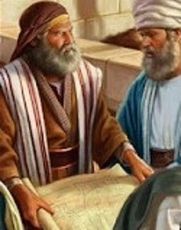
In the Bible, an anointed person is a man or woman chosen by God, through anointing, for a special mission. The anointing was done by pouring or applying a little oil to the head. At the time of Christ’s baptism, this anointing was done through the outpouring of the Holy Spirit: « After being baptized, Jesus immediately came up from the water; and look! the heavens were opened up, and he saw God’s spirit descending like a dove and coming upon him » (Matthew 3:16). Jesus Christ has anointed by the Holy Spirit, made visible by doves. On earth, Jesus was an Anointed One, a Messiah or Christ, a messenger of God.
At the time of Pentecost in the year 33, the first disciples of Christ were anointed with the Holy Spirit in an apparent and audible way with a sound of violent wind and tongues of fire: « Now while the day of the Festival of Pentecost was in progress, they were all together at the same place. 2 Suddenly there was a noise from heaven, just like that of a rushing, stiff breeze, and it filled the whole house where they were sitting. 3 And tongues as if of fire became visible to them and were distributed, and one came to rest on each one of them, 4 and they all became filled with holy spirit and started to speak in different languages, just as the spirit enabled them to speak » (Acts 2:1-4).
An anointed one is a messenger of God. An anointed one is a Holy One, since this word means set apart by God. In the prophecy of Zechariah, chapter 4, there is mention of two anointed ones serving in sacred ministry before God. The context of chapters 3 and 4 allows us to know who they are:
“The angel who had been speaking with me came back and woke me up, as when waking someone from sleep. 2 Then he said to me: “What do you see?”
So I said: “I see, and look! a lampstand entirely of gold, with a bowl on top of it. There are seven lamps on it, yes, seven, and the lamps, which are at the top of it, have seven pipes. 3 And next to it are two olive trees, one on the right of the bowl and one on the left.”
4 Then I asked the angel who was speaking with me: “What do these things mean, my lord?” 5 So the angel who was speaking with me asked: “Do you not know what these things mean?”
I replied: “No, my lord.”
6 He then said to me: “This is the word of Jehovah to Zerubbabel: ‘“Not by a military force, nor by power, but by my spirit,” says Jehovah of armies. 7 Who are you, O great mountain? Before Zerubbabel you will become a level land. And he will bring out the top stone amid shouts of: “How wonderful! How wonderful!”’”
8 The word of Jehovah again came to me, saying: 9 “The hands of Zerubbabel have laid the foundation of this house, and his own hands will finish it. And you will have to know that Jehovah of armies has sent me to you. 10 For who has despised the day of small beginnings? For they will rejoice and see the plumb line in the hand of Zerubbabel. These seven are the eyes of Jehovah, which are roving about in all the earth.”
11 Then I asked him: “What is the meaning of these two olive trees on the right and on the left of the lampstand?” 12 I asked him a second time: “What is the meaning of the two bunches of twigs of the olive trees that are pouring out the golden liquid through the two golden tubes?”
13 So he asked me: “Do you not know what these things mean?”
I replied: “No, my lord.”
14 He said: “These are the two anointed ones who are standing alongside the Lord of the whole earth” (Zechariah chapter 4).
In the historical context of this prophecy, the two anointed ones, symbolized by the two olive trees (verse 3), were Joshua, the high priest, mentioned in chapter 3, and Zerubbabel, the prince of royal lineage, by King David. Chapter 4 is a very encouraging message from God, addressed especially to Zerubbabel.
The first comforting message is this: “Not by a military force, nor by power, but by my spirit,” says Jehovah of armies” (Zechariah 4:6). Indeed, Prince Zerubbabel did not have a powerful army to protect his people as they returned from Babylon to Jerusalem and settled in a ruined city that needed rebuilding. God promised that He would protect him and his people (The historical account of the return and the organization of life in Jerusalem is recorded in Ezra chapters 1-3 and throughout that book, as well as in the historical book of Nehemiah).
The second encouraging message for Zerubbabel is messianic: “Who are you, O great mountain? Before Zerubbabel you will become a level land. And he will bring out the top stone amid shouts of: “How wonderful! How wonderful!” (Zechariah 4:7). God announces to him that his descendants will lead to Christ. This prophecy has been fulfilled according to the genealogical information recorded in Matthew (3:11-16) and Luke (3:23-27).
As a third message of encouragement from God to Prince Zerubbabel, he would lay the foundations of the new temple in Jerusalem and complete its construction: “The word of Jehovah again came to me, saying: 9 “The hands of Zerubbabel have laid the foundation of this house, and his own hands will finish it. And you will have to know that Jehovah of armies has sent me to you. 10 For who has despised the day of small beginnings? For they will rejoice and see the plumb line in the hand of Zerubbabel. These seven are the eyes of Jehovah, which are roving about in all the earth” (Zechariah 4:8-10).
Incidentally, this reconstruction has not been without difficulty, because the inhabitants of Jerusalem sometimes became discouraged and fell into a form of materialism, at the expense of the temple’s construction. This situation is described in the prophecy of Haggai, who encouraged the new inhabitants of Jerusalem to resume the temple’s construction:
“And the word of *Jehovah (YHWH) again came through Haggai the prophet, saying: 4 “Is it the time for you to dwell in your paneled houses, while this house lies in ruins? 5 Now this is what Jehovah of armies says, ‘Set your heart on your ways. 6 You have sown much seed, but you harvest little. You eat, but it is not to satisfaction. You drink, but you do not drink your fill. You put on clothing, but no one gets warm. The one who hires himself out puts his wages in a bag full of holes’”. (…) Go up to the mountain and bring in lumber. And build the house, so that I may take pleasure in it and I may be glorified,’ Jehovah says” (Haggai 1:3-6,8).
In Zechariah chapter 4:11-14, the “two anointed ones” seem to be the same as Apocalypse 11: “I will cause my two witnesses to prophesy for 1,260 days dressed in sackcloth.” These are symbolized by the two olive trees and the two lampstands and are standing before the Lord of the earth » (Revelation (Apocalypse) 11:3,4). Thees two witnesses are Moses and Eliyah (Elijah), who appeared in the vision ot the transfiguration of Christ with him (Mark 9:1-8).
Therefore, these two prophetic visions, that of Zechariah and that of Apocalypse, should not be placed in the same context. They are completely different because Moses was not of royal descent, unlike Zerubbabel, and Elijah was a prophet and not a priest, or of priestly lineage, unlike Joshua.
* YHWH is the tetragrammaton, or four-letter for the Divine Name. In the New World Translation of the Bible, it appears with the vocalization commonly used for centuries as « Jehovah ». This vocalization is doubly inaccurate because it inserts the pronunciation J instead of I (i) or Y, and the V corresponding to W, which is pronounced « U » or « ou » (not V). The correct vocalization of the Tetragrammaton is YeHou(W)aH, Yehouah. The inaccurate vocalization « Jehovah » is retained in the Bible translation used, just as the inaccurate vocalization of « Jesus, » pronounced Yeshua or Yeshoua, because they are the most known to readers (click on the link to examine the study on the Divine Name in more detail: The Divine Name YHWH is pronounced as it is written).
***
The Prophecy of the Book of Zechariah
The prophecy of Zechariah and its prophetic riddles, explanations to know the future…
The Prophecy of Gog of Magog (Ezekiel 38 and 39)
Gog of Magog is a coalition of nations that are currently persecuting God’s people…
The Synopsis of the Study of the Prophecy of Daniel
The study of the Prophecy of Daniel is the analysis of current prophetic events in the Middle East and in the World…
In the question of Matthew 24:3, there are three important words that allow us to understand its meaning and the answer of Christ…
The Greek word translated as « presence, » mentioned in Matthew (24:3), is “πάρειμι”, “parousia” (Strong’s Concordance (G3952))…
The biblical account shows that the investiture of a king at the head of a kingdom occurs in two stages…
The verse 29, describes the signs before the « coming, » not the « presence, » of the Son of Man…
***
Reading the Bible daily, this table of contents contains informative Bible articles (Please click on the link above to view it)…
Table of languages of more than seventy languages, with six important biblical articles, written in each of these languages…
***