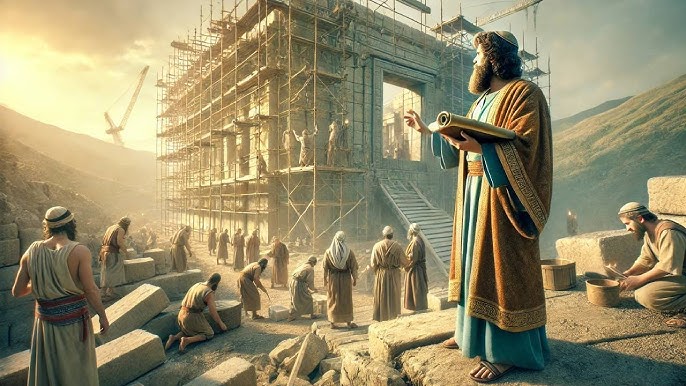
« This is what Jehovah of armies says, ‘In those days ten men out of all the languages of the nations will take hold, yes, they will take firm hold of the robe of a Jew, saying: “We want to go with you, for we have heard that God is with you people”’ »
(Zechariah 8:23)
The context of this prophetic statement shows that God will be with his people to protect them:
“This is what Jehovah says, ‘I will return to Zion and reside in Jerusalem; and Jerusalem will be called the city of truth, and the mountain of Jehovah of armies, the holy mountain. (…) This is what Jehovah of armies says, ‘Although it may seem too difficult to the remaining ones of this people in those days, should it seem too difficult also to me?’ declares Jehovah of armies. (…) And I will bring them in, and they will reside in Jerusalem; and they will become my people, and I will become their God in truth and in righteousness.’”
9 “This is what Jehovah of armies says, ‘Let your hands be strong, you who now hear these words from the mouth of the prophets, the same words that were spoken on the day the foundation of the house of Jehovah of armies was laid for the temple to be built. 10 For before that time, there were no wages being paid either for man or for beast; and it was not safe to come and go because of the adversary, for I turned all men one against another.’
11 “‘But now I will not deal with the remaining ones of this people as in the former days,’ declares Jehovah of armies. 12 ‘For the seed of peace will be sown; the vine will produce its fruit and the earth its yield, and the heavens will give their dew; and I will cause the remaining ones of this people to inherit all these things. 13 And just as you became an object of cursing among the nations, O house of Judah and house of Israel, so I will save you, and you will become a blessing. Do not be afraid! Let your hands be strong.’
14 “For this is what Jehovah of armies says, ‘“Just as I had determined to bring calamity on you because your forefathers made me indignant,” says Jehovah of armies, “and I felt no regret, 15 so at this time I have determined to do good to Jerusalem and to the house of Judah. Do not be afraid!”’
16 “‘These are the things you should do: Speak the truth with one another, and the judgments in your gates must promote truth and peace. 17 Do not scheme calamity against one another in your hearts, and do not love any false oath; for these are all things that I hate,’ declares *Jehovah (YHWH)” (Zechariah 8:3,6,8-17).
* YHWH is the tetragrammaton, or four-letter for the Divine Name. In the New World Translation of the Bible, it appears with the vocalization commonly used for centuries as « Jehovah ». This vocalization is doubly inaccurate because it inserts the pronunciation J instead of I (i) or Y, and the V corresponding to W, which is pronounced « U » or « ou » (not V). The correct vocalization of the Tetragrammaton is YeHou(W)aH, Yehouah. The inaccurate vocalization « Jehovah » is retained in the Bible translation used, just as the inaccurate vocalization of « Jesus, » pronounced Yeshua or Yeshoua, because they are the most known to readers (click on the link to examine the study on the Divine Name in more detail: The Divine Name YHWH is pronounced as it is written).
These words of encouragement were addressed to the Jews who had returned from Babylon to Jerusalem, a city in complete ruins and a temple in need of complete rebuilding. Through prophets such as Zechariah and Haggai, God reassured them, promising his protection. Furthermore, Zerubbabel, Yeshua, Ezra, and Nehemiah played a pivotal role in the reconstruction of the city, the temple, and the government administration of Israel, the tribe of Judah, and Jerusalem. The passage in Zechariah 8:23 is situated within this historical context:
“This is what Jehovah of armies says, ‘In those days ten men out of all the languages of the nations will take hold, yes, they will take firm hold of the robe of a Jew, saying: “We want to go with you, for we have heard that God is with you people”’”(Zechariah 8:23).
Jesus Christ explained how this prophecy would be fulfilled on a worldwide scale, especially when preaching to a Samaritan woman:
« You worship what you do not know; we worship what we know, because salvation begins with the Jews » (John 4:22). Jesus Christ explained to the Samaritan woman that his Father has used his special relationship with Israel to plan the everlasting salvation of all mankind. Abraham, Isaac, and Jacob are the founders of this nation (Matthew 8:11).
The man Jesus Christ, a Jew, is the Main Offspring of Abraham, through him the nations will be blessed (Galatians 3:16). Even though, this special relationship has ceased with Israel, God continues to love the Jewish people, like all the nations, which He created because He is not partial: “At this Peter began to speak, and he said: “Now I truly understand that God is not partial, but in every nation the man who fears him and does what is right is acceptable to him » (Acts 10:34,35; 17:26).
Nevertheless, Zechariah’s prophecy shows that Jehovah will make an everlasting mention of Zion, Jerusalem, Judah and Israel, among all nations: « “Shout for joy, O daughter of Zion; for I am coming, and I will reside in your midst,” declares Jehovah. “Many nations will join themselves to Jehovah in that day, and they will become my people; and I will reside in your midst.” And you will have to know that Jehovah of armies has sent me to you. Jehovah will take possession of Judah as his portion on the holy ground, and he will again choose Jerusalem. 13 Be silent, all flesh, before Jehovah, for he is taking action from his holy dwelling » (Zechariah 2:10-13; chapter 8; Ezekiel 40-48).
However, his nation is now spiritual, it is « the Israel of God »: « Peace and mercy be upon them, yes, upon the Israel of God » (Galatians 6:16). The Kingdom of God, the bride of Christ, the « New Jerusalem », will rule the earth: « I also saw the holy city, New Jerusalem, coming down out of heaven from God and prepared as a bride adorned for her husband. With that I heard a loud voice from the throne say: “Look! The tent of God is with mankind, and he will reside with them, and they will be his people. And God himself will be with them. And he will wipe out every tear from their eyes, and death will be no more, neither will mourning nor outcry nor pain be anymore. The former things have passed away” » (Revelation 21:2-4).
According to the prophecy of Zechariah , the present-day Jerusalem will be destroyed by an earthquake during the great tribulation (Zechariah 14:3-5). Jesus Christ repeated this important information, in Matthew 24:2: « In response he said to them: “Do you not see all these things? Truly I say to you, by no means will a stone be left here upon a stone and not be thrown down””.
The Kingdom of God on earth will rule the « twelve tribes of Israel », that is to say, the great crowd which will come out of the great tribulation and the earthly resurrected ones: « Jesus said to them: “Truly I say to you, in the re-creation, when the Son of man sits down on his glorious throne, you who have followed me will sit on 12 thrones, judging the 12 tribes of Israel » (Matthew 19:28; John 5:28,29; Revelation 7:9-17).
***
« And I have other sheep, which are not of this fold; those also I must bring, and they will listen to my voice, and they will become one flock, one shepherd »
(John 10:16)
As we carefully read John 10: 1-16, we notice that the central theme is the identification of the Messiah as a true shepherd for his disciples, the sheep.
In John 10: 1 and John 10: 16, it is written: « Most truly I say to you, He that does not enter into the sheepfold through the door but climbs up some other place, that one is a thief and a plunderer. (…) And I have other sheep, which are not of this fold; those also I must bring, and they will listen to my voice, and they will become one flock, one shepherd ». This « sheepfold » represents the territory where Jesus Christ preached, the Nation of Israel, in the context of the Mosaic law: « These twelve Jesus sent forth, giving them these orders: “Do not go off into the road of the nations, and do not enter into a Sa·marʹi·tan city; but, instead, go continually to the lost sheep of the house of Israel » (Matthew 10:5,6). « In answer he said: “I was not sent forth to any but to the lost sheep of the house of Israel” » (Matthew 15:24). This sheepfold is also the « house of Israel ».
In John (10:1-6), it is written that Jesus Christ presented himself at the gate of the sheepfold: « “Most truly I say to you, the one who does not enter into the sheepfold through the door but climbs in by another way, that one is a thief and a plunderer. 2 But the one who enters through the door is the shepherd of the sheep. 3 The doorkeeper opens to this one, and the sheep listen to his voice. He calls his own sheep by name and leads them out. 4 When he has brought all his own out, he goes ahead of them, and the sheep follow him, because they know his voice. 5 They will by no means follow a stranger but will flee from him, because they do not know the voice of strangers.” 6 Jesus spoke this comparison to them, but they did not understand what he was saying to them » (John 10:1-6).
In John 10:1-6, Jesus Christ presented himself before the gate of the sheepfold. This happened at the time of his baptism. The « doorkeeper » was John the Baptist (Matthew 3:13). By baptizing him, he became the Christ. John the Baptist opened the door for him and testified that Jesus is the Christ and the Lamb of God: « See, the Lamb of God that takes away the sin of the world! » (John 1:29-36).
In John 10:7-15, while remaining on the same Messianic theme, Jesus Christ uses another illustration by designating himself as the « door »: « So Jesus said again: “Most truly I say to you, I am the door for the sheep. 8 All those who have come in place of me are thieves and plunderers; but the sheep have not listened to them. 9 I am the door; whoever enters through me will be saved, and that one will go in and out and find pasturage. 10 The thief does not come unless it is to steal and slay and destroy. I have come that they may have life and have it in abundance. 11 I am the fine shepherd; the fine shepherd surrenders his life in behalf of the sheep. 12 The hired man, who is not a shepherd and to whom the sheep do not belong, sees the wolf coming and abandons the sheep and flees—and the wolf snatches them and scatters them— 13 because he is a hired man and does not care for the sheep. 14 I am the fine shepherd. I know my sheep and my sheep know me, 15 just as the Father knows me and I know the Father; and I surrender my life in behalf of the sheep » (John 10:7-15).
Jesus Christ uses a different metaphor by referring to himself as the door and later as the only way to everlasting life: “Jesus said to him: “I am the way and the truth and the life. No one comes to the Father except through me’” (John 14:6).
From verse 9 onward, in the same passage (the illustration changes once again), he refers to himself as the shepherd who tends his sheep, leading them « in and out » to find for them pasturage. The teaching is centered both on him and on how he cares for his sheep. Jesus Christ is the excellent shepherd who will lay down his life for his disciples and who loves his sheep (unlike the hired man (who is not a shepherd), who will not risk his life for sheep that do not belong to him).
Once again, the central point of Christ’s teaching is Himself as the shepherd who will sacrifice Himself for His sheep. He prophetically announces, at the time of his declaration, that He will lay down his life for his sheep, because his Father has given them to Him. He sacrificed his life for them so that they might obtain everlasting life: “Just as the Son of man came, not to be ministered to, but to minister and to give his life as a ransom in exchange for many” (Matthew 20:28; John 3:16, 36; 17:3). The main theme remains Jesus Christ as Messiah, as shepherd (John 10:1-6), and as the gate and the shepherd who actively cares for his sheep (John 10:7-15).
In John (10:16-18), he announces that his flock of sheep, at the time of his pronouncements, will increase considerably: « And I have other sheep, which are not of this fold; those too I must bring in, and they will listen to my voice, and they will become one flock, one shepherd. 17 This is why the Father loves me, because I surrender my life, so that I may receive it again. 18 No man takes it away from me, but I surrender it of my own initiative. I have authority to surrender it, and I have authority to receive it again. This commandment I received from my Father » (John 10:16-18).
Reading these verses, according to the context, Jesus Christ announces a revolutionary idea at that time: he would sacrifice his life not only for his Jewish disciples (in the sheepfold), but also in favor of other disciples who would not be part of this sheepfold of Israel. The proof is, the last command which he gave to his disciples, regarding the preaching, is this: « You will be witnesses of me both in Jerusalem and in all Judea and Samaria and to the most distant part of the earth » (Acts 1:8). It is precisely during the baptism of Cornelius that the words of Christ in John 10:16 began to be realized (See the narrative of Acts chapter 10).
Thus, the « other sheep » of John 10:16 apply to non-Jewish Christians in the flesh. In John 10:16-18 it is described the unity in the obedience of the sheep to the Shepherd Jesus Christ. He also spoke of all of his disciples in his day as a « little flock »: « Have no fear, little flock, because your Father has approved of giving you the kingdom » (Luke 12:32). Some use this biblical quote of Luke (12:32), to contrast the group of 144,000 of the Book of Apocalypse, as being the little flock, with the great crowd mentioned in the same book, this time referring to them as the other sheep of John (10:16) (Apocalypse chapter 7). Does such an interpretation respect the historical context of Christ’s statements? It does not.
By Pentecost in 33 C.E., the disciples of Christ, numbered only 120 (Acts 1:15). In the remainder of the Acts narrative, we read that their number was a few thousand (Acts 2:41 (3,000 souls); Acts 4:4 (5,000)). Be that as it may, the new Christians, whether in the time of Christ, as in that of the apostles, represented a « little flock », comparing with the whole population of the nation of Israel and then to the other nations of that time.
« Of all nations and tribes and peoples and tongues«
(Apocalypse 7:9)
The above quote, concerning the great crowd, does not mean that it represents alone, the other sheep (John 10:16). As a reminder, the other sheep in the time of Christ and the apostles represent Christ’s disciples, not Israelites by birth, from other nations. Therefore, among the other sheep, there will be disciples who are part of the 144,000, members of the great crowd, and those resurrected (Revelation 7; 14:1-5 and chapter 20).
The text above draws attention to three expressions that illustrate unity or harmony within the diversity of nations, tribes, peoples, and tongues. The Heavenly Father and His Son, through His Kingdom, will unite the different peoples, taking into account their cultural (nations with different tongues), tribal (tribes), and racial (peoples) differences. There will be a harmony which purpose will be to unify in diversity, particularly through the worship of God: « For then I will change the language of the peoples to a pure language, So that all of them may call on the name of Jehovah, To serve him shoulder to shoulder » (Zephaniah 3: 9)). There will be nations without nationalism and patriotism, tribes without tribalism and races diversities without racism and a worlwide unity in cultural diversities, without standardized globalism. Thus, the evils of patriotism and globalism, which are currently causing wars, famines and diseases, will disappear forever. There will be lovely unity in lovely diversities, willed and created by God (Acts 17:26).
We must be united as Jesus Christ asked his Father
« I make request, not concerning these only, but also concerning those putting faith in me through their word, so that they may all be one, just as you, Father, are in union with me and I am in union with you, that they also may be in union with us, so that the world may believe that you sent me » (John 17:20,21).
***
The Prophecy of the Book of Zechariah
The prophecy of Zechariah and its prophetic riddles, explanations to know the future…
The Prophecy of Gog of Magog (Ezekiel 38 and 39)
Gog of Magog is a coalition of nations that are currently persecuting God’s people…
The Synopsis of the Study of the Prophecy of Daniel
The study of the Prophecy of Daniel is the analysis of current prophetic events in the Middle East and in the World…
In the question of Matthew 24:3, there are three important words that allow us to understand its meaning and the answer of Christ…
The Greek word translated as « presence, » mentioned in Matthew (24:3), is “πάρειμι”, “parousia” (Strong’s Concordance (G3952))…
The biblical account shows that the investiture of a king at the head of a kingdom occurs in two stages…
The verse 29, describes the signs before the « coming, » not the « presence, » of the Son of Man…
The Commemoration of the Death of Jesus Christ (Luke 22:19)
Keep doing this in remembrance of me (Luke 22:19). How to celebrate the memorial of the death of Jesus Christ…
The Earthly Resurrection of the Righteous – They Will Not Be Judged (John 5:28, 29)
The righteous resurrected will not be judged or scrutinized, but will obtain a resurrection of everlasting life…
The Earthly Resurrection of the Unrighteous – They Will Be Judged (John 5:28, 29)
The unrighteous resurrected will be judged or scrutinized before possibly obtaining everlasting life…
The Heavenly Resurrection of the 144,000 (Apocalypse 14:1-3)
Many will live in paradise, but few will go to heaven, in the presence of God and of His Son Jesus Christ…
The Book of Apocalypse – The Great Crowd Coming from the Great Tribulation (Apocalypse 7:9-17)
The Great Crowd of Revelation (7:9-17) will be the size of the greatness of God’s mercy…
***
Reading the Bible daily, this table of contents contains informative Bible articles (Please click on the link above to view it)…
Table of languages of more than seventy languages, with six important biblical articles, written in each of these languages…
***