“So the angel of *Jehovah (YHWH) said: ‘O Jehovah of armies, how long will you withhold your mercy from Jerusalem and the cities of Judah, with whom you have been indignant these 70 years?’’
(Zechariah 1:12)
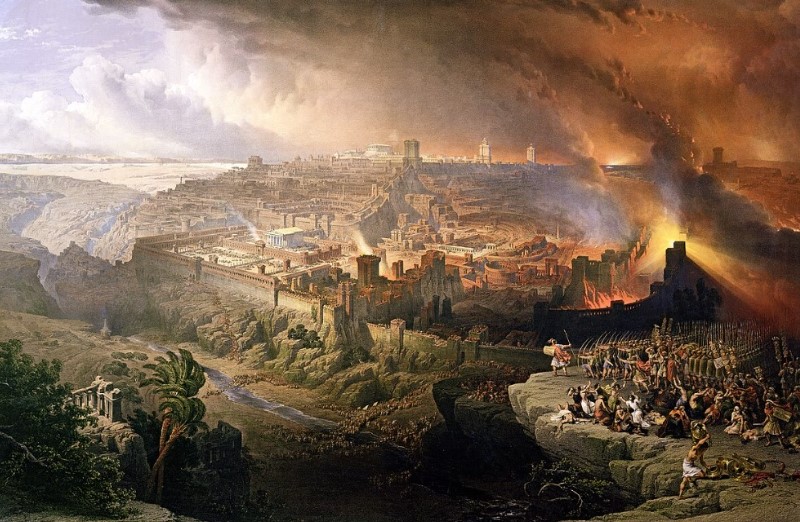
It is important to remember that understanding the historical context allows for a better grasp of the prophetic enigmas in the Book of Zechariah (you can consult the page dedicated to the study of this context by clicking on the following link: The Historical Context of Zechariah’s Prophecy).
In 1513 BCE, God made a covenant with Israel, through Moses, the mediator (Deuteronomy 4:23). From reading the historical biblical books of the Judges, up to 2 Chronicles, it is evident that the 10 tribes of Israel (after the split), and the tribes of Benjamin and Judah, represented by Jerusalem, did not keep this covenant (Zechariah 1:2-6):
“So the angel of Jehovah said: “O Jehovah of armies, how long will you withhold your mercy from Jerusalem and the cities of Judah, with whom you have been indignant these 70 years?”
13 Jehovah answered the angel who was speaking with me, with kind and comforting words. 14 Then the angel who was speaking with me told me: “Call out, ‘This is what Jehovah of armies says: “I am zealous for Jerusalem and for Zion with a great zeal. 15 With great indignation I am indignant with the nations that are at ease, because I felt indignant to a small extent, but they added to the calamity.”’
16 “Therefore this is what Jehovah says: ‘“I will return to Jerusalem with mercy, and my own house will be built in her,” declares Jehovah of armies, “and a measuring line will be stretched out over Jerusalem.”’
17 “Call out once more and say, ‘This is what Jehovah of armies says: “My cities will again overflow with goodness; and Jehovah will again comfort Zion and again choose Jerusalem’”” (Zechariah 1:12-17).
To the point, that God, in the prophecy of Ezekiel 23, compared them with two prostitutes: Oholah (Samaria) and Oholibah (Jerusalem) (The entire biblical book of Hosea (Oshea), is a similar description of the Israel’s marital infidelity towards its owner and husband, God). In this chapter, He vividly describes the infidelities of these two nations.
Therefore, God would use their respective « lovers » to punish them severely: Assyria would destroy Samaria and deport its inhabitants (Oholah). Babylon would do the same with Judah and Jerusalem (Oholibah): they would be destroyed and its inhabitants deported to Babylon for seventy years (Jeremiah 25:11,12). Although coming from the Levant (east), the Babylonian armies are described as coming from the north, which is the easiest route to attack Israel (for Assyria) and Judah (Jerusalem) (Zechariah 2:6; 6: 6.8 (Babylon); 10:8-12 (Assyria)).
God endured the unfaithfulness of the people of Israel (the 10 tribes of Israel, Judah, and Jerusalem) for several centuries. This patience is illustrated in the prophecy of the Book of Hosea. The prophet Hosea played the role of God by marrying his wife Gomer, who represented the nation of Israel:
“The word of Jehovah that came to Hosea the son of Beeri in the days of Uzziah, Jotham, Ahaz, and Hezekiah, kings of Judah, and in the days of Jeroboam son of Joash, the king of Israel. 2 When Jehovah started to speak his word through Hosea, Jehovah said to Hosea: “Go, marry a woman of prostitution and have children of prostitution, because by prostitution the land has turned completely away from following Jehovah.” So he went and married Gomer the daughter of Diblaim, and she conceived and bore him a son” (Hosea 1:1-3).
In chapter 3 of the same book, God asks Hosea to take back his wife who is returning home (it seems), after having committed an act of infidelity:
“Then Jehovah said to me: “Go once again, love the woman who is loved by another man and is committing adultery, just as Jehovah loves the people of Israel while they turn to other gods and love raisin cakes.” So I purchased her for myself for 15 silver pieces and a homer measure and a half of barley. Then I said to her: “You will remain mine for many days. You must not commit prostitution, and you must not have relations with another man, and I will behave the same way toward you”” (Hosea 3:1-3).
The aim was to illustrate God’s patience with the 10 tribes of Israel, Judah and Jerusalem, over several centuries…
The enigma of the myrtles illustrates the desperate situation in which Judah and Jerusalem find themselves: in an abyss comparable to final death. The prophecy of Ezekiel chapter 37 regarding the valley-plain covered with human bones, is another description of the plight of Judah and Jerusalem. However, this prophecy announces the general resurrection of Israel, Judah and Jerusalem, as a nation (Zechariah 9:11-17; 10:8-12).
So, given this information, we better understand the meaning of Jehovah’s response in Zechariah 1:13-17: “Jehovah answered the angel who was speaking with me, with kind and comforting words. Then the angel who was speaking with me told me: “Call out, ‘This is what Jehovah of armies says: “I am zealous for Jerusalem and for Zion with a great zeal. With great indignation I am indignant with the nations that are at ease, because I felt indignant to a small extent, but they added to the calamity.”’ “Therefore this is what Jehovah says: ‘“I will return to Jerusalem with mercy, and my own house will be built in her,” declares Jehovah of armies, “and a measuring line will be stretched out over Jerusalem.”’ “Call out once more and say, ‘This is what Jehovah of armies says: “My cities will again overflow with goodness; and Jehovah will again comfort Zion and again choose Jerusalem ».
While Jehovah applied an extremely painful discipline, the rest of the prophetic account will show how Jehovah God will exercise mercy on His people. Jehovah God announces that He will ask the nations which have caused devastation to his people Judah, Israel and Jerusalem, to render an account for themselves before Him.
The lesson of this study is that we must honor our commitment to God and his Son Jesus Christ, made at our Christian baptism, a commitment comparable to that of betrothal and marriage (Matthew 28:19). The entire Christian congregation represents the (spiritual) Israel of God: « Peace and mercy be upon them, yes, upon the Israel of God » (Galatians 6:16).
Today, infidelity to God and his Son is love for the world. It is love for money, riches, and pleasures, rather than love for God and his Son Jesus Christ:
“No one can slave for two masters; for either he will hate the one and love the other, or he will stick to the one and despise the other. You cannot slave for God and for Riches” (Matthew 6:24).
“Do not love either the world or the things in the world. If anyone loves the world, the love of the Father is not in him; 16 because everything in the world—the desire of the flesh and the desire of the eyes and the showy display of one’s means of life—does not originate with the Father, but originates with the world. 17 Furthermore, the world is passing away and so is its desire, but the one who does the will of God remains forever” (1 John 2:15-17).
“Adulteresses, do you not know that friendship with the world is enmity with God? Whoever, therefore, wants to be a friend of the world is making himself an enemy of God” (James 4:4).
* YHWH is the tetragrammaton, or four-letter for the Divine Name. In the New World Translation of the Bible, it appears with the vocalization commonly used for centuries as « Jehovah ». This vocalization is doubly inaccurate because it inserts the pronunciation J instead of I (i) or Y, and the V corresponding to W, which is pronounced « U » or « ou » (not V). The correct vocalization of the Tetragrammaton is YeHou(W)aH, Yehouah. The inaccurate vocalization « Jehovah » is retained in the Bible translation used, just as the inaccurate vocalization of « Jesus, » pronounced Yeshua or Yeshoua, because they are the most known to readers (click on the link to examine the study on the Divine Name in more detail: The Divine Name YHWH is pronounced as it is written).
***
The Prophecy of the Book of Zechariah
The prophecy of Zechariah and its prophetic riddles, explanations to know the future…
The Prophecy of Gog of Magog (Ezekiel 38 and 39)
Gog of Magog is a coalition of nations that are currently persecuting God’s people…
The Synopsis of the Study of the Prophecy of Daniel
The study of the Prophecy of Daniel is the analysis of current prophetic events in the Middle East and in the World…
In the question of Matthew 24:3, there are three important words that allow us to understand its meaning and the answer of Christ…
The Greek word translated as « presence, » mentioned in Matthew (24:3), is “πάρειμι”, “parousia” (Strong’s Concordance (G3952))…
The biblical account shows that the investiture of a king at the head of a kingdom occurs in two stages…
The verse 29, describes the signs before the « coming, » not the « presence, » of the Son of Man…
***
Reading the Bible daily, this table of contents contains informative Bible articles (Please click on the link above to view it)…
Table of languages of more than seventy languages, with six important biblical articles, written in each of these languages…
***