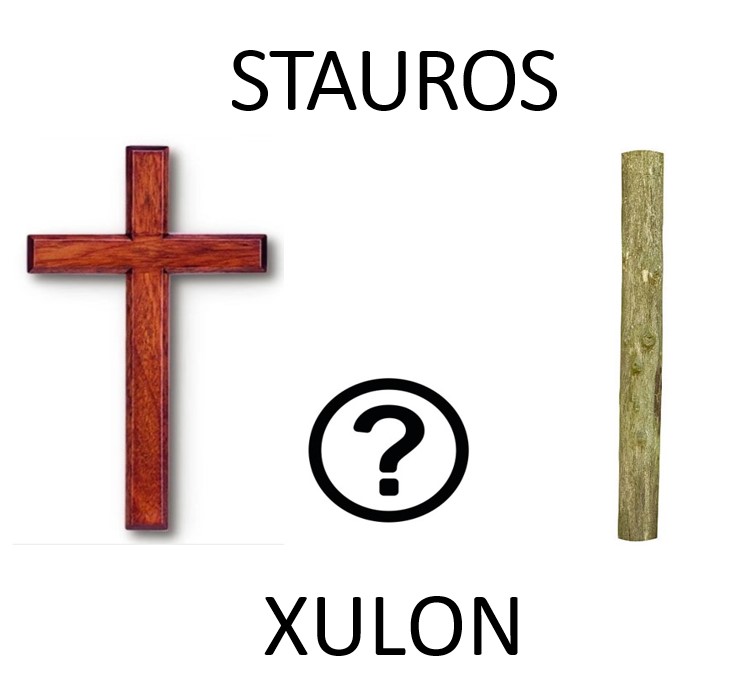
Most Bible translations state that Jesus Christ died on a cross, whereas one translation—the « New World Translation »—offers the highly unusual claim that Jesus Christ died nailed to a torture stake. There is a way to determine the accurate information on this matter.
In itself—fundamentally speaking—the question of whether it was a cross or an execution stake seems quite secondary; what matters is the sacrifice itself—Jesus Christ’s sinless human life—which makes eternal life possible: « For God loved the world so much that he gave his only-begotten Son, so that everyone exercising faith in him might not be destroyed but have everlasting life » (John 3:16).
Nevertheless, this question remains very important because the cross—as the (supposed) instrument of Jesus Christ’s death—has been instrumentalized to such an extent that it has given rise to idolatrous practices within Christendom. For example, in many Orthodox and Catholic churches, the body of Christ is displayed nailed to a cross. These representations are objects of veneration and worship. Orthodox and Catholic Christians make the Sign of the Cross when they pray. Many Orthodox, Catholic, and other Christian believers wear a cross around their necks. Protestant and Evangelical churches display crosses as symbols of Christianity and of faith in Christ’s sacrifice.
However, the fact remains: if one relies exclusively on the Bible (« Sola Scriptura »), neither the Gospel narratives nor the letters of the apostles contain any passage encouraging the veneration of the cross—or even the creation of a representation of it, however simple, as a symbol of Christianity or of Christ’s sacrifice.
It is worth recalling what Jesus Christ said to the Samaritan woman regarding how to worship the Heavenly Father: « Nevertheless, the hour is coming, and it is now, when the true worshippers will worship the Father with spirit and truth, for indeed, the Father is looking for ones like these to worship him. 24 God is a Spirit, and those worshipping him must worship with spirit and truth » (John 4:23,24). Consequently, true worshipers must not practice idolatry—let alone use the cross as an object of veneration—to demonstrate their faith in Christ’s sacrifice. Such a demonstration of faith in Christ’s sacrifice must take place « with spirit and truth » (and not through an intermediary object, such as the cross).
***
The « stauros » is a post
The English translation of the word « cross » (« crux » in Latin)—found in almost all Bible translations—derives from the Greek word « stauros » (Strong’s Concordance, G4716). Strong’s Concordance acknowledges that the primary meaning of « stauros » is a stake or a post (as set upright). It further explains that the word subsequently acquired the meaning of a cross as an instrument of capital punishment. We will examine whether such a shift in the meaning of « stauros »—from post to cross—is justified.
In Classical Greek, the word « stauros » signifies an upright stake, specifically a pointed one (Homer, Herodotus, Thucydides, Xenophon).
In Koine Greek, the word « stauros » denotes a simple, straight piece of wood set upright, without a crossbar.
A semantic and religious evolution took place; with the New Testament and the spread of Christianity, the term came to designate the instrument of Jesus Christ’s execution and was generally translated as « cross » in modern languages and mainstream Christian traditions.
The « xulon » is a post
To determine whether or not this semantic shift is justified, we will examine the meaning of another word used in the New Testament as a synonym for *stauros*: the Greek word « xulon » (ξύλον) (Strong’s Concordance, G3586).
The Greek word “xulon” can have several meanings:
1. wood (as fuel or material).
2. (by extension) a tree.
3. (by implication) a stick, staff or tree or other wooden article or substance.
It should be noted that, in this specific instance, the word « xulon » does not mean « cross, » but rather refers to a vertical piece of wood used in the New Testament as a synonym for the Greek word « stauros » (the word « stauros » appears in Matthew 27:32, 40, 42; Mark 15:21, 30, 32; Luke 23:26; and John 19:19, 25, 31, in the context of Christ’s death). Naturally, the word « stauros » found in the Greek text of the Gospels is translated as « cross » in virtually all Bible translations.
Let us examine other New Testament quotes that specifically refer to the moment of Jesus Christ’s sacrificial death, where the synonym for « stauros »—namely, the Greek word « xulon »—is used. For this purpose, we will cite passages containing the word « xulon » from translations other than the « New World Translation:
» The God of our ancestors raised Jesus to life after you killed him by hanging him on a tree » (Acts 5:30 – International Standard Version (ISV)).
« The God of our fathers raised up Jesus, whom ye slew and hanged on a tree » (Acts 5:30 – King James Version).
« We ourselves are witnesses of everything He did in both the Judean country and in Jerusalem, yet they killed Him by hanging Him on a tree » (Acts 10:39 – Holman Christian Standard Bible).
» And we are witnesses of all that he did both in the country of the Jews and in Jerusalem. They put him to death by hanging him on a tree » (Acts 10:39 – English Standard Version Anglicised).
« And when they had fulfilled all things that were written of him, taking him down from the tree, they laid him in a sepulchre » (Acts 13:29 – Douay-Rheims 1899 American Edition).
« When they had fulfilled all that had been written about Him, they took Him down from the tree and put Him in a tomb » (Acts 13:29 – Holman Christian Standard Bible).
« Christ paid the price to free us from the curse that the laws in Moses’ Teachings bring by becoming cursed instead of us. Scripture says, “Everyone who is hung on a tree is cursed »” (Galatians 3:13 – Names of God Bible).
« Christ ransomed us from the curse of the law by becoming a curse for us, for it is written, “Cursed be everyone who hangs on a tree » (Galatians 3:13 – New American Bible (Revised Edition)).
« He himself bore our sins in his body on the tree, that we may cease from sinning and live for righteousness. By his wounds you were healed » (1 Peter 2:24 – New English Translation).
« Who Himself bore our sins in His own body on the tree, that we, having died to sins, might live for righteousness—by whose stripes you were healed » (1 Peter 2:24 – New King James Version).
Consequently, given that the Greek word “stauros” is synonymous with “xulon”, there is no reason to translate it as « cross ».
***
Some rely on the historical argument that the Romans systematically used the cross as an instrument of capital punishment. However, the statue depicting the punishment of Marsyas—created by an anonymous artist in Pergamon during the 1st century BCE and currently housed in the Louvre Museum in France—shows the victim’s body nailed to a single upright stake. This demonstrates that the execution stake was indeed used during the Roman Empire.
Furthermore, the Gospel accounts state that Jesus Christ carried the « stauros » (the stake) for a time before Simon of Cyrene has been conscripted to carry it the rest of the way to Golgotha (Matthew 27:32; Mark 15:21; Luke 23:26). While the exact distance between the ancient city of Jerusalem and Golgotha (located outside the city walls) is unknown, traditional estimates place it between around 0.40 Mile. The question arises: if a healthy man can carry a wooden stake roughly two meters long, what about the additional weight of a crossbeam measuring at least 1.5 meters—given that a man’s arm span can easily exceed that width—carried over a distance of at least 0.40 Mile?
Everything suggests that such a feat would be extremely difficult, even for a healthy man. The notion of healthy men—fresh from Roman prisons—walking to their execution site is a highly idealized scenario. Even Jesus Christ, despite the physical fitness of a former carpenter, lacked the strength to carry his « stauros » (execution stake) after a sleepless night, having been brutalized by religious leaders and scourged by the Romans.
***
Consequently, the fact that the « New World Translation » translates the Greek word « stauros » as « torture stake » appears to fully respect the word’s original etymology—in both Classical and Koine Greek—namely, the meaning of a stake used for execution. There is no substantiated reason for translating it as « cross, » given that it is synonymous with another Greek word, « xulon », which simply means a post or a stake.
To those who might suggest that the majority view equates to the truth: this is not necessarily the case. Just because the vast majority of translations render « stauros » as « cross » does not make it accurate. There is a passage in the Bible demonstrating that following the crowd is not always right: « You must not follow after the crowd to do evil, and you must not pervert justice by giving testimony to go along with the crowd » (Exodus 23:2). Truth is based on facts, not on a democratic or popular vote. Truth does not follow after the crowd to pervert justice…
***
Is it appropriate to depict the body of Christ—
crucified or nailed to a stake?
“They nail the Son of God to the stake again for themselves and expose him to public shame”
(Hebrews 6:6)
It is important to understand that, in a biblical and historical context, the depiction of a human body—whether crucified or nailed to a torture stake—was deeply dishonorable for both the victim and their family. The Apostle Paul uses the term « public shame » in reference to the sight of Christ’s body nailed to a torture stake. Therefore, the answer to the question above should not be viewed through the lens of what is commonly seen in churches and cathedrals—namely, numerous depictions of Christ’s crucified body. One must not only understand but also fully grasp that such a depiction is not fitting in the eyes of God—Christ’s Heavenly Father—because the image publicly dishonors the Son by exposing Him to public shame.
When a traffic accident or natural disaster results in fatalities, the victims’ bodies are usually covered with a white sheet to shield them from public view, out of respect for the deceased and their loved ones. In news reports involving fatalities, the bodies are often blurred. Sometimes, when footage might be disturbing, a warning is issued advising sensitive viewers—and children—not to watch the images. All this serves to illustrate that publicly displaying the dead body of an executed person constitutes public disgrace. Thus, it is important to understand that displaying Christ’s body nailed to a cross or execution stake graphically exposes Him to public shame (Hebrews 6:6). Furthermore, it is worth noting that the veneration of the cross predates Christianity.
The origins of the cross symbol
The origin of the cross symbol dates back to antiquity, predating its role as the central emblem of Christianity by thousands of years. Long before it became associated with the crucifixion of Jesus Christ, the cross served as a universal, geometric motif used across numerous prehistoric and pagan civilizations.
Pre-Christian and Ancient Origins
In the ancient world, the cross held various cosmic, spiritual, and environmental meanings:
- Prehistoric Petroglyphs: Cross-shaped engravings appeared as early as the Palaeolithic and Bronze Ages, often used to mark the cardinal points or track the rising and setting of the sun.
- Ancient Egypt: The Ankh (or crux ansata), a looped cross, was used by ancient Egyptians as a sacred symbol representing life, fertility, and the afterlife.
- Mesopotamia and Babylon: A cross shape served as a pagan icon representing the deity Tammuz as early as the 23rd century BC. The Maltese cross variant was also used by Assyrian and Babylonian royalty.
- Greco-Roman Culture: The Tau cross (shaped like the letter ‘T’) was linked to ancient deities like Mithras and Attis. Roman coins from 46 BC even depicted the god Jupiter holding a scepter topped with a cross.
Consequently, a Christian who believed they were doing the right thing by praying to God using a crucifix should cease such a practice and instead worship God in spirit and truth, as Jesus Christ said (John 4:23,24). Furthermore, making the sign of the cross is not necessary for prayer, as such a practice does not exist in the Bible or the New Testament (« Sola Scriptura »). Finally, if you possess crosses or other idolatrous objects, you should dispose of them, just as the Bereans did: « And many of those who had become believers would come and confess and report their practices openly. 19 Indeed, quite a number of those who practiced magical arts brought their books together and burned them up before everybody. And they calculated their value and found them worth 50,000 pieces of silver » (Acts 19:18–19).
Jesus no longer appears as a newborn in a manger, nor as a dying man on a cross or execution stake. Jesus Christ is currently a King in Heaven, majestic and glorious, seated at the right hand of His Father: « No, it was not by following artfully contrived false stories that we made known to you the power and presence of our Lord Jesus Christ, but rather, we were eyewitnesses of his magnificence » (2 Peter 1:16).
***
The Commemoration of the Death of Jesus Christ (Luke 22:19)
Keep doing this in remembrance of me (Luke 22:19). How to celebrate the memorial of the death of Jesus Christ…
How often should be celebrated the Lord’s Evening Meal, or the Memorial of Christ’s death ?
You will know the truth, and the truth will set you free (John 8:32)
***
Table of contents of the http://yomelyah.fr/ website
Reading the Bible daily, this table of contents contains informative Bible articles (Please click on the link above to view it)…
Table of languages of more than seventy languages, with six important biblical articles, written in each of these languages…
***