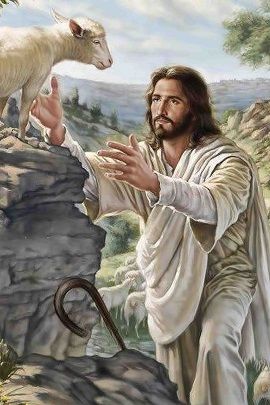
In the pronouncements of Zechariah chapter 10, God denounces the actions of shepherds who feed themselves and mislead the sheep of their flock (a metaphorical expression referring to the nations or religious congregations they are in charge of). At the same time, God announces that He will ensure that the true shepherds prevail over them, with His help:
“Make your requests of Jehovah for rain in the time of the spring rain, even of Jehovah who is making the storm clouds, and [who] gives a downpour of rain to them, to each one vegetation in the field. 2 For the teraphim themselves have spoken what is uncanny; and the practicers of divination, for their part, have visioned falsehood, and valueless dreams are what they keep speaking, and in vain they try to comfort. That is why they will certainly depart like a flock; they will become afflicted, because there is no shepherd” (Zechariah 10:1,2).
Instead of seeking God’s help, as Zerubbabel, Joshua, Ezra, Nehemiah, and the prophets like Zechariah and Haggai did, these shepherds resorted to « teraphim, » magic, and occultism.
In another prophecy, that of Ezekiel, there is a declaration from God denouncing the political and religious shepherds of Israel who were feeding themselves before the exile of the people of Israel to Babylon:
“And the word of Jehovah continued to occur to me, saying: 2 “Son of man, prophesy against the shepherds of Israel. Prophesy, and you must say to them, to the shepherds, ‘This is what the Sovereign Lord Jehovah has said: “Woe to the shepherds of Israel, who have become feeders of themselves! Is it not the flock that the shepherds ought to feed? 3 The fat is what you eat, and with the wool you clothe your own selves. The plump animal is what you slaughter. The flock itself you do not feed. 4 The sickened ones you have not strengthened, and the ailing one you have not healed, and the broken one you have not bandaged, and the dispersed one you have not brought back, and the lost one you have not sought to find, but with harshness you have had them in subjection, even with tyranny. 5 And they were gradually scattered because of there being no shepherd, so that they became food for every wild beast of the field, and they continued to be scattered. 6 My sheep kept straying on all the mountains and on every high hill; and on all the surface of the earth my sheep were scattered, with no one making a search and with no one seeking to find” (Ezekiel 34:1-6).
Nevertheless, as Zechariah’s prophecy states, the day will inevitably come when they will render an account for themselves to God:
“Against the shepherds my anger has grown hot, and against the goatlike leaders I shall hold an accounting; for Jehovah of armies has turned his attention to his drove, the house of Judah, and has made them like his horse of dignity in the battle. 4 Out of him is the keyman, out of him is the supporting ruler, out of him is the battle bow; out of him goes forth every taskmaster, all together. 5 And they must become like mighty men stamping down in the mire of [the] streets in the battle. And they must get engaged in battle, for Jehovah is with them; and the riders of horses will have to experience shame. 6 And I will make the house of Judah superior, and the house of Joseph I shall save. And I will give them a dwelling, for I will show them mercy; and they must become like those whom I had not cast off; for I am Jehovah their God, and I shall answer them. 7 And those of Eʹphra·im must become just like a mighty man, and their heart must rejoice as though from wine. And their own sons will see and certainly rejoice; their heart will be joyful in Jehovah” (Zechariah 10:3-7).
This text shows that it is God who truly cares for his flock by choosing the true shepherds who know how to look after them and who are ready, if necessary, to sacrifice themselves for him because, as the apostle Peter said in prayer centuries later, he knows hearts: “You, O Jehovah, who know the hearts of all, designate which one of these two men you have chosen” (Acts 1:24). Following Zechariah’s prophetic declaration, God promises that he will sow the nations with these true shepherds who will be concerned for the peoples and the congregations under their care:
“I will whistle for them and collect them together; for I shall certainly redeem them, and they must become many, just like those who have become many. 9 And I shall scatter them like seed among the peoples, and in the distant places they will remember me; and they must revive with their sons and return. 10 And I must bring them back from the land of Egypt; and from Assyria I shall collect them together; and to the land of Gilead and Lebanon I shall bring them, and no [room] will be found for them. 11 And he must pass through the sea [with] distress; and in the sea he must strike down [the] waves, and all the depths of the Nile must dry up. And the pride of Assyria must be brought down, and the very scepter of Egypt will depart. 12 And I will make them superior in Jehovah, and in his name they will walk about,’ is the utterance of Jehovah” (Zacharie 10:8-12).
While the world is currently infested with self-serving shepherds, both politically and religiously, who are more concerned with maintaining the organizations on which they feed, rather than the people and the congregations, God promises that he will cause the true shepherds to prevail over these profiteers: » I will whistle for them and collect them together (…) I will make them superior in Jehovah, and in his name they will walk about,’ is the utterance of *Jehovah (YHWH) » (Zechariah 10:8,12).
God will whistle for them to gather the true shepherds, to scatter them throughout the earth, so that they may lovingly care for the peoples and congregations under their care, as mentioned in Isaiah’s prophecy concerning the princes and shepherds on earth: » Look! A king will reign for righteousness itself; and as respects princes, they will rule as princes for justice itself. 2 And each one must prove to be like a hiding place from the wind and a place of concealment from the rainstorm, like streams of water in a waterless country, like the shadow of a heavy crag in an exhausted land » (Isaiah 32:1,2).
* YHWH is the tetragrammaton, or four-letter for the Divine Name. In the New World Translation of the Bible, it appears with the vocalization commonly used for centuries as « Jehovah ». This vocalization is doubly inaccurate because it inserts the pronunciation J instead of I (i) or Y, and the V corresponding to W, which is pronounced « U » or « ou » (not V). The correct vocalization of the Tetragrammaton is YeHou(W)aH, Yehouah. The inaccurate vocalization « Jehovah » is retained in the Bible translation used, just as the inaccurate vocalization of « Jesus, » pronounced Yeshua or Yeshoua, because they are the most known to readers (click on the link to examine the study on the Divine Name in more detail: The Divine Name YHWH is pronounced as it is written).
« And I saw that the round lid of lead was lifted up, and there was a woman sitting inside the container. 8 So he said: “This is Wickedness.” Then he threw her back into the ephah container, after which he thrust the lead weight over its mouth »
(Zechariah 5:7,8)
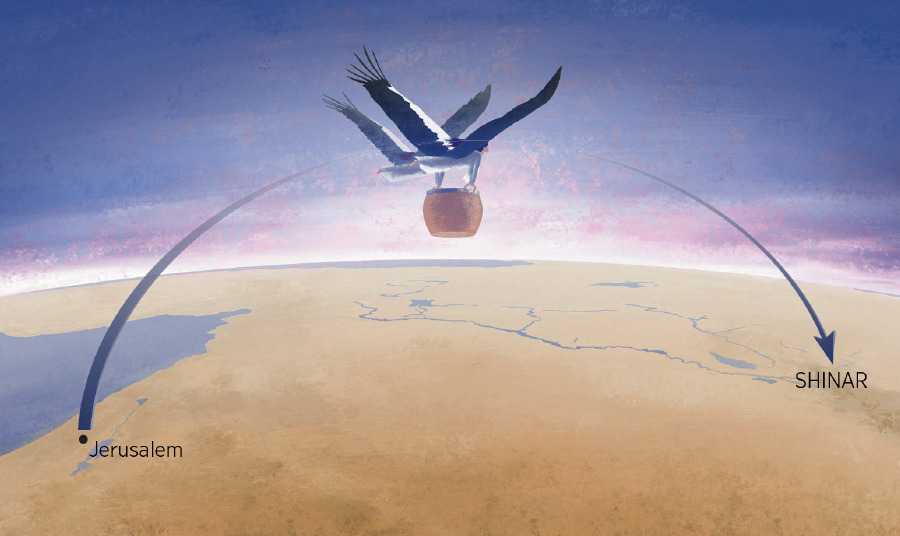
The ephah is a unit of measurement for quantifying flour or cereals. Obviously, in the enigma, the woman is inside the container made to measure the quantity of flour, with a lead cover on her, in order to be sent directly to Shinar, in Babylon. And it seems, so that she does not come back, they build a house for her, so that she stays there:
“Then the angel who was speaking with me came forward and said to me: “Look up, please, and see what is going out.”
6 So I asked: “What is it?”
He replied: “This is the eʹphah container that is going out.” He continued: “This is their appearance in all the earth.” 7 And I saw that the round lid of lead was lifted up, and there was a woman sitting inside the container. 8 So he said: “This is Wickedness.” Then he threw her back into the eʹphah container, after which he thrust the lead weight over its mouth.
9 Then I looked up and saw two women coming forward, and they were soaring in the wind. They had wings like the wings of a stork. And they lifted up the container between the earth and heaven. 10 So I asked the angel who was speaking with me: “Where are they taking the eʹphah container?”
11 He replied: “To the land of Shiʹnar to build her a house; and when it is prepared, she will be deposited there in her proper place”” (Zechariah 5:5-11).
Moreover, this woman is called « wickedness », why?
The symbol of the woman could be explained by the kind of worship, namely to a female deity. This woman could represent this deity, the « Queen of Heaven ». In fact, the Israelites who had fallen into apostasy, made bread for this « Queen of Heaven »: « The sons are gathering wood, the fathers are lighting the fire, and the wives are kneading dough in order to make sacrificial cakes to the Queen of Heaven, and they are pouring out drink offerings to other gods to offend me » (Jeremiah 7:18).
By the time of Israel’s biblical history, before the Babylonian exile, the nation had fallen into apostasy. The woman and the ephah, is the illustration of this situation in making sacrificial cakes for the « Queen of Heaven ». The fact that a lead cover was put on the ephah and the woman was sent to Shinar (the place where Babylon was, the origin of the false worship (Genesis 11)), shows that henceforth, God would no longer tolerate impregnation of true worship, through false Babylonian worship, He would send it to Shinar, to stay there (Zechariah 5:9-11).
The « two women with stork wings », who bring « the woman and the ephah », seem to illustrate this principle written in Revelation 22:11: « He that is doing unrighteousness, let him do unrighteousness still; and let the filthy one be made filthy still; but let the righteous one do righteousness still, and let the holy one be made holy still ». The image could be sarcastic towards this deity, of which female angels in her service, with wings of a stork, an unclean animal, would bring her to where she must be, in Babylon, by building her a house, or a temple to stay there forever (Leviticus 11:19,20).
The current Christian teachers must remove from their teaching, those with Babylonian and Greco-Roman origin, which are the trinity, the immortality of the soul, fiery hell, purgatory, the worship of saints, the worship of the cross and rid Christian congregations of all pagan representations… According to Zechariah’s prophecy, not doing this will be considered an act of « wickedness » (Zechariah 5:8; 10:1-3; 13:1-3): « Therefore, if someone knows how to do what is right and yet does not do it, it is a sin for him » (James 4:17).
Reading Zechariah chapter 4, depicting the high priest Yeshua with dirty clothes, with Satan the devil at his right hand to oppose him, shows that the devil plays a decisive role in the progressive corruption and spiritual deviance that infiltrates Christian congregations:
“And he showed me Joshua the high priest standing before the angel of Jehovah, and Satan was standing at his right hand to resist him. 2 Then the angel of Jehovah said to Satan: “May Jehovah rebuke you, O Satan, yes, may Jehovah, who has chosen Jerusalem, rebuke you! Is not this one a burning log snatched out of the fire?”” (Zechariah 3:1,2).
The angel’s declaration against Satan shows that we, as disciples of Christ, must denounce the devil’s schemes that corrupt the Christian congregation. The apostle Paul, like the angel of God, also denounced the devil’s subtle maneuvers to corrupt the Christian congregation through unscrupulous men: « For such men are false apostles, deceitful workers, disguising themselves as apostles of Christ. And no wonder, for Satan himself keeps disguising himself as an angel of light. It is therefore nothing extraordinary if his ministers also keep disguising themselves as ministers of righteousness. But their end will be according to their works » (2 Corinthians 11:13-15).
The rest of the story shows that clean garments were given to Joshua the high priest and that his sin has been forgiven:
“Now Joshua was clothed in filthy garments and standing before the angel. 4 The angel said to those standing before him, “Remove his filthy garments.” Then he said to him, “See, I have caused your error to pass away from you, and you will be clothed with fine garments”” (Zechariah 3:3,4).
Likewise, spiritually speaking, as disciples of Christ, we must remove the filthy spiritual garments—the Babylonian practices mixed with biblical Christianity—and put on fine spiritual garments using the pure water of God’s word. In this way, God will forgive our past sins through Jesus Christ:
« Husbands, continue loving your wives, just as the Christ also loved the congregation and gave himself up for it, in order that he might sanctify it, cleansing it with the bath of water by means of the word, so that he might present the congregation to himself in its splendor, without a spot or a wrinkle or any of such things, but holy and without blemish » (Ephesians 5:25-27).
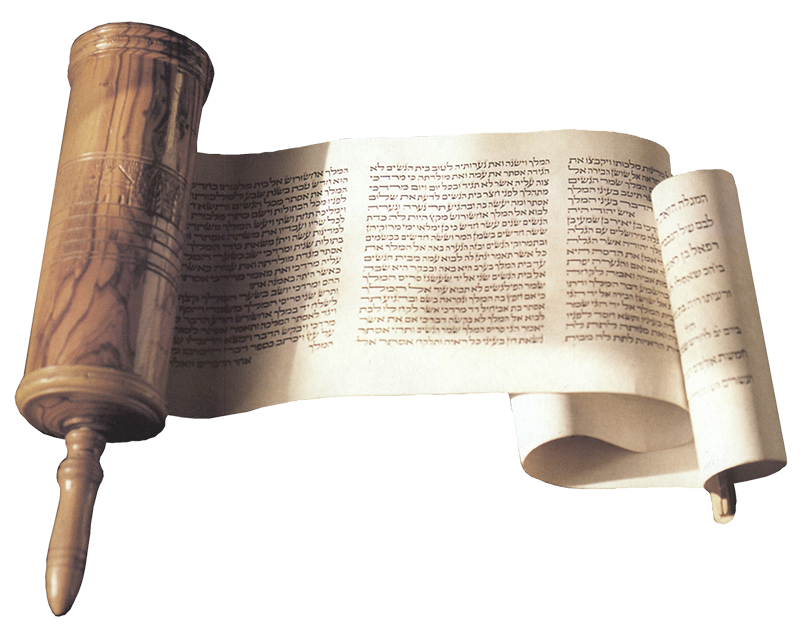
“Again I looked up, and I saw a flying scroll. He asked me: “What do you see?” I replied: “I see a flying scroll, which is 20 cubits long and 10 cubits wide””
(Zechariah 5:1,2)
This flying scroll is a proclamation from God, before the « day of *Jehovah (YHWH) », mentioned in Zechariah chapter 14. It is a worldwide proclamation, for the flying scroll goes among all nations:
“Again I looked up, and I saw a flying scroll. 2 He asked me: “What do you see?”
I replied: “I see a flying scroll, which is 20 cubits long and 10 cubits wide.”
3 Then he said to me: “This is the curse that is going out over the face of all the earth, because everyone who steals, as written on its one side, has gone unpunished; and everyone who makes a sworn oath, as written on its other side, has gone unpunished. 4 ‘I have sent it out,’ declares Jehovah of armies, ‘and it will enter into the house of the thief and into the house of the one who makes a false oath in my name; and it will remain inside that house and consume it and its timbers and its stones’”” (Zechariah 5:1-4).
This is an imprecation, or a message of condemnation from God, over the entire face of the earth. It may be the enigmatic message of condemnation against the « four horns » mentioned in Zechariah chapter 1:
“These are the horns that dispersed Judah to such an extent that no one was able to raise his head. These others will come to terrify them, to cast down the horns of the nations that lifted up their horns against the land of Judah, in order to disperse he” (Zechariah 1:18-21).
These horns represent nations like Assyria, Babylon, Ammon, Moab, and Edom, which caused the ruin of Israel, Judah, and Jerusalem. Nevertheless, this scroll must circulate throughout the entire earth.
In describing the signs of the end of this system of things, Jesus Christ mentioned the preaching of the « good news of the kingdom » as a testimony to all nations: “And this good news of the Kingdom will be preached in all the inhabited earth for a witness to all the nations, and then the end will come” (Matthew 24:14). How can this « good » news of the kingdom turn out, at the same time, to be a « curse » for the current « unpunished thieves » (Zechariah 5:3,4; 12:1-6)?
* YHWH is the tetragrammaton, or four-letter for the Divine Name. In the New World Translation of the Bible, it appears with the vocalization commonly used for centuries as « Jehovah ». This vocalization is doubly inaccurate because it inserts the pronunciation J instead of I (i) or Y, and the V corresponding to W, which is pronounced « U » or « ou » (not V). The correct vocalization of the Tetragrammaton is YeHou(W)aH, Yehouah. The inaccurate vocalization « Jehovah » is retained in the Bible translation used, just as the inaccurate vocalization of « Jesus, » pronounced Yeshua or Yeshoua, because they are the most known to readers (click on the link to examine the study on the Divine Name in more detail: The Divine Name YHWH is pronounced as it is written).
It was Jesus Christ who explained it. Officially, before starting to preach the « good news », Jesus Christ showed for which categories of humans this news would be « good »: « Jehovah’s spirit is upon me, because he anointed me to declare good news to the poor. He sent me to proclaim liberty to the captives and a recovery of sight to the blind, to send the crushed ones away free, to preach Jehovah’s acceptable year. » (Luke 4:18,19). So, this news is « good », for the « poor », the « captives », the « blind », the « crushed ones », that is to say, those who really suffer because of this system of things (compare with Ezekiel 9:4).
Jesus Christ vividly explained why this proclamation is « good » for the poor and a « curse » for others, in the illustration of « the rich man and the beggar Lazarus »:
“There was a rich man who used to dress in purple and linen, enjoying himself day after day with magnificence. 20 But a beggar named Lazʹa·rus used to be put at his gate, covered with ulcers 21 and desiring to be filled with the things dropping from the table of the rich man. Yes, even the dogs would come and lick his ulcers. 22 Now in the course of time, the beggar died and was carried off by the angels to Abraham’s side.
“Also, the rich man died and was buried. 23 And in the Grave he lifted up his eyes, being in torment, and he saw Abraham from afar and Lazʹa·rus by his side. 24 So he called and said, ‘Father Abraham, have mercy on me, and send Lazʹa·rus to dip the tip of his finger in water and cool my tongue, for I am in anguish in this blazing fire.’ 25 But Abraham said, ‘Child, remember that you had your fill of good things in your lifetime, but Lazʹa·rus for his part received bad things. Now, however, he is being comforted here, but you are in anguish. 26 And besides all these things, a great chasm has been fixed between us and you, so that those who want to go over from here to you cannot, neither may people cross over from there to us.’ 27 Then he said, ‘That being so, I ask you, father, to send him to the house of my father, 28 for I have five brothers, in order that he may give them a thorough witness so that they will not also come into this place of torment.’ 29 But Abraham said, ‘They have Moses and the Prophets; let them listen to these.’ 30 Then he said, ‘No, indeed, father Abraham, but if someone from the dead goes to them, they will repent.’ 31 But he said to him, ‘If they do not listen to Moses and the Prophets, neither will they be persuaded if someone rises from the dead” (Luke 16:19-31).
In this allegory, Lazarus the beggar, represents the people at the time of Christ, as sheep without a shepherd: « On seeing the crowds, he felt pity for them, because they were skinned and thrown about like sheep without a shepherd » (Matthew 9:36 ). When Jesus Christ began to preach the good news of the kingdom, he brought about a change of spiritual condition, of the people without a shepherd (Lazarus the beggar), and of the shepherds who did not spiritually feed this people (The rich).
These spiritual changes are symbolized by the respective deaths of the beggar and the rich. Thus, the preaching of Jesus Christ had two opposite effects: the divine blessing and approval for the « poor », the « captives », the « blind », the « crushed ones » and divine curse for the ruling class, then politico-religious (compare Luke 4:18,19 (blessing) and Matthew 23 (curse)).
The apostle Peter and the apostle Paul showed that the good news can become a curse for those who do not obey it:
“For it is the appointed time for the judgment to start with the house of God. Now if it starts first with us, what will the outcome be for those who are not obedient to the good news of God?” (1 Peter 4:17).
“This takes into account that it is righteous on God’s part to repay tribulation to those who make tribulation for you. 7 But you who suffer tribulation will be given relief along with us at the revelation of the Lord Jesus from heaven with his powerful angels 8 in a flaming fire, as he brings vengeance on those who do not know God and those who do not obey the good news about our Lord Jesus. 9 These very ones will undergo the judicial punishment of everlasting destruction from before the Lord and from the glory of his strength, 10 at the time when he comes to be glorified in connection with his holy ones and to be regarded in that day with wonder among all those who exercised faith, because the witness we gave met with faith among you” (2 Thessalonians 1:6-10).
Here is what Jesus Christ declared: “Jesus said to them: ‘If you were blind, you would have no sin. But now you say, ‘We see.’ Your sin remains’” (John 9:41). Indirectly, Jesus Christ explains the double-edged effect of the “good news”: there are people who will not have the opportunity to hear the good news; in this case, it is possible that on the day of judgment, shortly before the great tribulation, they may be considered innocent in the eyes of God and Christ.
On the other hand, for those who hear the good news, people are put in front of their own responsibility before God and his Son Jesus Christ, either to obey or to disobey… This message has two opposite effects, depending on the decision that will be made and Jesus Christ clearly said that there would be no escape: « Whoever is not on my side is against me, and whoever does not gather with me scatters » (Matthew 12:30).
The curse of the good news (for those who do not obey) on Satan’s system is symbolized by the plagues of the seven trumpets and the seven bowls in the book of Revelation (Apocalypse (Revelation) 8:7 to 15:8 (the plagues of the seven trumpets); Apocalypse 16:1 at 22:21 (the end) (the plagues of the seven bowls)). By means of the proclamation of the good news, « the woman and the ephah » are sent to Shinar (Babylon) (Zechariah 5:6-8).
“These are the two anointed ones who are standing alongside the Lord of the whole earth”
(Zechariah 4:14)
In the Bible, an anointed person is a man or woman chosen by God, through anointing, for a special mission. The anointing was done by pouring or applying a little oil to the head. At the time of Christ’s baptism, this anointing was done through the outpouring of the Holy Spirit: « After being baptized, Jesus immediately came up from the water; and look! the heavens were opened up, and he saw God’s spirit descending like a dove and coming upon him » (Matthew 3:16). Jesus Christ has anointed by the Holy Spirit, made visible by doves. On earth, Jesus was an Anointed One, a Messiah or Christ, a messenger of God.
At the time of Pentecost in the year 33, the first disciples of Christ were anointed with the Holy Spirit in an apparent and audible way with a sound of violent wind and tongues of fire: « Now while the day of the Festival of Pentecost was in progress, they were all together at the same place. 2 Suddenly there was a noise from heaven, just like that of a rushing, stiff breeze, and it filled the whole house where they were sitting. 3 And tongues as if of fire became visible to them and were distributed, and one came to rest on each one of them, 4 and they all became filled with holy spirit and started to speak in different languages, just as the spirit enabled them to speak » (Acts 2:1-4).
An anointed one is a messenger of God. An anointed one is a Holy One, since this word means set apart by God. In the prophecy of Zechariah, chapter 4, there is mention of two anointed ones serving in sacred ministry before God. The context of chapters 3 and 4 allows us to know who they are:
“The angel who had been speaking with me came back and woke me up, as when waking someone from sleep. 2 Then he said to me: “What do you see?”
So I said: “I see, and look! a lampstand entirely of gold, with a bowl on top of it. There are seven lamps on it, yes, seven, and the lamps, which are at the top of it, have seven pipes. 3 And next to it are two olive trees, one on the right of the bowl and one on the left.”
4 Then I asked the angel who was speaking with me: “What do these things mean, my lord?” 5 So the angel who was speaking with me asked: “Do you not know what these things mean?”
I replied: “No, my lord.”
6 He then said to me: “This is the word of Jehovah to Zerubbabel: ‘“Not by a military force, nor by power, but by my spirit,” says Jehovah of armies. 7 Who are you, O great mountain? Before Zerubbabel you will become a level land. And he will bring out the top stone amid shouts of: “How wonderful! How wonderful!”’”
8 The word of Jehovah again came to me, saying: 9 “The hands of Zerubbabel have laid the foundation of this house, and his own hands will finish it. And you will have to know that Jehovah of armies has sent me to you. 10 For who has despised the day of small beginnings? For they will rejoice and see the plumb line in the hand of Zerubbabel. These seven are the eyes of Jehovah, which are roving about in all the earth.”
11 Then I asked him: “What is the meaning of these two olive trees on the right and on the left of the lampstand?” 12 I asked him a second time: “What is the meaning of the two bunches of twigs of the olive trees that are pouring out the golden liquid through the two golden tubes?”
13 So he asked me: “Do you not know what these things mean?”
I replied: “No, my lord.”
14 He said: “These are the two anointed ones who are standing alongside the Lord of the whole earth” (Zechariah chapter 4).
In the historical context of this prophecy, the two anointed ones, symbolized by the two olive trees (verse 3), were Joshua, the high priest, mentioned in chapter 3, and Zerubbabel, the prince of royal lineage, by King David. Chapter 4 is a very encouraging message from God, addressed especially to Zerubbabel.
The first comforting message is this: “Not by a military force, nor by power, but by my spirit,” says Jehovah of armies” (Zechariah 4:6). Indeed, Prince Zerubbabel did not have a powerful army to protect his people as they returned from Babylon to Jerusalem and settled in a ruined city that needed rebuilding. God promised that He would protect him and his people (The historical account of the return and the organization of life in Jerusalem is recorded in Ezra chapters 1-3 and throughout that book, as well as in the historical book of Nehemiah).
The second encouraging message for Zerubbabel is messianic: “Who are you, O great mountain? Before Zerubbabel you will become a level land. And he will bring out the top stone amid shouts of: “How wonderful! How wonderful!” (Zechariah 4:7). God announces to him that his descendants will lead to Christ. This prophecy has been fulfilled according to the genealogical information recorded in Matthew (3:11-16) and Luke (3:23-27).
As a third message of encouragement from God to Prince Zerubbabel, he would lay the foundations of the new temple in Jerusalem and complete its construction: “The word of Jehovah again came to me, saying: 9 “The hands of Zerubbabel have laid the foundation of this house, and his own hands will finish it. And you will have to know that Jehovah of armies has sent me to you. 10 For who has despised the day of small beginnings? For they will rejoice and see the plumb line in the hand of Zerubbabel. These seven are the eyes of Jehovah, which are roving about in all the earth” (Zechariah 4:8-10).
Incidentally, this reconstruction has not been without difficulty, because the inhabitants of Jerusalem sometimes became discouraged and fell into a form of materialism, at the expense of the temple’s construction. This situation is described in the prophecy of Haggai, who encouraged the new inhabitants of Jerusalem to resume the temple’s construction:
“And the word of *Jehovah (YHWH) again came through Haggai the prophet, saying: 4 “Is it the time for you to dwell in your paneled houses, while this house lies in ruins? 5 Now this is what Jehovah of armies says, ‘Set your heart on your ways. 6 You have sown much seed, but you harvest little. You eat, but it is not to satisfaction. You drink, but you do not drink your fill. You put on clothing, but no one gets warm. The one who hires himself out puts his wages in a bag full of holes’”. (…) Go up to the mountain and bring in lumber. And build the house, so that I may take pleasure in it and I may be glorified,’ Jehovah says” (Haggai 1:3-6,8).
In Zechariah chapter 4:11-14, the “two anointed ones” seem to be the same as Apocalypse 11: “I will cause my two witnesses to prophesy for 1,260 days dressed in sackcloth.” These are symbolized by the two olive trees and the two lampstands and are standing before the Lord of the earth » (Revelation (Apocalypse) 11:3,4). Thees two witnesses are Moses and Eliyah (Elijah), who appeared in the vision ot the transfiguration of Christ with him (Mark 9:1-8).
Therefore, these two prophetic visions, that of Zechariah and that of Apocalypse, should not be placed in the same context. They are completely different because Moses was not of royal descent, unlike Zerubbabel, and Elijah was a prophet and not a priest, or of priestly lineage, unlike Joshua.
* YHWH is the tetragrammaton, or four-letter for the Divine Name. In the New World Translation of the Bible, it appears with the vocalization commonly used for centuries as « Jehovah ». This vocalization is doubly inaccurate because it inserts the pronunciation J instead of I (i) or Y, and the V corresponding to W, which is pronounced « U » or « ou » (not V). The correct vocalization of the Tetragrammaton is YeHou(W)aH, Yehouah. The inaccurate vocalization « Jehovah » is retained in the Bible translation used, just as the inaccurate vocalization of « Jesus, » pronounced Yeshua or Yeshoua, because they are the most known to readers (click on the link to examine the study on the Divine Name in more detail: The Divine Name YHWH is pronounced as it is written).
“On the 24th day of the 11th month, that is, the month of Shebat, in the second year of Darius, the word of Jehovah came to the prophet Zechariah son of Berechiah son of Iddo”
(Zechariah 1:7)
It is important to remember that understanding the historical context allows for a better grasp of the prophetic enigmas in the Book of Zechariah (you can consult the page dedicated to the study of this context by clicking on the following link: The Historical Context of Zechariah’s Prophecy). Zechariah was a contemporary of Ezra and Nehemiah. Reading these two books, which bear their names, helps us to understand how the return of the Jews from exile, from Babylon to Jerusalem, was organized after 70 years of captivity.
After the return from this exile, God’s message is benevolent towards Israel, the tribe of Judah and Jerusalem, in the form of a first prophetic enigma:
“On the 24th day of the 11th month, that is, the month of Shebat, in the second year of Darius, the word of Jehovah came to the prophet Zechariah son of Berechiah son of Iddo, saying: 8 “I saw a vision in the night. There was a man riding on a red horse, and he stood still among the myrtle trees in the ravine; and behind him there were red, reddish-brown and white horses”
9 So I said: “Who are these, my lord?”
The angel who was speaking with me replied: “I will show you who these are.”
10 Then the man who was standing still among the myrtle trees said: “These are the ones whom Jehovah has sent out to walk about in the earth.” 11 And they said to the angel of Jehovah who was standing among the myrtle trees: “We have walked about in the earth, and look! the whole earth is quiet and undisturbed”” (Zechariah 1:7-11).
This first prophetic riddle appears to be in act 1 of scene 1, of a prophetic play, of which there is both the summary and the revealed end of the story, but in an encrypted way. This is why the examination of the book of Zechariah will be done by focusing on the decryption of these biblical enigmas.
The situation seems truly dramatic for these myrtles: they are in an abyss, that is to say in a situation comparable to death or complete inactivity (the expression » in the ravine » where the myrtles are found, can be translated as « abyss »).
Another parallel prophecy, that of Ezekiel (a contemporary of the prophet Daniel), illustrates the disastrous condition in which Israel, the tribe of Judah, and Jerusalem found themselves. It is the prophecy of the valley of human bones, dried by time, which are subsequently resurrected, illustrating that God will restore life to Israel, Judah, and Jerusalem upon their return from exile in Babylon:
“The hand of Jehovah was upon me, and by his spirit Jehovah took me and set me down in the middle of the valley plain, and it was full of bones. 2 He had me pass all around them, and I saw that there were very many bones lying in the valley plain, and they were very dry. 3 He asked me: “Son of man, can these bones come to life?” To that I said: “Sovereign Lord Jehovah, you are the one who knows.” 4 So he said to me: “Prophesy over these bones, and say to them, ‘You dry bones, hear the word of Jehovah:
5 “‘This is what the Sovereign Lord Jehovah says to these bones: “I will cause breath to enter you, and you will come to life. 6 I will put sinews and flesh on you, and I will cover you with skin and put breath in you, and you will come to life; and you will have to know that I am Jehovah.”’”
7 Then I prophesied just as I had been commanded. As soon as I prophesied, there was a noise, a rattling sound, and the bones began to come together, bone to bone. 8 Then I saw sinews and flesh come on them, and skin covered over them. But there was still no breath in them.
9 He then said to me: “Prophesy to the wind. Prophesy, son of man, and say to the wind, ‘This is what the Sovereign Lord Jehovah says: “From the four winds come in, O wind, and blow upon these people who were killed, so that they may come to life.”’”
10 So I prophesied just as he commanded me, and breath came into them, and they began to live and to stand on their feet, an extremely large army.
11 Then he said to me: “Son of man, these bones are the whole house of Israel. Here they are saying, ‘Our bones are dry, and our hope has perished. We are completely cut off.’ 12 So prophesy and say to them, ‘This is what the Sovereign Lord Jehovah says: “I will open your graves and raise you up from your graves, my people, and bring you to the land of Israel. 13 And you will have to know that I am Jehovah when I open your graves and when I raise you up out of your graves, O my people.”’ 14 ‘I will put my spirit in you and you will come to life, and I will settle you on your land; and you will have to know that I myself, Jehovah, have spoken and I have done it,’ declares Jehovah”” (Ezekiel 37:1-14).
The prophecy of Zechariah simply illustrates, in another way, this resurrection of Israel, Judah, and the city of Jerusalem.
The rider among the myrtles is an angel who appears to be acting benevolently toward them. This angel, with a red horse, is accompanied by other riders on red, reddish-brown, and white horses.
These three colors seem to correspond to the three colors of the myrtles: red, reddish-brown, and white. What does this field of myrtles represent in a desperate, near-death situation? It seems evident that they represent Israel as a whole, the tribe of Judah, where its capital and Jerusalem.:
“So the angel of *Jehovah (YHWH) said: “O Jehovah of armies, how long will you withhold your mercy from Jerusalem and the cities of Judah, with whom you have been indignant these 70 years?”” (Zechariah 1:12). Even though Israel is not mentioned by name, the context of the prophecy makes it clear that the nation as a whole is represented by these myrtles. The fact that God only designates Judah and Jerusalem is because the prophecy of the restoration of the people of Israel is centered on Jerusalem, its capital.
The encouraging message of this study is that even if God disciplines his people, or us, it is a manifestation of his love for his people and for us individually. The apostle Paul, under inspiration, aptly illustrated this painful discipline from God, which causes us suffering but ultimately leads to eternal well-being:
“It is for discipline you are enduring. God is dealing with you as with sons. For what son is he that a father does not discipline? 8 But if you are without the discipline of which all have become partakers, you are really illegitimate children, and not sons. 9 Furthermore, we used to have fathers who were of our flesh to discipline us, and we used to give them respect. Shall we not much more subject ourselves to the Father of our spiritual life and live? 10 For they for a few days used to discipline us according to what seemed good to them, but he does so for our profit that we may partake of his holiness. 11 True, no discipline seems for the present to be joyous, but grievous; yet afterward to those who have been trained by it it yields peaceable fruit, namely, righteousness” (Hebrews 12:7-11).
* YHWH is the tetragrammaton, or four-letter for the Divine Name. In the New World Translation of the Bible, it appears with the vocalization commonly used for centuries as « Jehovah ». This vocalization is doubly inaccurate because it inserts the pronunciation J instead of I (i) or Y, and the V corresponding to W, which is pronounced « U » or « ou » (not V). The correct vocalization of the Tetragrammaton is YeHou(W)aH, Yehouah. The inaccurate vocalization « Jehovah » is retained in the Bible translation used, just as the inaccurate vocalization of « Jesus, » pronounced Yeshua or Yeshoua, because they are the most known to readers (click on the link to examine the study on the Divine Name in more detail: The Divine Name YHWH is pronounced as it is written).
“You should know and understand that from the issuing of the word to restore and to rebuild Jerusalem until Messiah the Leader, there will be 7 weeks, also 62 weeks”
(Daniel 9:25)
The first visible presence of Christ
There was a first visible presence of Christ which preceded the destruction of Jerusalem in the 70 CE. This earthly, visible presence began at the time of Christ’s baptism and ended at his ascension into heaven (Acts 1:9). This first visible presence was mentioned in the prophecy of the 70 weeks of years and announced that its conclusion would result in the destruction of Jerusalem: « And the people of a leader who is coming will destroy the city and the holy place. And its end will be by the flood. And until the end there will be war; what is decided upon is desolations” (Daniel 9:24-26).
This prophetic statement announces the time of Christ’s coming to earth. First of all, they are weeks of years, not days, which means that each week represents, not seven days, but seven years. So seventy weeks of years (70×7) are 490 years. When does this period begin?
From the issuing of the word to restore and to rebuild Jerusalem: The city of Jerusalem has been desolated and forsaken, after the exile of its inhabitants to Babylon, for 70 years (Jeremiah 25:11,12). After this time, the temple and the walls of Jerusalem were gradually rebuilt. So the beginning of this period is the year the order was given to rebuild Jerusalem. According to Nehemiah, one of the writers of the Bible, this order came « in the 20th year of King Ar·ta·xerxʹes » (Nehemiah 2:1,5-8.). As historians confirm, 474 BCE was the first year of Artaxerxes’ reign. The twentieth year of his reign was therefore, in 455 BCE.
Until Messiah the Leader, there will be 7 weeks, also 62 weeks: from the year 455 BCE, until the baptism of Christ, it is necessary to count, 7 weeks of years (7×7 = 49 years), and 62 weeks of years (62×7 = 434 years), that are 483 years (49 + 434). By adding, these 483 years to the year of departure, 455 BCE, we get to autumn 29 CE, when Christ was baptized in the Jordan, by John the Baptist (Matthew 3:13-17). So at the end of the 69 weeks of years (483 years), and at the beginning of the seventieth week of years, Jesus Christ has been baptized.
And after the 62 weeks, Mes·siʹah will be cut off, with nothing for himself: It is written that after these seven and sixty-two weeks of years, Christ would be cut off. But when in the time of the week 70? In the middle of the week, that is to say three and a half years, after his baptism: “And he will keep the covenant in force for the many for one week; and at the half of the week, he will cause sacrifice and gift offering to cease” (Daniel 9: 27a). By his sacrificial death, « at the half of the week », three and a half years, after his baptism, he made the « sacrifice and gift offering to cease », that is to say on 14 Nisan 14, 33 CE: “For Christ is the end of the Law, so that everyone exercising faith may have righteousness” (Romans 10:4).
During the three and a half years, corresponding to the second part of the seventieth week of years, the resurrected Jesus Christ, shortly before his ascension, asked his disciples to preach the Good News, first in Jerusalem, in Judea, in Samaria and then, to all the nations: « But you will receive power when the holy spirit comes upon you, and you will be witnesses of me in Jerusalem, in all Ju·deʹa and Sa·marʹi·a, and to the most distant part of the earth » (Acts 1:8). At the end of the seventieth week, God officially turned His attention to the whole of the nations, at the time of Cornelius’ baptism, mentioned in Acts 10: « At this Peter began to speak, and he said: “Now I truly understand that God is not partial, but in every nation the man who fears him and does what is right is acceptable to him » (Acts 10:34,35).
The second part of this last week of years, this period of 70 weeks of years, ended in the year 36 CE, with the baptism of the Roman officer Cornelius, at the moment when God turned his attention to all the nations. From then on, God’s special relationship with the earthly nation of Israel had definitively ceased (Acts 10).
The prophecy (of Daniel) of the 70 weeks of years foretold the first presence of Christ on earth and the imminent end of the special relationship with the former nation of Israel, culminating in its destruction, particularly its administrative structure, in the year 70 CE, through the destruction of Jerusalem by the Roman armies. This description of Jesus Christ in Matthew (24:15-20) is its first fulfillment.
There is the prophecy of Jesus Christ concerning the signs of his second presenc, announcing the near end of this system of things (Matthew 24:3). This prophecy is the subject of a study on another page (click the link to access the study article: The Presence of Christ (Matthew 24:3-28)).
As the prophet Daniel indicates, this dream has been later fulfilled in the person of the king of Babylon. Because of his pride, God was going to teach him a lesson in humility and modesty by afflicting him with a mental illness (a form of lycanthropy that would make him believe he was a wild bull) that would prevent him from exercising his kingship for seven times, or seven prophetic years of 360 days. Those times corresponded to the felling of the tree with the preservation of its stump in the ground (Daniel 4:10-25). After this period, the king resumed his royal function (Daniel 4:29-37).
This study examines a possible second fulfillment of Daniel’s dream in chapter 4. Some dispute the existence of a second fulfillment and question the chronological calculation presented later, citing some interpretive weaknesses. These weaknesses will be addressed subsequently, and it will be up to each reader to accept or reject the explanations that follow. While the editorial approach has acknowledged the possibility of a second fulfillment, the explanations will be presented conditionally, as a possible interpretation, without dogmatism or any desire to impose a single, dominant viewpoint.
The idea of a second fulfillment considers that the dream tree of the king of Babylon represents the dominion of God’s kingdom on earth, embodied by King David and his dynasty, reigning in Jerusalem. This fulfillment would pertain to the last days we are currently living in, as mentioned in the prophecy of Daniel (2:28; 8:19, 23; 10:14; 12:8).
Daniel chapter 4, would have had a second fulfillment which makes it possible to know when Jesus Christ, a descendant (when he was human) of King David, has been enthroned as king in Heaven, at the head of the Kingdom of God (Matthew 1:1-16; Luke 3:23-38).
By applying the momentary interruption of the reign of Nebuchadnezzar, of « seven times », to the same momentary interruption, of the reign of the Davidic dynasty, in Jerusalem, which took place in 607 BCE, we get to the date of 1914 CE.
In 607 BCE, when Jerusalem has been conquered by the Babylonians, “the Davidic throne” representing God’s earthly sovereignty, has been found vacant, and no longer representing it (2 Kings 25:1-26). In the prophecy of Ezekiel, it is written that this reign of the Davidic dynasty would be restored: “This is what the Sovereign Lord Jehovah says: ‘Remove the turban, and take off the crown. This will not remain the same. Raise up the low one, and bring low the high one. A ruin, a ruin, a ruin I will make it. And it will not belong to anyone until the one who has the legal right comes, and I will give it to him” (Ezekiel 21:26, 27). The one who would have “the legal right” to the Davidic crown, is Christ Jesus (Luke 1:32, 33).
The kingship of the son of man, Jesus Christ, given by his Heavenly Father is mentioned in the prophecy of Daniel chapter 7: « I kept watching in the visions of the night, and look! with the clouds of the heavens, someone like a son of man was coming; and he gained access to the Ancient of Days, and they brought him up close before that One. And to him there were given rulership, honor, and a kingdom, that the peoples, nations, and language groups should all serve him. His rulership is an everlasting rulership that will not pass away, and his kingdom will not be destroyed » (Daniel 7:13,14).
The prophecy of Daniel, chapter 4, indicates the duration of this temporary interruption of the reign of the Davidic dynasty: 7 times, that are, 7 prophetic years of 360 days. Which are 2520 days or 7 prophetic years. The historical and prophetic context, of the events after the beginning of the temporary overthrow of the Davidic dynasty, in 607 BCE, allows to understand that these 2520 days, are in fact 2520 years. Adding 7 years, to the year 607 BCE, nothing historically important has happened: which makes it possible to discern that it is indeed the biblical correspondence, of « a day for a year », 2520 years (Ezekiel 4:6).
This conversion, a day for a year, exists in the book of Daniel chapter 9, regarding the seventy weeks of years in Daniel 9:24-27. What is interesting is that at no time is the word « week » written accompanied by the word « year ». And yet, depending on the context, in this prophecy, the seven days of the week are automatically translated into weeks of years. Therefore, converting the 2520 days into 2520 years, to arrive at the last days period mentioned in Daniel’s prophecy, also respects its context.
Adding the 2520 years, to 607 BCE, we get to the year 1914 CE. In 1 Kings 25:25,26, it is written that Jerusalem has been completely uninhabited from the seventh month of the year 607 BCE, that is, from the month of Tishri (Ethanim). The date of Tishri (Ethanim)15, is the most biblically logical, particularly according to the prophecy of Zechariah 14:16, which associates Ethanim, 15, the date of the Festival of Booths, with the celebration of Jehovah’s sovereignty (compare with Revelation 12:10, (the heavenly enthronement of Christ, in 1914 CE)).
Adding the 2520 years, to 607 BCE, we get to the year 1914 CE. In 1 Kings 25:25,26, it is written that Jerusalem has been completely uninhabited from the seventh month of the year 607 BCE, that is, from the month of Tishri (Ethanim).
***
What would represent the year 1914?
What would the year 1914 represent, both biblically and historically? 1914 is a historical marker or starting point where important events occurred, both in heaven and on earth.
In order of importance, 1914 would be the year in which Jesus Christ, as King, received a kingdom in heaven and currently reigns in the midst of his enemies (Psalm 2).
An important point to note: The biblical account shows that the investiture of a king at the head of a kingdom occurs in two stages. The first step is the anointing process, or designation by God, of the human who will be king. The second stage is when he receives a kingdom over which he will exercise his authority as king.
Jesus Christ has been anointed as King by his Heavenly Father, Jehovah God, at his baptism in 29 CE. Before the birth of the child Jesus, the angel Gabriel told Mary, his future mother, that her son would become king: « He will rule as King over the house of Jacob forever, and there will be no end to his Kingdom » (Luke 1:33). Thus, Jesus Christ became King anointed by his Father, at the beginning of his first visible presence on earth, in the year 29 CE.
When he ascended into Heaven to join his Heavenly Father, according to Psalms 110, he sat at the right hand of the Father expecting to receive the inheritance of the Kingdom of God, or the governance both in Heaven and on Earth: « Jehovah declared to my Lord: “Sit at my right hand Until I place your enemies as a stool for your feet »” (Psalms 110, compare with Luke 19:12). In 1914, according to the prophecy of Daniel chapter 4, and the book of Apocalypse, it would appear that King Jesus Christ was invested with this kingship with a kingdom.
It was during this same time that Satan and the demons were cast out of heaven, which had the consequences of many misfortunes for the earth, as written in the book of Apocalypse:
“And war broke out in heaven: Michael and his angels battled with the dragon, and the dragon and its angels battled 8 but they did not prevail, nor was a place found for them any longer in heaven. 9 So down the great dragon was hurled, the original serpent, the one called Devil and Satan, who is misleading the entire inhabited earth; he was hurled down to the earth, and his angels were hurled down with him. 10 I heard a loud voice in heaven say:
“Now have come to pass the salvation and the power and the Kingdom of our God and the authority of his Christ, because the accuser of our brothers has been hurled down, who accuses them day and night before our God! 11 And they conquered him because of the blood of the Lamb and because of the word of their witnessing, and they did not love their souls even in the face of death. 12 On this account be glad, you heavens and you who reside in them! Woe for the earth and for the sea, because the Devil has come down to you, having great anger, knowing that he has a short period of time”” (Apocalypse 12:7-12).
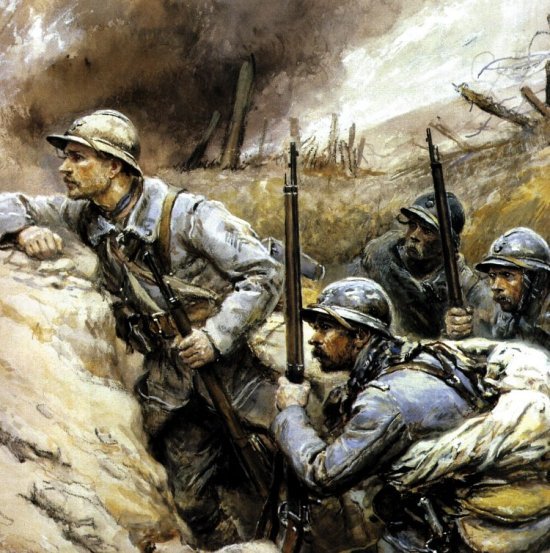
Historical events seem to confirm that the year 1914 represents a turning point in human history on a global scale. The First World War, a true industrial war with new combat techniques—machine guns, long-range artillery, the first aerial combat, the first bombs dropped from the sky, poison gas—all supported by global finance and the military-industrial complex.
In addition to the tens of millions of deaths, a global pandemic, the Spanish flu, claimed millions of lives. Since then, humanity has been plagued by wars, diseases, and global famines. Since then, humankind has possessed the means to bring about the extinction of the human species on Earth through these methods of mass destruction. Moreover, concerning the last days, here is what Jesus Christ said: « In fact, unless those days were cut short, no flesh would be saved; but on account of the chosen ones those days will be cut short » (Matthew 24:22).
***
The weaknesses of this interpretation leading to 1914
Many Christians have serious doubts about this interpretation and calculation. Here are four major objections: The first simple objection is that in the immediate context of Daniel chapter 4, there is no information that would indicate that this dream would have a second fulfillment. The second objection is that, assuming that there was another accomplishment, the date of 607 BCE for the first destruction of Jerusalem is not consistent with the date held by historians, which would be 586 BCE. The third objection is that nothing indicates, in the immediate context, that the seven times are 7 prophetic years. The fourth objection is that there is no indication, in the immediate context of chapter 4, that the 2520 days should be converted into 2520 years, according to Ezekiel 4:6. These four entirely admissible objections show that this interpretive date must be considered with caution and not with dogmatism. Now, taking into account these objections, here is why this date and its chronological calculation were retained in the editorial line of this biblical site, as a historical marker recognized by many historians.
Those who contest the validity of the calculation of this date, say that they are basing themselves on an exegetical study of the biblical text. However, it is appropriate to go to the end of this exegesis by admitting that the original biblical texts were not divided into chapters and verses. Thus, while remaining in the general context of the book of Daniel, it is not appropriate to reason only on the basis of the context of the single « chapter 4 », when it obviously does not directly give its meaning. Without necessarily going to another biblical book, looking at the whole context of the book of Daniel, can be usually enough. Let us see how.
Concerning the first objection, which shows that nothing indicates, in chapter 4, that there would be a second fulfillment. In any case, in the Bible, there is never any direct or written indication that there would be two fulfillments. It is only the context that allows us to understand it (see above the reasoning on the expression « great tribulation »). Furthermore, sometimes there are historical biblical narratives that have, at first glance, no prophetic dimension, and yet, it exists. Let us take two examples. The story of manna falling from heaven (Exodus 16:31-36). Nothing in the historical context of this passage shows the prophetic dimension of this story. However, Jesus Christ considered that it did indeed have a prophetic dimension (John 6:31-58). The historical account of the making of the copper serpent (Numbers 21:7-9). Nothing in the historical context of this passage shows the prophetic dimension of this narrative. However, Jesus Christ considered that it did indeed have a prophetic dimension (John 3:14,15).
Let us look at the story of Nebuchadnezzar’s dream in Daniel chapter 4. First of all, it should be noted that it is his second dream sent by God to this king (Daniel 2). In his first dream, Daniel says that God has revealed to him (through the interpretation of this dream) « what is to happen in the final part of the days ». Thus, the historical account of Daniel 2 has more than a simple anecdotal value, but also a prophetic value, concerning our time. The question that arises is: should we expect less from the story of the second dream given by God to King Nebuchadnezzar? Namely, that the scope of this second prophetic dream would concern « the final part of the days ». Basing ourselves, this time on the whole context of the book of Daniel, if we were to consider the second dream of King Nebuchadnezzar as applying only to his time, and to his person alone, then it would be the only prophetic vision which would not concern our time, while the whole of this book is directly related to « the final part of the days » (Daniel 12:9). Therefore, it would be rather the failure to not admit that there would be a second fulfillment of this dream, concerning the last days, which would not respect the entire context of the prophetic book of Daniel.
The second objection is about the date of 607 BCE, which would correspond to the first destruction of Jerusalem by the Babylonian armies. However, all historians consider that this event happened around 20 years later, that is to say in 586 BCE. Furthermore, there is no known historical written record today regarding this date of 607 BCE. Why, on a biblical level, would this date be chosen as a starting point? Because the date of Cyrus’ edict allowing the Jews to return to Jerusalem, recognized by historians, was promulgated in 539 BCE. The Jews arrived in Jerusalem in 537 BCE, ending the 70 years of desolation of that city, according to the prophecy of Jeremiah (Jeremiah 25:11,12): « In the first year of his reign I, Daniel, discerned by the books the number of years mentioned in the word of Jehovah to Jeremiah the prophet to fulfill the desolation of Jerusalem, namely, 70 years” (Daniel 9:2). If we go back 70 years, from 537 BCE, we arrive at 607 BCE.
The third objection is about the seven times, translated into 7 prophetic years of 360 days. It is in chapter 12 that we have confirmation that this correspondence is correct: « It will be for an appointed time, appointed times, and half a time » (Daniel 12:7). This period would correspond to 3 and a half times, or three and a half prophetic years, or 1260 days. Then, the angel mentions two other periods which would begin with the 1260 days, that is, 1290 days (1260 days plus 30 days) (verse 11), 1335 days (1260 days plus 75 days) (verse 12). Which demonstrates that the three and a half times correspond to the 1260 days, and that the 7 times represent seven prophetic years, or 2520 days.
The fourth objection is about the conversion of the 2520 days, the seven times, into 2520 years. This conversion exists in the book of Daniel chapter 9, regarding the seventy weeks of years in Daniel 9:24-27. What is interesting is that at no time is the word « week » written accompanied by the word « year ». And yet, depending on the context, in this prophecy, the seven days of the week are automatically translated into weeks of years. Therefore, converting the 2520 days into 2520 years, to arrive at the last days period mentioned in Daniel’s prophecy, also respects its context.
Therefore, we can consider that the year 1914 would be the beginning of the reign of King Jesus Christ in heaven, among his enemies (Psalms 2). He is present in the sense that since this period, his attention has been turned to the earth to act on behalf of the people of God (Daniel 12:1). If his presence is currently invisible, his coming, shortly before the great tribulation, will be visible (Matthew 24:30; 25:31-33; Apocalypse 1:7). It was also during this year, it seems, according to the Apocalypse, that the Devil and the demons were expelled to the neighborhood of the earth, plunging the world into a process of self-destruction and collective suicide against the all peoples, which we can observe particularly today: « Woe for the earth and for the sea, because the Devil has come down to you, having great anger, knowing that he has a short period of time » (Apocalypse 12:12). However, a little farther on, we will see what the year 1914 does not represent.
« As for the fourth kingdom, it will be strong like iron. For just as iron crushes and pulverizes everything else, yes, like iron that shatters, it will crush and shatter all of these. “And just as you saw the feet and the toes to be partly of clay of a potter and partly of iron, the kingdom will be divided, but some of the hardness of iron will be in it, just as you saw the iron mixed with soft clay. And as the toes of the feet were partly of iron and partly of clay, so the kingdom will be partly strong and partly fragile. Just as you saw iron mixed with soft clay, they will be mixed with the people; but they will not stick together, one to the other, just as iron does not mix with clay »
Iron symbolizes the expression of the power of the Roman Empire, and its extension to our time. It is a force of authority imposed politically, by the power of an army or a police force. Iron is the symbol of the metal from which weapons are forged; in Roman times, these were swords, shields, spears… And in our time, they are cannons, rifles, pistols, shot guns, bombs, and bombers dropping fire from the sky, to borrow the expression from the Book of Apocalypse, regarding the wild beast with two lamb horns, representing current world power: “It exercises all the authority of the first wild beast in its sight. And it makes the earth and its inhabitants worship the first wild beast, whose mortal wound was healed. And it performs great signs, even making fire come down out of heaven to the earth in the sight of mankind” (Apocalypse 13:12,13).
For example, during World War II, Italy, Germany, and Japan (the Axis powers) plunged the world into chaos and bloodshed, while the other Allied nations retaliated. In the aftermath of World War II, far from bringing peace to the world, these same Allied powers, in turn, caused widespread destruction and much bloodshed in post-colonial wars and the Cold War in many countries.
Nevertheless, these iron powers, with their military strength, were hampered by clay. How? Let us take two examples, France and the United States: After the Second World War, these two countries engaged in colonial wars, in Africa (in the Maghrib), in Asia (in Korea, Vietnam, Laos and in Cambodia). On the military level (iron), these countries have undoubtedly exerted a power comparable to iron which destroyed everything in its path, by rifles, machine guns, cannons, incendiary bombs destroying men, women and children living in villages, and forests, in Vietnam and Laos.
Nevertheless, the clay, the men and women, the public opinion, was quick to denounce the exaction of these great colonial powers, which « weakened » their military action (iron), to the point of converting their military victories, in political and diplomatic defeats. More recently, confidential classified information has been hacked, revealing to the general public (clay), abuses made by armies (iron) against civilian populations in the Far East, thereby discrediting these institutions.
Currently, the actions of iron governments are largely hampered by human clay, the « many waters », in the form of crowds protesting against the authority, revolutions, terrorist acts and mob movements that are flexing the authority of « militarized iron », widely relayed by union and media powers, particularly the Internet, which have acted and are acting as powerful checks and balances.
The prophecy of Daniel mentions the “toes” of iron and clay, which accentuates the fragility and stability of the “statue”, through Balkanization and claims of autonomy that have fragmented great empires. This phenomenon has been accentuated after the fall of the former Soviet Union, from the beginning of the years 90. New forms of conflicts by worldwide generalized terrorist actions, with the appearance of the Internet, make that the human clay has nowadays become almost uncontrollable by most governments with their police and militarized iron power.
The uncontrolled and rebellious clay, of the prophecy of Daniel, finds its symbolic correspondence with the book of Apocalypse, with the horizontality of the rough sea and the many waters: “One of the seven angels who had the seven bowls came and said to me: “Come, I will show you the judgment on the great prostitute who sits on many waters. (…) He said to me: “The waters that you saw, where the prostitute is sitting, mean peoples and crowds and nations and tongues“”(Apocalypse 17:1,15). While iron is represented by the verticality of the governmental “former heaven”, in the book of Apocalypse, it is written that they will disappear: “And I saw a new heaven and a new earth; for the former heaven and the former earth had passed away, and the sea is no more“ (Apocalypse 21:1).
To illustrate the destabilizing effect of the weakening of iron by the presence of clay, another chapter of Daniel’s prophecy states that in the last days, all of humanity would no longer respect authority: « And in the final part of their kingdom, as the transgressors act to a completion, a fierce-looking king who understands ambiguous sayings will stand up » (Daniel 8:23). This text describes the last days when transgressors would prosper. They are part of the clay that weakens the iron governmental authority. Also, Jesus Christ, in prophetically describing the last days, mentioned this weakening of authority through the growth of contempt for the law: « because of the increasing of lawlessness, the love of the greater number will grow cold » (Matthew 24:12).
The conclusion of this dream foretells the destruction of human sovereignty (without God), through the establishment, by force, of the Kingdom of God on earth:
“You looked on until a stone was cut out, not by hands, and it struck the image on its feet of iron and of clay and crushed them. At that time the iron, the clay, the copper, the silver, and the gold were, all together, crushed and became like the chaff from the summer threshing floor, and the wind carried them away so that not a trace of them could be found. But the stone that struck the image became a large mountain, and it filled the whole earth. (…) In the days of those kings the God of heaven will set up a kingdom that will never be destroyed. And this kingdom will not be passed on to any other people. It will crush and put an end to all these kingdoms, and it alone will stand forever, 45 just as you saw that out of the mountain a stone was cut not by hands, and that it crushed the iron, the copper, the clay, the silver, and the gold. The Grand God has made known to the king what will happen in the future. The dream is true, and its interpretation is trustworthy” (Daniel 2:34,35,44,45).
The stone that will destroy the image, is the Kingdom of God. This will be the fulfillment of the request made in the Lord’s Prayer: « Our Father in the heavens, let your name be sanctified. Let your Kingdom come. Let your will take place, as in heaven, also on earth » (Matthew 6:9,10).
Let your Kingdom come: it is a heavenly government whose king is Jesus Christ, with 144,000 kings and priests, the New Jerusalem, according to the Book of Apocalypse (21:1-4). The mountain from which the stone comes from, is the everlasting sovereignty of God YHWH (Yehouah), which will once again be exercised on planet Earth. This is why this stone, which will destroy the image, will become a mountain over the whole Earth, in expression of the sovereignty of God.
In order to make his disciples understand that he had indeed been raised from the dead, he put on a human body, whose face was not always recognizable by his disciples
The narrative of the gospels of the resurrection of Jesus Christ to strengthen our faith in the Christian hope of everlasting life
Introduction
The purpose of this meditation on the different narratives of the resurrection of Jesus Christ is twofold: the first is, as the main title indicates, to encourage those who have faith in the Christian hope of the resurrection and of everlasting life (John 3:16,36). The second, is to show that according to the Bible, it is a guarantee given by God, that the resurrection of the dead will be effective. It is precisely the apostle Paul who wrote it in 1 Corinthians chapter 15, dedicated especially to this theme of the resurrection. While some people in the congregation said there would be no resurrection, here is what the apostle Paul wrote in response:
« Now if Christ is being preached that he has been raised up from the dead, how is it some among you say there is no resurrection of the dead? If, indeed, there is no resurrection of the dead, neither has Christ been raised up. But if Christ has not been raised up, our preaching is certainly in vain, and our faith is in vain. Moreover, we are also found false witnesses of God, because we have borne witness against God that he raised up the Christ, but whom he did not raise up if the dead are really not to be raised up. For if the dead are not to be raised up, neither has Christ been raised up. Further, if Christ has not been raised up, your faith is useless; you are yet in your sins. In fact, also, those who fell asleep [in death] in union with Christ perished. If in this life only we have hoped in Christ, we are of all men most to be pitied » (1 Corinthians 15:12-19; the reader who wishes, may read the whole of chapter 15, about the different kinds of resurrections).
The last point, this time regarding to the different narratives of the appearances of Jesus Christ resurrected, and this, for forty days, before his ascension. You will notice something surprising, that is the disciples did not recognize him right away, as if his face had changed. He was recognized by his ancient gestures, such as breaking loaf, or the way of pronouncing the name of loved ones such as Mary Magdalene. Why ? In 1 Corinthians 15:45 it is written: « It is even so written: “The first man Adam became a living soul.” The last Adam became a life-giving spirit ». This text shows that the resurrected Jesus Christ has been raised up as a spirit, and a spirit or angel is not usually seen with human eyes. In order to make his disciples understand that he had indeed been raised from the dead, he put on a human body, whose face was not always recognizable by his disciples.
***
– A generous woman: « She did what she could » (Mark 14:8)
« And while he was at Bethʹa·ny dining in the house of Simon the leper, a woman came with an alabaster jar of perfumed oil, genuine nard, very expensive. She broke open the alabaster jar and began pouring it on his head. At this some said to one another indignantly: “Why has this perfumed oil been wasted? For this perfumed oil could have been sold for more than 300 denarii and the money given to the poor!” And they were greatly annoyed with her. But Jesus said: “Let her alone. Why do you try to make trouble for her? She did a fine deed toward me. For you always have the poor with you, and you can do them good whenever you want to, but you will not always have me. She did what she could; she poured perfumed oil on my body beforehand, in view of the burial. Truly I say to you, wherever the good news is preached in all the world, what this woman did will also be told in memory of her” (Mark 14: 3-9).
The generosity of this woman, is similar to that of the very poor widow who was noticed by Jesus Christ: « Now as he looked up, he saw the rich dropping their gifts into the treasury chests. Then he saw a needy widow drop in two small coins of very little value, and he said: “Truly I say to you that this poor widow put in more than they all did. For all of these put in gifts out of their surplus, but she, out of her want, put in all the means of living she had” » (Luke 21:1-4). Thus, Jesus Christ notices the slightest effort that we make with all our heart, to serve his Father (Matthew 7:21).
***
– The courage of Joseph of Arimathea who asks Pilate, the Roman governor of Judea, for the lifeless body of Christ:
Reading historical stories, in this case, the Gospels, we often know the end and maybe the « happy end ». However, the characters who lived the dangerous and scary situation, did not know the consequences of their courageous decisions, for example, imprisonment or all kinds of mistreatment. Among these courageous characters, in the Bible, there is Joseph of Arimathea, a man who asked for the body of Christ to have a suitable burial. The gesture of courage of Joseph of Arimathea, is that he made his grave available, especially prepared for him (Joseph of Arimathea), for the dead body of Christ. The story of Mark 15, describes him as a « reputable » man and his act before Pilate, who had decreed the death sentence of Christ, as a « courageous » act.
« Now as it was late in the afternoon, there came a rich man of Arimathea, named Joseph, who had also himself become a disciple of Jesus. This man went up to Pilate and asked for the body of Jesus. Then Pilate commanded it to be given over. And Joseph took the body, wrapped it up in clean fine linen, and laid it in his new memorial tomb, which he had quarried in the rock-mass. And, after rolling a big stone to the door of the memorial tomb, he left. But Mary Magʹda·lene and the other Mary continued there, sitting before the grave » (Matthew 27:57-61).
« Now as it was already late in the afternoon, and since it was Preparation, that is, the day before the sabbath, there came Joseph of Arimathea, a reputable member of the Council, who also himself was waiting for the kingdom of God. He took courage to go in before Pilate and asked for the body of Jesus. But Pilate wondered whether he was already dead, and, summoning the army officer, he asked him whether he had already died. So after making certain from the army officer, he granted the corpse to Joseph. Accordingly he bought fine linen and took him down, wrapped him in the fine linen and laid him in a tomb which was quarried out of a rock-mass; and he rolled a stone up to the door of the memorial tomb. But Mary Magʹda·lene and Mary the mother of Joʹses continued looking at where he had been laid » (Mark 15:42-47).
« Now after these things Joseph from Arimathea, who was a disciple of Jesus but a secret one out of his fear of the Jews, requested Pilate that he might take away the body of Jesus; and Pilate gave him permission. Therefore he came and took his body away. Nic·o·deʹmus also, the man that came to him in the night the first time, came bringing a roll of myrrh and aloes, about a hundred pounds of it. So they took the body of Jesus and bound it up with bandages with the spices, just the way the Jews have the custom of preparing for burial. Incidentally, at the place where he was impaled there was a garden, and in the garden a new memorial tomb, in which no one had ever yet been laid. There, then, on account of the preparation of the Jews, they laid Jesus, because the memorial tomb was nearby » (John 19:38-42).
– The day after the death of Christ, the Nisan, 15 (Jewish biblical calendar) the chief priests and the Pharisees ensure that the tomb of Christ is both sealed and kept by two soldiers:
« The next day, which was after the Preparation, the chief priests and the Pharisees gathered together before Pilate, saying: “Sir, we have called to mind that that impostor said while yet alive, ‘After three days I am to be raised up.’ Therefore command the grave to be made secure until the third day, that his disciples may never come and steal him and say to the people, ‘He was raised up from the dead!’ and this last imposture will be worse than the first.” Pilate said to them: “you have a guard. Go make it as secure as you know how.” So they went and made the grave secure by sealing the stone and having the guar » (Matthew 27:62-66).
– Jesus Christ resurrected appears to women who came very early on the morning of Sunday Nisan,16:
« After the sabbath, when it was growing light on the first day of the week, Mary Magdalene and the other Mary came to view the grave. And, notice! a great earthquake had taken place; for Jehovah’s angel had descended from heaven and approached and rolled away the stone, and was sitting on it. His outward appearance was as lightning, and his clothing as white as snow. Yes, for fear of him the watchmen trembled and became as dead men. But the angel in answer said to the women: “Do not you be fearful, for I know you are looking for Jesus who was impaled. 6 He is not here, for he was raised up, as he said. Come, see the place where he was lying. And go quickly and tell his disciples that he was raised up from the dead, and, look! he is going ahead of you into Galʹi·lee; there you will see him. Look! I have told you.” So, quickly leaving the memorial tomb, with fear and great joy, they ran to report to his disciples. And, look! Jesus met them and said: “Good day!” They approached and caught him by his feet and did obeisance to him. Then Jesus said to them: “Have no fear! Go, report to my brothers, that they may go off into Galʹi·lee; and there they will see me”” (Matthew 28:1-10).
***
– The women announce the good news of the resurrection of Jesus Christ to the apostles who do not believe them:
« On the first day of the week, however, they went very early to the tomb, bearing the spices they had prepared. But they found the stone rolled away from the memorial tomb, and when they entered they did not find the body of the Lord Jesus. While they were in perplexity over this, look! two men in flashing clothing stood by them. As the women became frightened and kept their faces turned to the ground, the men said to them: “Why are you looking for the living One among the dead? [He is not here, but has been raised up.] Recall how he spoke to you while he was yet in Galilee, saying that the Son of man must be delivered into the hands of sinful men and be impaled and yet on the third day rise.” So they called his sayings to mind, and they returned from the memorial tomb and reported all these things to the eleven and to all the rest. They were the Magdalene Mary, and Joanna, and Mary the mother of James. Also, the rest of the women with them were telling the apostles these things. However, these sayings appeared as nonsense to them and they would not believe the women » (Luke 24:1-11).
– Peter and John run to the grave to check the truth of women’s narrative:
« On the first day of the week Mary Magdalene came to the memorial tomb early, while there was still darkness, and she beheld the stone already taken away from the memorial tomb. Therefore she ran and came to Simon Peter and to the other disciple, for whom Jesus had affection, and she said to them: “They have taken away the Lord out of the memorial tomb, and we do not know where they have laid him.” Then Peter and the other disciple went out and started for the memorial tomb. Yes, the two together began to run; but the other disciple ran ahead of Peter with greater speed and reached the memorial tomb first. And, stooping forward, he beheld the bandages lying, yet he did not go in. Then Simon Peter also came following him, and he entered into the memorial tomb. And he viewed the bandages lying, also the cloth that had been upon his head not lying with the bandages but separately rolled up in one place. At that time, therefore, the other disciple who had reached the memorial tomb first also went in, and he saw and believed. For they did not yet discern the scripture that he must rise from the dead. And so the disciples went back to their homes » (John 20:1-10).
***
– Magdalene Mary meets Jesus Christ resurrected, and she does not recognize him and takes him for the gardener:
« Mary, however, kept standing outside near the memorial tomb, weeping. Then, while she was weeping, she stooped forward to look into the memorial tomb and she viewed two angels in white sitting one at the head and one at the feet where the body of Jesus had been lying. And they said to her: “Woman, why are you weeping?” She said to them: “They have taken my Lord away, and I do not know where they have laid him.” After saying these things, she turned back and viewed Jesus standing, but she did not discern it was Jesus. Jesus said to her: “Woman, why are you weeping? Whom are you looking for?” She, imagining it was the gardener, said to him: “Sir, if you have carried him off, tell me where you have laid him, and I will take him away.” Jesus said to her: “Mary!” Upon turning around, she said to him, in Hebrew: “Rabboni!” (which means “Teacher!”) Jesus said to her: “Stop clinging to me. For I have not yet ascended to the Father. But be on your way to my brothers and say to them, ‘I am ascending to my Father and your Father and to my God and your God.’” 18 Mary Magdalene came and brought the news to the disciples: “I have seen the Lord!” and that he said these things to her » (John 20:11-18).
– Two disciples discuss with Jesus Christ resurrected, without recognizing him, on the road to Emmaus:
« But, look! on that very day two of them were journeying to a village about seven miles distant from Jerusalem and named Emmaus, 1and they were conversing with each other over all these things that had come about. Now as they were conversing and discussing, Jesus himself approached and began walking with them; but their eyes were kept from recognizing him. He said to them: “What are these matters that you are debating between yourselves as you walk along?” And they stood still with sad faces. In answer the one named Cleopas said to him: “Are you dwelling as an alien by yourself in Jerusalem and so do not know the things that have occurred in her in these days?” And he said to them: “What things?” They said to him: “The things concerning Jesus the Nazareneʹ, who became a prophet powerful in work and word before God and all the people; and how our chief priests and rulers handed him over to the sentence of death and impaled him. But we were hoping that this [man] was the one destined to deliver Israel; yes, and besides all these things, this makes the third day since these things occurred. Moreover, certain women from among us also astonished us, because they had been early to the memorial tomb but did not find his body and they came saying they had also seen a supernatural sight of angels, who said he is alive. Further, some of those with us went off to the memorial tomb; and they found it so, just as the women had said, but they did not see him.” So he said to them: “O senseless ones and slow in heart to believe on all the things the prophets spoke! Was it not necessary for the Christ to suffer these things and to enter into his glory?” And commencing at Moses and all the Prophets he interpreted to them things pertaining to himself in all the Scriptures. Finally they got close to the village where they were journeying, and he made as if he was journeying on farther. But they used pressure upon him, saying: “Stay with us, because it is toward evening and the day has already declined.” With that he went in to stay with them. And as he was reclining with them at the meal he took the loaf, blessed it, broke it and began to hand it to them. At that their eyes were fully opened and they recognized him; and he disappeared from them. And they said to each other: “Were not our hearts burning as he was speaking to us on the road, as he was fully opening up the Scriptures to us?” And in that very hour they rose and returned to Jerusalem, and they found the eleven and those with them assembled together, saying: “For a fact the Lord was raised up and he appeared to Simon!” Now they themselves related the events on the road and how he became known to them by the breaking of the loaf » (Luke 24:13-35).
***
– Jesus Christ resurrected, appears to his disciples:
« While they were speaking of these things he himself stood in their midst and said to them: “May you have peace.” But because they were terrified, and had become frightened, they were imagining they beheld a spirit. So he said to them: “Why are you troubled, and why is it doubts come up in your hearts? See my hands and my feet, that it is I myself; feel me and see, because a spirit does not have flesh and bones just as you behold that I have.” And as he said this he showed them his hands and his feet. But while they were still not believing for sheer joy and were wondering, he said to them: “Do you have something there to eat?” And they handed him a piece of broiled fish; and he took it and ate it before their eyes. He now said to them: “These are my words which I spoke to you while I was yet with you, that all the things written in the law of Moses and in the Prophets and Psalms about me must be fulfilled.” Then he opened up their minds fully to grasp the meaning of the Scriptures, and he said to them: “In this way it is written that the Christ would suffer and rise from among the dead on the third day, and on the basis of his name repentance for forgiveness of sins would be preached in all the nations—starting out from Jerusalem, you are to be witnesses of these things. And, look! I am sending forth upon you that which is promised by my Father. you, though, abide in the city until you become clothed with power from on high” » (Luke 24:36-49).
***
– Jesus Christ resurrected appears to the Apostle Thomas who did not believe the other disciples, informing him that they had seen him at a time when he was not present:
« Therefore, when it was late on that day, the first of the week, and, although the doors were locked where the disciples were for fear of the Jews, Jesus came and stood in their midst and said to them: “May you have peace.” And after he said this he showed them both his hands and his side. Then the disciples rejoiced at seeing the Lord. Jesus, therefore, said to them again: “May you have peace. Just as the Father has sent me forth, I also am sending you.” And after he said this he blew upon them and said to them: “Receive holy spirit. If you forgive the sins of any persons, they stand forgiven to them; if you retain those of any persons, they stand retained.” But Thomas, one of the twelve, who was called The Twin, was not with them when Jesus came. Consequently the other disciples would say to him: “We have seen the Lord!” But he said to them: “Unless I see in his hands the print of the nails and stick my finger into the print of the nails and stick my hand into his side, I will certainly not believe.” Well, eight days later his disciples were again indoors, and Thomas with them. Jesus came, although the doors were locked, and he stood in their midst and said: “May you have peace.” Next he said to Thomas: “Put your finger here, and see my hands, and take your hand and stick it into my side, and stop being unbelieving but become believing.” In answer Thomas said to him: “My Lord and my God!” Jesus said to him: “Because you have seen me have you believed? Happy are those who do not see and yet believe.” To be sure, Jesus performed many other signs also before the disciples, which are not written down in this scroll. But these have been written down that YOU may believe that Jesus is the Christ the Son of God, and that, because of believing, you may have life by means of his name » (John 20:19-31).
***
– Jesus Christ resurrected appears on the beach of the Sea of Tiberias, is recognized by his disciples by a miraculous cash. Then he encourages the Apostle Peter to spiritually feed his sheep:
« After these things Jesus manifested himself again to the disciples at the sea of Tiberias; but he made the manifestation in this way. There were in company Simon Peter and Thomas, who was called The Twin, and Nathanael from Cana of Galilee and the sons of Zebedee and two others of his disciples. Simon Peter said to them: “I am going fishing.” They said to him: “We also are coming with you.” Out they went and got aboard the boat, but during that night they caught nothing. However, just as it was getting to be morning, Jesus stood on the beach, but the disciples did not, of course, discern that it was Jesus. Then Jesus said to them: “Young children, you do not have anything to eat, do you?” They answered “No!” to him. He said to them: “Cast the net on the right side of the boat and you will find some.” Then they cast it, but they were no longer able to draw it in because of the multitude of the fishes. Therefore that disciple whom Jesus used to love said to Peter: “It is the Lord!” Hence Simon Peter, upon hearing that it was the Lord, girded about himself his top garment, for he was naked, and plunged into the sea. But the other disciples came in the little boat, for they were not a long way from land, only about three hundred feet away, dragging the net of fishes. However, when they disembarked onto land they beheld lying there a charcoal fire and fish lying upon it and bread. Jesus said to them: “Bring some of the fish you just now caught.” Simon Peter, therefore, went on board and drew the net to land full of big fishes, one hundred and fifty-three of them. But although there were so many the net did not burst. Jesus said to them: “Come, take your breakfast.” Not one of the disciples had the courage to inquire of him: “Who are you?” because they knew it was the Lord. Jesus came and took the bread and gave it to them, and the fish likewise. This was now the third time that Jesus appeared to the disciples after his being raised up from the dead. When, now, they had breakfasted, Jesus said to Simon Peter: “Simon son of John, do you love me more than these?” He said to him: “Yes, Lord, you know I have affection for you.” He said to him: “Feed my lambs.” Again he said to him, a second time: “Simon son of John, do you love me?” He said to him: “Yes, Lord, you know I have affection for you.” He said to him: “Shepherd my little sheep.” He said to him the third time: “Simon son of John, do you have affection for me?” Peter became grieved that he said to him the third time: “Do you have affection for me?” So he said to him: “Lord, you know all things; you are aware that I have affection for you.” Jesus said to him: “Feed my little sheep. Most truly I say to you, When you were younger, you used to gird yourself and walk about where you wanted. But when you grow old you will stretch out your hands and another man will gird you and bear you where you do not wish.” This he said to signify by what sort of death he would glorify God. So, when he had said this, he said to him: “Continue following me.” Upon turning about Peter saw the disciple whom Jesus used to love following, the one who at the evening meal had also leaned back upon his breast and said: “Lord, who is the one betraying you?” Accordingly, when he caught sight of him, Peter said to Jesus: “Lord, what will this [man do]?” Jesus said to him: “If it is my will for him to remain until I come, of what concern is that to you? You continue following me.” In consequence, this saying went out among the brothers, that that disciple would not die. However, Jesus did not say to him that he would not die, but: “If it is my will for him to remain until I come, of what concern is that to you?” This is the disciple that bears witness about these things and that wrote these things, and we know that the witness he gives is true. There are, in fact, many other things also which Jesus did, which, if ever they were written in full detail, I suppose, the world itself could not contain the scrolls written » (John 21:1-25).
***
– The narrative of the ascension of Jesus resurrected in heaven:
« However, the eleven disciples went into Galilee to the mountain where Jesus had arranged for them, and when they saw him they did obeisance, but some doubted. And Jesus approached and spoke to them, saying: “All authority has been given me in heaven and on the earth. Go therefore and make disciples of people of all the nations, baptizing them in the name of the Father and of the Son and of the holy spirit, teaching them to observe all the things I have commanded you. And, look! I am with you all the days until the conclusion of the system of things” » (Matthew 28:16-20).
« But he led them out as far as Bethany, and he lifted up his hands and blessed them. As he was blessing them he was parted from them and began to be borne up to heaven. And they did obeisance to him and returned to Jerusalem with great joy. And they were continually in the temple blessing God » (Luke 24:50-53).
« When, now, they had assembled, they went asking him: “Lord, are you restoring the kingdom to Israel at this time?” He said to them: “It does not belong to you to get knowledge of the times or seasons which the Father has placed in his own jurisdiction; but you will receive power when the holy spirit arrives upon you, and you will be witnesses of me both in Jerusalem and in all Ju·deʹa and Sa·marʹi·a and to the most distant part of the earth.” And after he had said these things, while they were looking on, he was lifted up and a cloud caught him up from their vision. And as they were gazing into the sky while he was on his way, also, look! two men in white garments stood alongside them, and they said: “Men of Galʹi·lee, why do you stand looking into the sky? This Jesus who was received up from you into the sky will come thus in the same manner as you have beheld him going into the sky” » (Acts 1:6-11).
***
– Jesus Christ glorified appears to Saul (which later will be called the Apostle Paul), he is blinded for three days. Then, Jesus appears to a disciple named Ananias to baptize Saul:
« But Saul, still breathing threat and murder against the disciples of the Lord, went to the high priest and asked him for letters to the synagogues in Damascus, in order that he might bring bound to Jerusalem any whom he found who belonged to The Way, both men and women. Now as he was traveling he approached Damascus, when suddenly a light from heaven flashed around him, and he fell to the ground and heard a voice say to him: “Saul, Saul, why are you persecuting me?” He said: “Who are you, Lord?” He said: “I am Jesus, whom you are persecuting. 6 Nevertheless, rise and enter into the city, and what you must do will be told you.” Now the men that were journeying with him were standing speechless, hearing, indeed, the sound of a voice, but not beholding any man. But Saul got up from the ground, and though his eyes were opened he was seeing nothing. So they led him by the hand and conducted him into Damascus. And for three days he did not see anything, and he neither ate nor drank. There was in Damascus a certain disciple named Ananias, and the Lord said to him in a vision: “Ananiʹas!” He said: “Here I am, Lord.” The Lord said to him: “Rise, go to the street called Straight, and at the house of Judas look for a man named Saul, from Tarsus. For, look! he is praying, and in a vision he has seen a man named Ananias come in and lay his hands upon him that he might recover sight.” But Ananias answered: “Lord, I have heard from many about this man, how many injurious things he did to your holy ones in Jerusalem. And here he has authority from the chief priests to put in bonds all those calling upon your name.” But the Lord said to him: “Be on your way, because this man is a chosen vessel to me to bear my name to the nations as well as to kings and the sons of Israel. For I shall show him plainly how many things he must suffer for my name” » (Acts 9:1-16).
***
– The vision of the Apostle John, then very old, of Jesus Christ glorified, in the beginning of the narrative of the book of the Apocalypse: They are in the Holy of the Temple Sanctuary:
« I John, your brother and a sharer with you in the tribulation and kingdom and endurance in company with Jesus, came to be in the isle that is called Patmos for speaking about God and bearing witness to Jesus. By inspiration I came to be in the Lord’s day, and I heard behind me a strong voice like that of a trumpet, saying: “What you see write in a scroll and send it to the seven congregations, in Ephesus and in Smyrna and in Pergamum and in Thyatira and in Sardis and in Philadelphia and in Laodicea.” And I turned to see the voice that was speaking with me, and, having turned, I saw seven golden lampstands, and in the midst of the lampstands someone like a son of man, clothed with a garment that reached down to the feet, and girded at the breasts with a golden girdle. Moreover, his head and his hair were white as white wool, as snow, and his eyes as a fiery flame; and his feet were like fine copper when glowing in a furnace; and his voice was as the sound of many waters. And he had in his right hand seven stars, and out of his mouth a sharp, long two-edged sword was protruding, and his countenance was as the sun when it shines in its power. And when I saw him, I fell as dead at his feet. And he laid his right hand upon me and said: “Do not be fearful. I am the First and the Last, and the living one; and I became dead, but, look! I am living forever and ever, and I have the keys of death and of Hades. Therefore write down the things you saw, and the things that are and the things that will take place after these. As for the sacred secret of the seven stars that you saw upon my right hand, and of the seven golden lampstands: The seven stars mean the angels of the seven congregations, and the seven lampstands mean seven congregations » (Revelation 1:9-20).
This vision that the apostle John had, then between 90 and 100 years old (in 96 Common Era), seems to correspond to the prediction of Jesus Christ resurrected, told to the apostle Peter, regarding John, namely that he would see the return of Jesus glorified (John 21 the part of the conversation between Jesus and Peter).
***
– The vision of the Apostle John, of Jesus Christ glorified, in the narrative of the book of the Apocalypse, seated on white horse, coming against the nations with a sharp and long sword:
« And I saw when the Lamb opened one of the seven seals, and I heard one of the four living creatures say with a voice as of thunder: “Come!” And I saw, and, look! a white horse; and the one seated upon it had a bow; and a crown was given him, and he went forth conquering and to complete his conquest » (Revelation 6:1,2).
« And I saw the heaven opened, and, look! a white horse. And the one seated upon it is called Faithful and True, and he judges and carries on war in righteousness. His eyes are a fiery flame, and upon his head are many diadems. He has a name written that no one knows but he himself, and he is arrayed with an outer garment sprinkled with blood, and the name he is called is The Word of God. Also, the armies that were in heaven were following him on white horses, and they were clothed in white, clean, fine linen. And out of his mouth there protrudes a sharp long sword, that he may strike the nations with it, and he will shepherd them with a rod of iron. He treads too the winepress of the anger of the wrath of God the Almighty. And upon his outer garment, even upon his thigh, he has a name written, King of kings and Lord of lords » (Revelation 19:11-16).
***
– The visions of Revelation, regarding Jesus Christ glorified as King and High Priest, should make us think. Jesus Christ is no longer a harmless infant in a manger. Jesus Christ is no longer the representation of a sacrificed and dead man, nailed by the hands and feet with the side pierced by a spear. Jesus Christ is currently a King and High Priest who has the right of life and death over each of us, the living, but also over the dead who will be resurrected. The resurrected Jesus Christ (Yehoshuah Mashiah) said shortly before his ascension that his Father Jehovah God (YHWH Elohim) had given him all authority (Matthew 28:19,20). In addition, here are two biblical quotes that will illustrate this important teaching point, allowing us to see in Jesus Christ a King now in office, both benevolent, but also to be verentially feared:
« Not everyone saying to me, ‘Lord, Lord,’ will enter into the kingdom of the heavens, but the one doing the will of my Father who is in the heavens will. Many will say to me in that day, ‘Lord, Lord, did we not prophesy in your name, and expel demons in your name, and perform many powerful works in your name?’ And yet then I will confess to them: I never knew you! Get away from me, you workers of lawlessness » (Matthew 7:21-23).
« When the Son of man arrives in his glory, and all the angels with him, then he will sit down on his glorious throne. And all the nations will be gathered before him, and he will separate people one from another, just as a shepherd separates the sheep from the goats. And he will put the sheep on his right hand, but the goats on his left.
“Then the king will say to those on his right, ‘Come, you who have been blessed by my Father, inherit the kingdom prepared for you from the founding of the world. For I became hungry and you gave me something to eat; I got thirsty and you gave me something to drink. I was a stranger and you received me hospitably; naked, and you clothed me. I fell sick and you looked after me. I was in prison and you came to me.’ Then the righteous ones will answer him with the words, ‘Lord, when did we see you hungry and feed you, or thirsty, and give you something to drink? When did we see you a stranger and receive you hospitably, or naked, and clothe you? When did we see you sick or in prison and go to you?’ And in reply the king will say to them, ‘Truly I say to you, To the extent that you did it to one of the least of these my brothers, you did it to me.’
“Then he will say, in turn, to those on his left, ‘Be on your way from me, you who have been cursed, into the everlasting fire prepared for the Devil and his angels. For I became hungry, but you gave me nothing to eat, and I got thirsty, but you gave me nothing to drink. I was a stranger, but you did not receive me hospitably; naked, but you did not clothe me; sick and in prison, but you did not look after me.’ Then they also will answer with the words, ‘Lord, when did we see you hungry or thirsty or a stranger or naked or sick or in prison and did not minister to you?’ Then he will answer them with the words, ‘Truly I say to you, To the extent that you did not do it to one of these least ones, you did not do it to me.’ And these will depart into everlasting cutting-off, but the righteous ones into everlasting life » (Matthew 25:31-46; see also Psalm 2 and Revelation chapters 1-3).
You will know the truth, and the truth will set you free
(John 8:32)
What truth is this, and how does it set us free?
Among Bible readers, and especially some teachers of God’s Word, this statement is understood in terms of a knowledge of biblical truth that would set free from religious lies commonly taught in many Christian congregations. For example, knowing that the Bible does not teach the existence of purgatory, limbo, or a fiery hell where the wicked would be eternally tortured has a liberating effect on people. Indeed, it is comforting to know that these religious lies, such as fiery hell, purgatory, the Trinity, the immortality of the soul, and other superstitions linked to the occultism, are not taught in the Bible. In a way, the comfort of biblical truth has a liberating effect on people who have been enslaved by these superstitions and false religious teachings. However, should Christ’s statement (above) be applied in the context of an accurate knowledge of the Bible that would set free from religious lies? Given the context of John’s Gospel, such an explanation does not respect the immediate context of Christ’s statement, nor even the whole context of the Gospel of John.
Let us read Christ’s statement, this time in its immediate context: « Then Jesus went on to say to the Jews who had believed him: “If you remain in my word, you are really my disciples, and you will know the truth, and the truth will set you free.” They replied to him: “We are Abraham’s offspring and never have been slaves to anyone. How is it you say, ‘You will become free’?” Jesus answered them: “Most truly I say to you, every doer of sin is a slave of sin. Moreover, the slave does not remain in the household forever; the son remains forever. So if the Son sets you free, you will be truly free. I know that you are Abraham’s offspring. But you are seeking to kill me, because my word makes no progress among you. I speak the things I have seen while with my Father, but you do the things you have heard from your father.” In answer they said to him: “Our father is Abraham.” Jesus said to them: “If you were Abraham’s children, you would be doing the works of Abraham. But now you are seeking to kill me, a man who has told you the truth that I heard from God. Abraham did not do this. You are doing the works of your father.” They said to him: “We were not born from immorality; we have one Father, God” » (John 8:31-41).
What kind of truth is it? What is this truth Jesus Christ is speaking of? Is it the whole body of knowledge contained in the Word of God, or something else?
Jesus Christ explains that abiding in his word will allow one to know this truth that will set them free. The Jewish interlocutors are offended by what Christ says because it implies that they are slaves, even though they are descendants of a free man, Abraham. There is a misunderstanding between what Christ says and what the Jews understood, and therefore Jesus Christ clarifies his thinking. He tells them that it is the slavery of sin, meaning the sinful condition that all humanity inherited from Adam. This slavery leads to death (Romans 5:12). Then, delicately, he makes them understand that he is the truth, who has the means to set them free. Jesus Christ presents himself as the embodiment of the truth that sets free: « So if the Son sets you free, you will be truly free » (John 8:36). This understanding is reinforced by another statement he made some time later: « Jesus said to him: “I am the way and the truth and the life. No one comes to the Father except through me » » (John 14:6). Therefore, it is obvious that using this text of John 8:32 to explain that biblical truth sets free from religious lies is simply inaccurate and does not respect the context of this statement of Christ.
While Jesus Christ refers to himself as the truth that sets free, he explains more specifically in the rest of his statement: « Most truly I say to you, if anyone observes my word, he will never see death at all » (John 8:51). Jewish religious fundamentalists take his statement literally, while Jesus Christ refers to never seeing death without the possibility of resurrection. For example, on another occasion, speaking to Sadducees who did not believe in the resurrection, in referring to this hope, Jesus Christ referred to Abraham, Isaac, and Jacob as being « alive » in the perspective of this hope: « Regarding the resurrection of the dead, have you not read what was spoken to you by God, who said: ‘I am the God of Abraham and the God of Isaac and the God of Jacob’? He is the God, not of the dead, but of the living » (Matthew 22:31, 32).
Thus, this truth that set us free from the slavery of sin that leads to death, is faith in the truth that is Jesus Christ, which leads to everlasting life: « For the wages sin pays is death, but the gift God gives is everlasting life by Christ Jesus our Lord » (Romans 6:23).