
The administration of the Christian congregation according to the latest instructions of King Yehoshuah Mashiah
(Jesus Christ)
What is a congregation?
The answer will be based on the Bible (Sola Scriptura) and, specifically, on the context of early Christianity as described in the Acts of the Apostles and the diferent letters written by Christ’s apostles and disciples found in the New Testament—or the Christian Greek Scriptures. The word « congregation » is used on this Bible-teaching site; however, there are other synonyms, such as church, assembly, community, or religious group.
Chapters 2 and 3 of the Book of Revelation contain seven messages from Jesus Christ to seven congregations or churches. The words « church » and « congregation » derive from the Greek word « ekklesia » (G1577, Strong’s Concordance), which simply means an assembly or church. The point—a simple one, as this definition from the Greek text illustrates—is that, according to the Bible, a church refers exclusively to a group of people, not to the architectural structure where that group might meet. For instance, within major Christian denominations—Catholic, Orthodox, and Protestant—the word « church » is generally associated with a physical building, such as a cathedral, a small church, a chapel, or a temple. In the context of chapters 2 and 3, Jesus Christ addresses an « angel » responsible for the congregation in question. The messages discuss the qualities and shortcomings of these congregations, clearly demonstrating that the reference is to a community of Christ’s disciples (rather than a building).
When does a group of Christ’s disciples biblically become a congregation? Here is what Jesus Christ said: « For where there are two or three gathered together in my name, there I am in their midst » (Matthew 18:20). Thus, from Jesus Christ’s perspective, a group of two or three people gathered in his name constitutes a congregation. For example, in countries where Christ’s disciples face violent persecution, they cannot gather in large numbers for the sake of safety. In such cases, congregations may consist of just a single family or an extended family meeting in a private home. They apply Christ’s counsel: « Look! I am sending you out as sheep among wolves; so prove yourselves cautious as serpents and yet innocent as doves » (Matthew 10:16). Of course, Christian congregations can also be a larger number of disciples.
Still drawing upon the messages to the seven congregations (Revelation chapters 2 and 3), Jesus Christ distinguishes congregations based on their geographical location. This aligns with the account in Acts: « It was first in Antioch that the disciples were by divine providence called Christians » (Acts 11:26). Thus, among the different designations currently used for Christian congregations, the only one that matters in Christ’s eyes—according to the book of Acts—is « Christian ». We must not forget that one of the last requests he made to his heavenly Father was for unity: « I make request, not concerning these only, but also concerning those putting faith in me through their word, 21 so that they may all be one, just as you, Father, are in union with me and I am in union with you, that they also may be in union with us, so that the world may believe that you sent me » (John 17:20, 21). The tens, hundreds, and thousands of denominations that divide the Church of Christ hold no value in His eyes; the only identification consistent with divine providence is that of « Christian » (Acts 11:26).
Where did Christian congregations meet? They met in private homes: « After he realized this, he went to the house of Mary the mother of John who was called Mark, where quite a few were gathered together and were praying » (Acts 12:12).
In Acts chapter 20, Paul gave a long speech—lasting late into the night—in a private setting. Eutychus dozed off and fell, and Paul raised him back to life: « On the first day of the week, when we were gathered together to have a meal, Paul began addressing them, as he was going to depart the next day; and he prolonged his speech until midnight. 8 So there were quite a few lamps in the upper room where we were gathered together. 9 Seated at the window, a young man named Eutychus sank into a deep sleep while Paul kept talking, and overcome by sleep, he fell down from the third story and was picked up dead. 10 But Paul went downstairs, threw himself on him and embraced him, and said: “Stop making a commotion, for he is alive.” 11 He then went upstairs and began the meal and ate. He continued conversing for quite a while, until daybreak, and then he departed. 12 So they took the boy away alive and were comforted beyond measure » (Acts 20:7-12).
« Give my greetings to Prisca and Aquila, my fellow workers in Christ Jesus, 4 who have risked their own necks for me and to whom not only I but also all the congregations of the nations give thanks. 5 Also greet the congregation that is in their house. Greet my beloved Epaenetus, who is a firstfruits of Asia for Christ. 6 Greet Mary, who has worked hard for you. 7 Greet Andronicus and Junias, my relatives and fellow prisoners, who are men well-known to the apostles and who have been in union with Christ longer than I have » (Romans 16:3-5). In this instance, it was the home of Prisca and Aquila that housed one of the Christian congregations in Rome (if not the entire congregation in Rome).
« Give my greetings to the brothers in Laodicea and to Nympha and to the congregation at her house » (Colossians 4:15). The congregation in Laodicea met in Nympha’s house.
« Paul, a prisoner for the sake of Christ Jesus, and Timothy our brother, to Philemon our beloved fellow worker, 2 and to Apphia our sister, and to Archippus our fellow soldier, and to the congregation that is in your house » (Paul’s letter to Philemon, verses 1,2). Philemon made a part of his home available to the Christian congregation for the purpose of holding meetings.
These different biblical quotes show that early Christians did not meet in buildings or temples used exclusively for Christian gatherings. They met in family homes.
How often did Christians meet each week? There is no indication specifying exactly how often Christians gathered weekly. Reading the Book of Acts, it appears that for a time, Christians maintained the custom of meeting every Sabbath, just as the Jews did. It is worth noting that the Christian congregation is the fulfillment of the prophetic dimension of the Mosaic Law: « Those things are a shadow of the things to come, but the reality belongs to the Christ » (Colossians 2:17). This implies that Christians met officially once a week.
The administration of the congregation by the “angels”
The angel of the congregation:
The Elders, The Overseers and The Stewards
As suggested by the glorified Jesus Christ, the Christian congregation must be administered by at least one « angel », a « messenger » or a « priest » who transmits to the congregation the sacred declarations of God, through the Bible (2 Timothy 3:16,17; Acts 17:11). The Apostle Paul designated them as « elders », « overseers » or « stewards »:
« This statement is trustworthy: If a man is reaching out to be an overseer, he is desirous of a fine work. The overseer should therefore be irreprehensible, a husband of one wife, moderate in habits, sound in mind, orderly, hospitable, qualified to teach, not a drunkard, not violent, but reasonable, not quarrelsome, not a lover of money, a man presiding over his own household in a fine manner, having his children in subjection with all seriousness (for if any man does not know how to preside over his own household, how will he care for the congregation of God?), not a newly converted man, for fear that he might get puffed up with pride and fall into the judgment passed on the Devil. Moreover, he should also have a fine testimony from outsiders so that he does not fall into reproach and a snare of the Devil » (1 Timothy 3:1-7).
« For this reason I left you in Crete, that you might correct the things that were defective and might make appointments of older men in city after city, as I gave you orders; if there is any man free from accusation, a husband of one wife, having believing children that were not under a charge of debauchery nor unruly. For an overseer must be free from accusation as God’s steward, not self-willed, not prone to wrath, not a drunken brawler, not a smiter, not greedy of dishonest gain, but hospitable, a lover of goodness, sound in mind, righteous, loyal, self-controlled, holding firmly to the faithful word as respects his art of teaching, that he may be able both to exhort by the teaching that is healthful and to reprove those who contradict » (Titus 1:5-9).
The word of the Greek text, translated as « overseer » is « ἐπίσκοπος » (epískopos) (Strong’s Concordance (G1985)): « an overseer a man charged with the duty of seeing that things to be done by others are done rightly, any curator, guardian or superintendent, elder, or overseer of a Christian church ». In the text of Titus 1:5-9, the word « presbyteros » is used for « elders », with other synonymic expressions, such as that of « overseers » (epískopos) and « steward » (oikonomos (G3623)). If we merge all the spiritual functions of the elders, the overseers and the stewards, we understand that they are teachers of the Word of God, but also, they can be judges in the congregation (Matthew 18:15-17). The only function the Apostle Paul does not directly write, is the prayer within the congregation, although it is obvious that they were praying on behalf of the congregation. The disciple James describes them primarily, as people who pray for Christians spiritually sick: « Is there anyone sick among you? Let him call the elders of the congregation to him, and let them pray over him, applying oil to him in the name of Jehovah » (James 5:14). Thus, the elders, the overseers or the stewards, of the congregation have three major roles in the congregation: The Prayer, The Teaching, and The Judgment of the congregation. Who in the temple sanctuary fulfilled these three functions? burning spiritual incense offerings, praying (Psalms 141: 2), teaching (Malachi 2:7) and judging (Deuteronomy 19:15-17)? The priests.
If the elders or supervisors are priests, why then did not the Apostle Paul and the other apostles directly use the word « priest » to designate the elders of the Christian congregation (« hiereus » (G2409); « chief priest » « archiereus » (G749)), which is well differentiated from the word of « elders », in Matthew (16:21; 21:23; 26: 3)? The expression of priest or high priest, is applied exclusively to Jesus Christ, in the letter to the Hebrews (2:17; 3:1; 4:14,15; chapters 5 to 8; 9:11). Obviously, that in the context of the explanations of the Apostle Paul, this expression can only be applied to Christ (and not to the elders of the congregations).
In addition, Jesus Christ insisted on the « pastoral » office, as spiritual shepherd, of the elders, particularly in one of the last conversations with the apostle Peter: « Shepherd my little sheep » (John 21:15-17). This pastoral function is repeated in the letter to the Hebrews: « Be obedient to those who are taking the lead among you and be submissive, for they are keeping watch over you as those who will render an account, so that they may do this with joy and not with sighing, for this would be damaging to you » (Hebrews 13:17). The apostle Peter also insisted on the pastoral office of the elders: « Shepherd the flock of God under your care, serving as overseers, not under compulsion, but willingly before God; not for love of dishonest gain, but eagerly » (1Peter 5:2).
The first meaning definition of « hiereus » is that of « sacrificer » (and not of people who pray, teach or judge in the name of a congregation), whether in Israel, but also in the cities of Rome, Corinth and many others with Greco-Roman customs (1 Corinthians 10: 18-22). At the time, the fact of appointing the elders as priests, even in a spiritual sense, would have created, perhaps, a confusion: The image of the priest sacrificer of the temple of Herod, the Christians no longer under the Mosaic Law, and the Greco-Roman priest in the pagan temples. The word « elder » is closely associated, in their role, with the chief priests, as judges, in the narrative of the Gospels. The high priest finds his correspondence in Jesus Christ, himself (Hebrews 4:14).
However, does it mean that the function of the elder does not correspond to that of the priest? As we have seen, it is not the same as the priesthood of Christ. However, their function is quite similar to those of priests in Israel, this time making spiritual sacrifices: « Through him let us always offer to God a sacrifice of praise, that is, the fruit of lips which make public declaration to his name » (Hebrews 13:15). The elders, in the right hand of Jesus Christ, are the priests of the spiritual temple sanctuary (Revelation 1:20).
Should the Elders of the congregation be called by a title linked to their function, such as « Father », « Rabbi », « Teacher » or « Pastor »? The answer of Christ is, not at all: « But you, do not you be called Rabbi, for one is your Teacher, and all of you are brothers. Moreover, do not call anyone your father on earth, for one is your Father, the heavenly One. Neither be called leaders, for your Leader is one, the Christ. But the greatest one among you must be your minister. Whoever exalts himself will be humbled, and whoever humbles himself will be exalted » (Matthew 23:8-12). The reason given by Christ, is that if the Elders have an authority in the congregation, it must be exercised with humility, without any condescension: « Not that we are the masters over your faith, but we are fellow workers for your joy, for it is by your faith that you are standing » (2 Corinthians 1:24).
Is there a minimum age required for a brother to be named Elder in the Christian Congregation? Yes, of course, for example, under one of the required conditions, it is written: « Not a newly converted man, for fear that he might get puffed up with pride and fall into the judgment passed on the Devil » (1 Timothy 3:1-7). The function of Elder is like of the priests in the former Israel. Now, a man could only become a priest or be in office in the Temple Sanctuary, only from the age of thirty (numbers 4:1-3,22,23,30). Jesus Christ began his ministry, his priesthood, at the age of thirty: « Furthermore, Jesus himself, when he commenced his work, was about thirty years old » (Luke 3:23).
May an overseer ask to be paid by the congregation? No. Payment implies a financial obligation on the part of the whole congregation to support the overseer’s lifestyle—based, for example, on the tithing system under the Mosaic Law.
First, Jesus Christ stated this general principle: « Cure the sick, raise up the dead, make lepers clean, expel demons. You received free, give free » (Matthew 10:8). No disciple of Christ, including congregation overseers, should demand financial compensation for spiritual services. Furthermore, demanding a tithe is inconsistent with the functioning of the Christian congregation, because Christians are no longer under the authority of the Mosaic Law: « For Christ is the end of the Law, so that everyone exercising faith may have righteousness » (Romans 10:4).
It is worth remember that the Christian congregation is the prophetic fulfillment of the Mosaic Law, according to Colossians 2:17: “Those things are a shadow of the things to come, but the reality belongs to the Christ”. This reality also belongs to the Christian congregation, which belongs to Christ…
The Ministerial Servants
Still proceeding from the important premise that the Mosaic Law is a prophetic pattern of the Christian congregation belonging to Christ, we will examine what corresponds to the role of ministerial servants, as mentioned in Paul’s first letter to Timothy (Colossians 2:17; Hebrews 10:1):
« Ministerial servants should likewise be serious, not double-tongued, not giving themselves to a lot of wine, not greedy of dishonest gain, holding the sacred secret of the faith with a clean conscience. Also, let these be tested as to fitness first, then let them serve as ministers, as they are free from accusation. Women should likewise be serious, not slanderous, moderate in habits, faithful in all things. Let ministerial servants be husbands of one wife, presiding in a fine manner over children and their own households. For the men who minister in a fine manner are acquiring for themselves a fine standing and great freeness of speech in the faith in connection with Christ Jesus » (1 Timothy 3:8-10,12,13).
The word « likewise » shows that the conditions required to be ministerial servant, are exactly the same as for the « elders ». The only difference is the teaching requirement, which is not mentioned directly. However, the expression « great freeness of speech in the faith that is in Christ Jesus », suggests a verbal declaration or a public declaratin of his faith in Jesus Christ (« παρρησία » « parrhesia » (Strong’s Concordance G3954)). In the framework of Christian meetings, the servant ministerial may speak out, to express his faith in Christ with freeness.
The Greek word used for « ministerial servant », is « διάκονος » (« diakonos » Strong’s Concordance (G1249)): « an attendant, i.e. (genitive case) a waiter (at table or in other menial duties); specially, a Christian teacher and pastor (technically, a deacon or deaconess):—deacon, minister, servant ». Concretely, the ministerial servants help the elders of the congregation. How? Their christian minister allows to the overseers to focus fully on their spiritual minister of prayer and teaching, to spiritually build the Christian congregation. More concretely, the ministerial servants are attendants for the material stewardship activities of the congregation, whether to help Christian brothers and sisters, or stewardship in relation to the building that houses the congregation, if it exists.
In the book of Acts we find a situation in which this division of labor is described between the elders and the ministerial servants: « Now in those days when the disciples were increasing, the Greek-speaking Jews began complaining against the Hebrew-speaking Jews, because their widows were being overlooked in the daily distribution. So the Twelve called the multitude of the disciples together and said: “It is not right for us to leave the word of God to distribute food to tables. So, brothers, select for yourselves seven reputable men from among you, full of spirit and wisdom, that we may appoint them over this necessary matter; but we will devote ourselves to prayer and to the ministry of the word.” What they said was pleasing to the whole multitude, and they selected Stephen, a man full of faith and holy spirit, as well as Philip, Prochʹo·rus, Ni·caʹnor, Tiʹmon, Parʹme·nas, and Nic·o·laʹus, a proselyte of Antioch. They brought them to the apostles, and after praying, they laid their hands on them » (Acts 6:1-6).
This does not mean that the appointed men, in this circumstance were ministerial servants, nevertheless, they did a material assistance work to allow the apostles to focus fully in their spiritual activities (In Acts 7, if Stephen was appointed for this food distribution activity, his speech shortly before his death in martyrdom, denotes a great spiritual maturity that could have been that of a Christian overseer).
What activity in the temple corresponds to the function of ministerial servant? To that of the non-priestly Levites who were serving the priesthood. The tribe of Levi, in its non-priestly part, were material stewards of the tabernacle (Numbers 1:47-53), and later of the temple (1 Kings 8:1-6). The non-priestly Levites were in the material service of the Aaronic Priesthood (Numbers 3: 9,10: « You are to give the Levites to Aaron and his sons. They are given ones, given to him from the Israelites. You should appoint Aaron and his sons, and they are to carry out their priestly duties, and any unauthorized person who comes near should be put to death »).
What should be the minimum age requirement for the appointment of ministerial servants? Twenty years, according to the Mosaic Law pattern: « In the second year after they came to the house of the true God at Jerusalem, in the second month, Ze·rubʹba·bel the son of She·alʹti·el, Jeshʹu·a the son of Je·hozʹa·dak and the rest of their brothers, the priests and the Levites, and all those who had come to Jerusalem out of the captivity started the work; they appointed the Levites from 20 years old and up to serve as supervisors over the work of the house of Jehovah » (Ezra 3:8).
Can a ministerial servant later be appointed as an overseer or elder? Under the Mosaic Law, the status of a non-priestly Levite—and also that of a priest—was determined by membership in the tribe of Levi and, for priests, the house of Aaron. Consequently, both roles were permanent or fixed. Thus, the Mosaic Law model has its limitations, as appointments of elders and ministerial servants are not tied to ethnic background but rather to aspiring to these roles within the congregation (1 Timothy 3). It is therefore logical to conclude that a young ministerial servant can later become a congregation overseer, provided he aspires to that role. Returning to the example of the disciple Stephen in the book of Acts, it is possible that he was an elder, given his good reputation and the content of his speech in Acts chapter 7 (Acts 6:8). This implies that a congregation overseer can fulfill the role of a ministerial servant.
Who does what ?
The elders are teachers, those who represent the congregation with prayers and if necessary, they judge in the congregation. The ministerial servants are primarily working in the material stewardship of the Christian congregation. In 1 Corinthians chapters 12 and 14, the Apostle Paul gives instructions for the Christian meetings to proceed in order.
In 1 Corinthians chapter 12, the Apostle Paul shows that in a congregation there is a diversity of spiritual gifts to build the congregation, which represents the body of Christ: « Now you are Christ’s body, and each of you individually is a member. And God has assigned the respective ones in the congregation: first, apostles; second, prophets; third, teachers; then powerful works; then gifts of healings; helpful services; abilities to direct; different tongues. Not all are apostles, are they? Not all are prophets, are they? Not all are teachers, are they? Not all perform powerful works, do they? Not all have gifts of healings, do they? Not all speak in tongues, do they? Not all are interpreters, are they? But keep striving for the greater gifts. And yet I will show you a surpassing way » (1 Corinthians 12:27-31).
In 1 Corinthians 14, the apostle Paul insists that Christian meetings should be conducted in order: « For God is a God not of disorder but of peace » (1 Corinthians 14:33). Let everyone speak for the purpose of spiritually building the congregation (1 Corinthians 14:26). This teaching must be understandable for the whole congregation: « Nevertheless, in a congregation I would rather speak five words with my mind, that I might also instruct others, than ten thousand words in a tongue » (1 Corinthians 14:19).
As part of congregational meetings, in the spiritual sanctuary temple, in the framework of teaching, women are not allowed to speak in any way: « As in all the congregations of the holy ones, let the women keep silent in the congregations, for it is not permitted for them to speak. Rather, let them be in subjection, as the Law also says. If they want to learn something, let them ask their husbands at home, for it is disgraceful for a woman to speak in the congregation » (1 Corinthians 14:33-35).
The expression, « As in all the congregations of the holy ones », shows that it is not simply a local decision, or only applying to the congregation of Corinth, but a divine instruction applied to all Christian congregations of holy ones. Moreover, this biblical instruction is repeated in the first letter to Timothy: « Let a woman learn in silence with full submissiveness. I do not permit a woman to teach or to exercise authority over a man, but she is to remain silent » (1 Timothy 2:11,12).
All situations can not be written, it is up to the elders to make the right decisions, based on the Bible to administer the Christian congregation, in order to give glory to God and to encourage brothers and sisters in Christ (1 Corinthians 10:31; Hebrews 10:24,25).
A local administration of Christian congregations
Should local Christian congregations be administered on a global or a local level? For instance, given that Christian congregations are scattered across the face of the earth, should there be an international headquarters in a specific city to oversee them regarding doctrinal matters? Or does this administration rest with the local overseers of the Christian congregations? Christ’s answer is clear: those responsible for administering Christian congregations are the local administrators or overseers.
In Revelation chapter 1, the seven congregations are represented by seven lampstands. The angels of the seven congregations are represented by the seven stars in the right hand of Christ. In Revelation 2 and 3, the encouragements but also the reproaches, sometimes very serious, made by Jesus Christ, are written to the seven « angels » of the seven congregations. In that case, the « angels » are not those in heaven who have no sinful tendency. In Revelation 1:1, John wrote that the Revelation has been transmitted to him by an « angel » (ἄγγελος « angelos » (Strong’s Concordanc G32): « Messenger, by implication pastor »). According to the context, this angel was a heavenly messenger. In Revelation 1:20, the same word « angelos » is used to designate, this time, a human « angel » responsible for a Christian congregation. These seven angels therefore represent the stewards, the shepherds, the elders or human messengers responsible, before King Jesus Christ, for the administration of the Christian congregation (The translation of the Bible Chouraqui « messenger »), (« messenger » (« messengers), « human leaders » Expanded Bible (EXB); (GOD’S WORD Translation « messenger »)) (1 Timothy 3:1-7).
These « angels » or « messengers » are the intercessors between Jesus Christ and the congregation (Jesus Christ being the only mediator between God and the humanity (1 Timothy 2:5)). In this vision, Jesus Christ stands in the « Holy » of the spiritual temple, the usual place of priests who burned incense. These « angels » or « messengers » are also « priests » for the congregation, under the authority of the high priest Jesus Christ. Moreover, in Malachi 2:7, they are « human messengers » or « angels » of Jehovah: « For the lips of a priest should safeguard knowledge, and people should seek the law from his mouth, because he is the messenger of Jehovah of armies » (Malachi 2:7).
The priests, in the former Israel, had three major functions, burning incense (prayers (Revelation 8: 3,4)), teaching and judgment (Deuteronomy 17:8,10-13; 21,1,2,5 ; Numbers 5:11-31). The elders, the shepherds or the pastors of the congregations have exactly the same priestly functions in the spiritual temple, the Christian congregation: the prayer (James 5:14), the teaching (1 Timothy 3:2 « qualified to teach »), judgment in the congregation (Matthew 18:18).
Before the Great Tribulation, King Jesus Christ will directly ask for accounts to the « angels » of the different congregations scattered around the world. According to Revelation chapters 2 and 3 these overseers of local congregations have a great responsibility (Matthew 25). This is why the disciple James wrote: « Not many of you should become teachers, my brothers, knowing that we will receive heavier judgment » (James 3:1).
In the illustrations of the administrators of the « talents » (but also of the « minas »), who will render an account just before the great tribulation, they are these human « angels », of Revelation 1 to 3. However, in that illustration there are only three administrators, probably to illustrate the three main judgment, two are favorable and one is condemnatory. Two administrators have done their job, one better than the other, however both will have the same reward from the master. A third who will not have done his job and will be seriously condemned by the master (Matthew 25:14-30 (talents); Luke 19:12-27 (minas)).
Jesus Christ will judge the congregations of a town or village and with their respective administrators. Consequently, the administration of the Christian congregations is described as decentralized. They will have a direct responsibility before Jesus Christ, for the whole congregation of a town, or a village: « Be obedient to those who are taking the lead among you and be submissive, for they are keeping watch over you as those who will render an account, so that they may do this with joy and not with sighing, for this would be damaging to you » (Hebrews 13:17).
Regarding the different religious denominations of the Christian congregations, the Bible is clear, the disciple of Christ is quite simply a « Christian », without additional religious denomination: « It was first in Antioch that the disciples were by divine providence called Christians » (Acts 11:26).
In his concluding prayer on the evening of the last Passover, Jesus Christ made this request to his Father: « I make request, not concerning these only, but also concerning those putting faith in me through their word, so that they may all be one, just as you, Father, are in union with me and I am in union with you, that they also may be in union with us, so that the world may believe that you sent me » (John 17:20,21). All Christian congregations should unite before the great tribulation, doing as possible in the best way, the will of God written in the Bible: « Not everyone saying to me, ‘Lord, Lord,’ will enter into the Kingdom of the heavens, but only the one doing the will of my Father who is in the heavens will » (Matthew 7:21-23; « She did what she could » (Mark 14:8)).
Who is the Faithful and Discreet Slave and who is the Evil Slave (Matthew 24:45-25:46)?
« Who really is the faithful and discreet slave whom his master appointed over his domestics, to give them their food at the proper time? Happy is that slave if his master on arriving finds him doing so. Truly I say to you, He will appoint him over all his belongings »
(Matthew 24:45-47)
The purpose of this study is to see the different ways of understanding of this enigmatic question of Christ. It is not a question of giving a definitive answer to this question, because in the direct context of this quotation, we understand that it will not be given permanently, only during the « coming » of King Jesus Christ to judge humankind, mentioned in Matthew 25:31, shortly before the great tribulation. To better understand this question and to find specific elements of answers, in the direct context of this prophecy of Christ, regarding the last days, it is advisable to examine his chronological description. It is important to understand that the fragmentation in two chapters (24 and 25) of this prophecy, does not exist in the original Greek text, so they constitute the whole of the response of the question of Matthew 24:3: « Tell us, When will these things be, and what will be the sign of your presence and of the conclusion of the system of things? ».
The first part begins from verse 4 and ends at verse 22. The peculiarity of this part is that it is geographically centered on Jerusalem and the imminence of its destruction. The other peculiarity is that it is fulfilled in two stages. Matthew 24:23-28 is an important transition with the second part. Jesus Christ said that his first presence on earth would only be understood by humans with an insight comparable to the visual acuity of eagles (the chosen ones) (acuity three times greater than that of humans). Matthew 24:29 is truly a break in the description of the last days: « Jesus Christ said that his first presence on earth would only be understood by humans with an insight comparable to the visual acuity of eagles (the chosen ones) (acuity three times greater than that of humans) ». This period of human dramatic history is just before the arrival of King Jesus Christ, to judge all of humanity, and particularly the administrators of all Christian congregations.
By the expression « Christian congregations », we must understand all the religions which assume their Christian identity and which will be judged on the basis of a simple criterion: will they have made the will of God (Matthew 7:21-23)? On the basis of Acts 11:26, where it is written that it is by divine providence that the members of the Christian Congregation, are called « Christians », therefore the other additional religious names will have no value in the day of the judgment. Also, in one of his last prayers, shortly before his death, Jesus Christ prayed for the unity of the Christian congregation (read John 17). On this basis, on the day of their judgment, how will he consider the different Christian religious denominations?
This second part is in Matthieu 24:29 to Matthew 25:46. The study of this part is to understand, when this faithful and discreet slave is appointed by the Master, and also to understand when he will be rewarded by him, by appointing him over all his belongings.
This very short period is described by Jesus Christ in a repetitive way, however from different ways and situations. Matthew 24:29-31, describes surrealist historical events, which would be just before the judgment of humanity. Verse 30 « They will see the Son of man coming on the clouds of heaven with power and great glory », is obviously repeated in Matthew 25:31 « When the Son of man arrives in his glory, and all the angels with him, then he will sit down on his glorious throne ». The judgment of humanity is described in the verse (24:31), in this case (a favorable judgment) by a harvest made by the angels, of the chosen ones who will have everlasting life.
Verses 32-35, by the illustration of the fig tree, Jesus Christ explains that during this short period which would very little precede the great tribulation, the attentive observer would understand that the end is very close. To properly prove, depending on the general context of Matthew 24 and 25, that this part is very different from the previous one (Matthew 24:4-22), please compare Matthew 24:32-35 with Matthieu 24:6: « You are going to hear of wars and reports of wars; see that you are not terrified. For these things must take place, but the end is not yet » (in the first part of Matthew 24:4-22). It is also, in this second descriptive part where there is this famous enigmatic sentence regarding the generation that would not pass before the end: « Truly I say to you that this generation will by no means pass away until all these things occur » (Verse 34). Jesus Christ says that when the observers would see these events (From Matthew 24:29), they could consider that the time that remains would be so short, that the generation that would witness them, would not pass before the end.
It is in this part of the description, when Jesus Christ asks this enigmatic question regarding the faithful and discreet slave: « Who really is the faithful and discreet slave whom his master appointed over his domestics, to give them their food at the proper time? Happy is that slave if his master on arriving finds him doing so. Truly I say to you, He will appoint him over all his belongings » (Matthew 24: 45-47).
This question is in the context of the second part of Christ description, regarding the last days (Matthew 24:29 at 25:46), which will especially focus on the way of King Jesus Christ to settle his accounts with the administrators of the Christian congregations (Compare with the reading of Apocalypse Chapters 2 and 3 on the seven congregations. This attentive reading will allow to better understand of how this future worldwide judgment of all Christian congregations could happen). With the study of the passage of Matthew 24:45 to Matthew 25:46, we can better understand who could be the faithful and discreet slave (or slaves). All the contextual information above make it possible to understand the moment of the presence of this slave, the moment when he will render an account of his work to King Jesus Christ and the moment of his reward.
Jesus Christ talks about only one slave, that is to say, that it can be only one man? Maybe, particularly if this faithful and discreet slave is the Messenger of Jehovah God who is just before His Day, mentioned in the prophecy of Malachi: « Look! I am sending my messenger, and he must clear up a way before me. And suddenly there will come to His temple the true Lord, whom you people are seeking, and the messenger of the covenant in whom you are delighting. Look! He will certainly come,” Jehovah of armies has said » (Malachi 3:1). This messenger was John, the Baptist, at the time of the first presence of Christ on earth (Matthew 11:14). Since the context of the prophecy of Malachi is part of the proximity of the great tribulation, the presence of this messenger of Jehovah should have a second fulfillment, in our days (Malachi 4:5). Just as John the Baptist has been recognized by very few people, it is very likely that this messenger will suffer the same situation: « However, I say to you that Elijah has already come and they did not recognize him but did with him the things they wanted » (Matthew 17:12). According to the Gospels, it does not belong to the person (or a group of Christians) to proclaim himself to be « faithful and discreet », before the favorable judgment of King Jesus Christ (Matthew 24:47).
In the other hand, the faithful and discreet slave can be, at the same time, a group of good administrators of the Christian congregation, this is then, confirmed by the words of Christ, concerning, this time, the evil slave: « But if ever that evil slave should say in his heart, ‘My master is delaying,’ and should start to beat his fellow slaves and should eat and drink with the confirmed drunkards, the master of that slave will come on a day that he does not expect and in an hour that he does not know, and will punish him with the greatest severity and will assign him his part with the hypocrites. There is where his weeping and the gnashing of his teeth will be » (Matthew 24:48-51). It is interesting to note that Jesus Christ, describes this evil slave as only one man, beating his fellow slaves (in the plural). Which would suggest that the faithful and discreet slave, beaten by the evil slave, can constitute a group of good administrators of the Christian congregation, working as fellow slaves. The evil slave could constitute a group of Christians having lost their faith, behaving badly towards their brothers in faith (Isaiah 66:5). This understanding is reinforced by the three illustrations of Christ in the continuation of the narrative of Matthew 25.
Let us see first, which represent the domestics. The faithful and discreet slave is obviously an administrator of the Christian congregation, under the orders of King Jesus Christ (Revelation 1-3 (the seven stars in the right hand of Christ)). The domestics represent the disciples of Christ (men, women and children) in each respective congregation.
In the three illustrations that will follow, we could consider that Christ illustrates the insight of the faithful and discreet slave, by the five discreet virgins, the two good administrators of the talents and the sheep who have helped the brothers of Christ.
« Then the Kingdom of the heavens may be likened to ten virgins who took their lamps and went out to meet the bridegroom. Five of them were foolish, and five were discreet. For the foolish took their lamps but took no oil with them, whereas the discreet took oil in their flasks along with their lamps. While the bridegroom was delaying, they all became drowsy and fell asleep. Right in the middle of the night there was a shout: ‘Here is the bridegroom! Go out to meet him.’ Then all those virgins got up and put their lamps in order. The foolish said to the discreet, ‘Give us some of your oil, because our lamps are about to go out.’ The discreet answered, saying: ‘Perhaps there may not be enough for both us and you. Go instead to those who sell it, and buy some for yourselves.’ While they were going off to buy it, the bridegroom came. The virgins who were ready went in with him to the marriage feast, and the door was shut.Afterward, the rest of the virgins also came, saying, ‘Sir, Sir, open to us!’ In answer he said, ‘I tell you the truth, I do not know you » (Matthew 25:1-12).
Matthew 25:1-12, is the illustration of the ten virgins, five foolish, five discreet. These virgins are promised in marriage with Christ. They represent the heavenly congregation of the remnant of the 144,000, which will be 7,000, just before the great tribulation, to join Christ in the heaven (Apocalypse 11:11-13). Without necessarily saying that the whole of the group of the 7,000 Christian disciples (men and women) represents the faithful and discreet slave, however, their spiritual vigilance illustrates that of this faithful and discreet slave. It is very likely, that among these 7,000 disciples called to live with Christ, there are currently excellent administrators of the Christian congregation, excellent faithful and discreet slaves.
« For it is just like a man about to travel abroad who summoned his slaves and entrusted his belongings to them. He gave five talents to one, two to another, and one to still another, to each according to his own ability, and he went abroad. Immediately the one who received the five talents went and did business with them and gained five more. Likewise, the one who received the two gained two more. But the slave who received just one went off and dug in the ground and hid his master’s money.
“After a long time, the master of those slaves came and settled accounts with them. So the one who had received the five talents came forward and brought five additional talents, saying, ‘Master, you entrusted five talents to me; see, I gained five talents more.’ His master said to him: ‘Well done, good and faithful slave! You were faithful over a few things. I will appoint you over many things. Enter into the joy of your master.’ Next the one who had received the two talents came forward and said, ‘Master, you entrusted two talents to me; see, I gained two talents more.’ His master said to him: ‘Well done, good and faithful slave! You were faithful over a few things. I will appoint you over many things. Enter into the joy of your master.’
“Finally the slave who had received the one talent came forward and said: ‘Master, I knew you to be a demanding man, reaping where you did not sow and gathering where you did not winnow. So I grew afraid and went and hid your talent in the ground. Here, you have what is yours.’ In reply his master said to him: ‘Wicked and sluggish slave, you knew, did you, that I reaped where I did not sow and gathered where I did not winnow? Well, then, you should have deposited my money with the bankers, and on my coming I would have received it back with interest.
“‘Therefore, take the talent away from him and give it to the one who has the ten talents. For to everyone who has, more will be given, and he will have an abundance. But the one who does not have, even what he has will be taken away from him. And throw the good-for-nothing slave out into the darkness outside. There is where his weeping and the gnashing of his teeth will be.’ » (Matthew 25:14-30).
Matthieu 25:14-30, is the illustration of the three talent administrators (1 talent of silver (or gold) is about twenty kilos). Two have done their job correctly, making business, they have been faithful and discreet slaves (Matthew 25:19-23). The third did not do his job. He behaved as a bad slave (Matthew 25:24-30).
« When the Son of man comes in his glory, and all the angels with him, then he will sit down on his glorious throne. All the nations will be gathered before him, and he will separate people one from another, just as a shepherd separates the sheep from the goats. And he will put the sheep on his right hand, but the goats on his left.
“Then the King will say to those on his right: ‘Come, you who have been blessed by my Father, inherit the Kingdom prepared for you from the founding of the world. For I became hungry and you gave me something to eat; I was thirsty and you gave me something to drink. I was a stranger and you received me hospitably; naked and you clothed me. I fell sick and you looked after me. I was in prison and you visited me.’ Then the righteous ones will answer him with the words: ‘Lord, when did we see you hungry and feed you, or thirsty and give you something to drink? When did we see you a stranger and receive you hospitably, or naked and clothe you? When did we see you sick or in prison and visit you?’ In reply the King will say to them, ‘Truly I say to you, to the extent that you did it to one of the least of these my brothers, you did it to me.’
“Then he will say to those on his left: ‘Go away from me, you who have been cursed, into the everlasting fire prepared for the Devil and his angels. For I became hungry, but you gave me nothing to eat; and I was thirsty, but you gave me nothing to drink. I was a stranger, but you did not receive me hospitably; naked, but you did not clothe me; sick and in prison, but you did not look after me.’ Then they too will answer with the words: ‘Lord, when did we see you hungry or thirsty or a stranger or naked or sick or in prison and did not minister to you?’ Then he will answer them, saying: ‘Truly I say to you, to the extent that you did not do it to one of these least ones, you did not do it to me.’ These will depart into everlasting cutting-off, but the righteous ones into everlasting life » (Matthew 25:31-46).
Finally, Matthew 25:31-46, is the illustration of sheep and goats. The sheep represent people, or Christians who have helped the brothers of Christ, while the goats are those who have not helped the brothers of Christ. The expression « brothers » of Christ can be understood in two ways. The brothers of Christ can represent those who are part of the wise virgins who will join Christ in the heavens, shortly before the great tribulation. They are called the holy ones or chosen ones (heavenly): « For God is not unrighteous so as to forget your work and the love you showed for his name, in that you have ministered to the holy ones and continue ministering » (Hebrews 6:10). The second complementary way to understand this expression is that the brothers of Christ represent the faithful disciples of Christ. Here, what he said to a certain circumstance: « As an answer he said to the one telling him: “Who is my mother, and who are my brothers?” And extending his hand toward his disciples, he said: “Look! My mother and my brothers! For whoever does the will of my Father who is in heaven, the same is my brother, and sister, and mother.” » (Matthew 12:48-50).
Moreover, in the illustration, we can understand that the actions which will be rewarded by Jesus Christ, actions of assistance to the person, to feed, to give drink, dress, to manifest hospitality, to take care of the sick, to visit prisoners due to persecution. This illustrates in detail the characteristics of the real disciples: « By this all will know that you are my disciples, if you have love among yourselves » (John 13:35). So obviously, all the sheep does not represent the faithful and discreet slave. It is obvious that among them, there are excellent administrators who care about both spiritual welfares, but also, if necessary, to help those who need it, in physical necessity, like faithful and discreet slaves.
Was the faithful and discreet slave,
identified and rewarded by King Jesus Christ,
in 1914 or shortly after this date (1918 or 1919)?
The question arises for several reasons. The first reason is biblical. Indeed, in Matthew 25:31, it is written: « When the Son of man comes in his glory, and all the angels with him, then he will sit down on his glorious throne ». However, according to the biblical chronological calculations (made by Christians, students of the Bible, during the end of the 19th century), based on the prophecy of Daniel (see the page « Prophecy of Daniel », of the present site), the Kingship of Jesus Christ began in 1914. In Matthew 25:19, it is written about the return of the master to settle accounts with the administrators of the talents, also seems to be referring to this same passage, of Matthew 25:31. However, this last text, mentioned, according to the context, does not refer to the beginning of the Kingship, of Jesus Christ (Apocalypse 11:15), but rather to his function of king who will judge the whole of humanity.
The second reason to ask this question is that some Christians think that Matthew 25:19, the return of the master to settle accounts with the administrators of the Christian congregations, occurred in 1914. After a period of judgment, he would have found a group of Christians, as fulfilling the criteria of loyalty and wisdom, of the faithful and discreet slave. After that, he would have established this same group of Christians on all his belongings, that is to say, the worldwide Christian Congregation (Matthew 24:45-47). The important question is not so much to focus on this interpretation itself, but rather on the expressions used by Christ to know when the slave would be rewarded, and what would represent the whole of the belongings of the master.
At the beginning of this study, regarding the question of the identity of the faithful and discreet slave, it was insisted on the context which surrounds this question: in what stage of the description of Christ, he asked this question (namely In the first part (Matthew 24:4-22), that is to say towards the period beginning 1914, or the second part (Matthew 24:29 at 25:46), that is to say the short the period just before the great tribulation). Obviously, this question is in the second part of his description (Matthew 24:29 at 25:46 (24: 45-47)). How does it help us to understand when the slave would be formally identified by King Jesus Christ and he would be rewarded? If Jesus Christ had asked such a question in the conclusion of his first part, also before Matthew’s famous transition (24:23-28), then it would have been actually logical to think that the faithful and discreet slave, would have been identified and rewarded by King Jesus Christ shortly after 1914, and that he would have established him over all his congregation, as all of his belongings. However, according to the context, this is not the case: this identification of the good slave would be during the judgment just before the great tribulation (Matthew 24:45 to 25:46).
On the other hand, the question arises of what represents all the belongings of the master, on which the faithful and discreet slave would be established: is it only the Christian congregation, or all of the nations? It is Jesus Christ himself who answers this question: « All the nations will be gathered before him » (Matthew 25:32). The current King Jesus Christ owns the set of nations, both the living and the dead (which will be resurrected later). This is confirmed by Psalms 2 and 110: « Ask of me, and I will give nations as your inheritance And the ends of the earth as your possession » (Psalms 2:8). Particularly, since 1914, King Jesus Christ has owned the nations (even hostiles (see Psalms 2)). It is logical to think that he was not going to establish the faithful and discreet slave over all his belongings, shortly after 1914, in the context of the current hostility of the nations, mentioned in Psalms 2 and 110.
When the faithful and discreet slave
will be rewarded by the master?
According to the illustrations of the five wise virgins, the talents and sheep and goats, it will be rewarded shortly before the great tribulation, when King Jesus Christ will note the good work of the faithful and discreet slave. In what sense, the faithful and discreet slave will be established over all his belongings? The master’s belongings represent the whole of humanity which will live in the earthly paradise, both the living and the dead ones which will be resurrected (Matthew 19:28 « The twelve tribes of Israel »). Those who will be established over all the belongings of the master are, the 144000 (Apocalypse 14:1-5). Those who will be established over all the belongings of the master are the earthly princes (Isaiah 32:1,2). Those who will be established over all the belongings of the master are the earthly priests, the sons of Zadok (Ezekiel 43:19).
The administration of the Christian congregation
and the Spiritual Temple of Revelation
To understand how a Christian congregation or a Christian church should be organized, it is important to refer to the spiritual administration of the Temple that was in Jerusalem, in order to worship God: « For all the things that were written beforehand were written for our instruction, so that through our endurance and through the comfort from the Scriptures we might have hope » (Romans 15:4).
The Apostle Paul, in inspiration, wrote this, regarding the prophetic dimension of the Law given to Moses by God: « For since the Law has a shadow of the good things to come, but not the very substance of the things » (Hebrews 10:1); « Those things are a shadow of the things to come, but the reality belongs to the Christ » (Colossians 2:17). Moreover, in almost the last words of the prophecy of Malachi, it is written: « Remember the Law of my servant Moses, the regulations and judgments that I commanded at Hoʹreb for all Israel to obey » (Malachi 4:4). Why should such an exhortation be useful for us today, when we are no longer under the authority of the Law given through Moses? Also, Christ is the end of the Law: « For Christ is the end of the Law, so that everyone exercising faith may have righteousness » (Romans 10: 4).
We must make the difference between the fact that we are no longer, as disciples of Christ, under the authority of the Law and its prophetic dimension, because these are two fundamentally different ideas. The symbolism of the prophecies of Ezekiel (37-48) and the biblical book that echoes it most, the prophecies of Revelation (along with other prophetic books), is completely modeled on the symbolism of the prophetic dimension of the Mosaic law. So that, to use the expression of the prophecy of Malachi 4: 4, if one does not « remember the law of Moses », or if one did not read it, he will be in the absolute impossibility to understand or decipher them. So that to understand that the administration of the current Christian church, must be modeled on the symbolism of the Law given to Moses, is an important biblical truth that even the first disciples of Christ understood.
The law given to Moses by God has a prophetic dimension
THE TEMPLE AND ITS ADMINISTRATION
Understanding the prophetic fulfillment of the Mosaic Law within the Christian congregation requires a basic knowledge of the layout of the Tabernacle—which would later become the Temple built in Jerusalem. Following this simplified overview, we will examine the spiritual interpretation provided by the book of Revelation—specifically, where the Christian congregation is currently situated within this sacred space, in light of the symbolism surrounding the presence of God (in the Most Holy) and His Son, Jesus Christ (in the Holy). To facilitate the understanding, a video and illustrations of the Great Temple and the Temple Sanctuary will be provided (for those unable to access the video, the accompanying illustrations will suffice for a clear descriptive understanding).
The Tabernacle or Tent of Meeting
(before the construction of Solomon’s Temple)
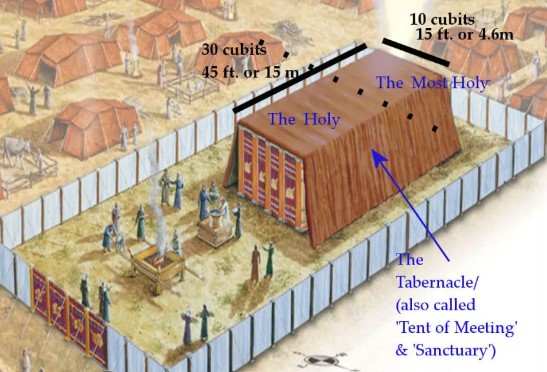
The Tabernacle prefigured what would become the Temple-Sanctuary—first in Solomon’s Temple, and later in Herod’s Temple. In the Sanctuary there are the Holy and the Most Holy. In front of the Sanctuary lies the enclosed courtyard.
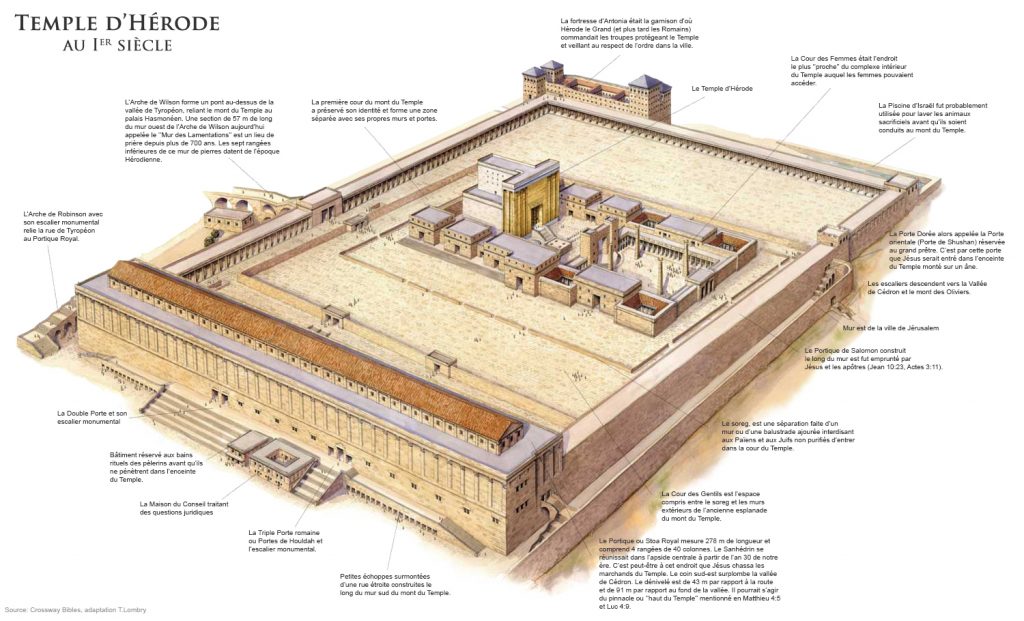
The temple is a place where we worship God. The Great Temple had two major parts (see the photo of the Temple of King Herod, at the time Jesus Christ ministered on earth, comments are written in French):
1 – The Outer Courtyard of the Gentiles (or nations), surrounded by external fortifications, constitutes the « great temple ».
2 – The temple sanctuary is the tall T-shaped building, with the small inner courtyard in front of its large porch where there was the large copper sea of water and the sacrificial altar.
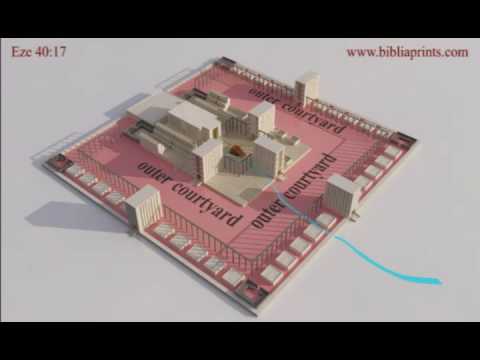
In the representation of the temple, seen in vision by the prophet Ezekiel, modeled in broad outline on the plans of the tabernacle and later the temple of Solomon, allows us to have a more simplified view to better visualize the explanations that follow. The red section (Outer Courtyard) represents the courtyard of the great temple. The white section represents the temple-sanctuary itself, with the inner courtyard and the sanctuary.
THE TEMPLE SANCTUARY
SOLOMON’S TEMPLE VIDEO
1 KINGS Chapter 6
(PLEASE, CLICK ON THE LINK TO SEE THE VIDEO)

Video explanation
Freeze-frame at 1 minute: General view of Solomon’s Temple. The large, walled courtyard corresponds to the main temple complex. This large courtyard was known as the Court of the Gentiles, because Gentiles—people from the nations—were permitted to enter it. In the top-left corner stands the Temple Sanctuary itself, with the small inner courtyard and the sanctuary building. The video provides a graphic description of the Temple Sanctuary and the inner courtyard.
Freeze-frame at 1 minute 14 seconds: General view of the Temple Sanctuary. There is a circular copper water basin. Next is the altar—also made of copper—situated in front of the Sanctuary entrance. The Sanctuary entrance is the white building.
Freeze-frame at 2 minutes 26 seconds: Entrance to the Sanctuary, opening directly into the Holy. The furnishings—consisting of the lampstands and the incense altar—were made of gold.
Freeze-frame at 3 minutes 18 seconds: Opening to the Most Holy Place, which housed the Ark of the Covenant—a gold-covered chest topped by two cherubim (the incense altar is depicted facing the entrance to the Most Holy Place).
Freeze-frame at 3 minutes 28 seconds: General view of the Most Holy, featuring the Ark of the Covenant. On the left stands the High Priest; he was the only person permitted to enter the presence of the Ark of the Covenant, and only once a year—on the 10th of Ethanim (Tishri), the Day of Atonement (Yom Kippur).
Freeze-frame at 3 minutes 45 seconds: Close-up view of the Ark of the Covenant, with the two cherubim on its lid. Acacia wood poles were attached to each side to allow for its transport.
Freeze-frame at 3 minutes and 58 seconds: Opening of the Ark of the Covenant, containing the two tablets of the Ten Commandments.
***
The Book of Revelation enables us to fully understand the symbolism of the Temple built in Jerusalem. In Chapter 1, the glorified Jesus Christ is described as standing among seven golden lampstands. Clearly, He is in the Holy of the temple-sanctuary, dressed in priestly garments:
“I turned to see who was speaking with me, and when I turned, I saw seven golden lampstands, 13 and in the midst of the lampstands someone like a son of man, clothed in a garment that reached down to the feet and wearing a golden sash around his chest. 14 Moreover, his head and his hair were white as white wool, as snow, and his eyes were like a fiery flame, 15 and his feet were like fine copper when glowing in a furnace, and his voice was like the sound of many waters. 16 And he had in his right hand seven stars, and out of his mouth a sharp, long, two-edged sword was protruding, and his countenance was like the sun when it shines at its brightest. 17 When I saw him, I fell as dead at his feet. (…) As for the sacred secret of the seven stars that you saw in my right hand and of the seven golden lampstands: The seven stars mean the angels of the seven congregations, and the seven lampstands mean the seven congregations” (Revelation 1:12–17, 20).
The seven lampstands represent the seven congregations, and the seven stars represent the angels or overseers of the congregations. Thus, the whole Christian congregations is situated in the Holy Place of the spiritual temple-sanctuary. The overseers or local administrators of the Christian congregations are in Christ’s right hand. Consequently, no human religious organization should interpose itself between Christ and the local congregations administered by the overseers, because Christ is the only mediator between God and men: “For there is one God, and one mediator between God and men, a man, Christ Jesus” (1 Timothy 2:5).
God and His Son Jesus Christ have no need for a globalized religious organization—the kind that inevitably becomes corrupted over time. The messages to the seven local congregations demonstrate this. Imagine for a moment a globalized Christian organization managing hundreds, or even thousands, of local congregations, all sharing the same flaws found in the congregations of Sardis and Laodicea; a flaw in a single local congregation would escalate into a worldwide deviation. The history of spiritual deviations within major European and American global churches bears this out. The evidence reveals serious deviation: the assimilation of pagan religious rites by major European churches, and—in the case of globalized churches of American origin—a form of prostitution within the financial world (a matter left to the reader’s discernment).
What should be done if a local congregation finds itself under the completely wayward authority of an international religious organization that claims to be Christian? The exhortation to flee Babylon the Great applies to these globalized religious organizations that shamelessly prostitute themselves with paganism and finance:
“And I heard another voice out of heaven say: “Get out of her, my people, if you do not want to share with her in her sins, and if you do not want to receive part of her plagues. For her sins have massed together clear up to heaven, and God has called her acts of injustice to mind” (Revelation 18:4,5).
The local overseers of these congregations must break away from these apostate globalized organizations that illegitimately place themselves between local congregations and Christ.
What do we think about the sale of the Kingdom Halls dedicated to God?
Article rédigé en français
Artículo escrito en español
Artigo escrito em português
***
The Measuring of the Temple-Sanctuary by the Apostle John
and the Administration of the Christian Congregation
“And a reed like a rod was given to me as he said: “Get up and measure the temple sanctuary of God and the altar and those worshipping in it. But as for the courtyard that is outside the temple sanctuary, leave it out and do not measure it, because it has been given to the nations, and they will trample the holy city underfoot for 42 months”
(Revelation 11:1, 2)
The angel’s precise instructions are that the apostle John, in a vision, is to measure only the Temple-Sanctuary—that is, the inner court with the copper basin and the copper altar, as well as the sanctuary itself, with the Holy and the Most Holy. The Temple-Sanctuary is the place where those who worship God are found. Thus, Christian congregations are located only within the Holy Place of the Temple-Sanctuary, where the seven lampstands are situated (Revelation chapters 1 to 3).
The angel instructs the apostle John not to measure the court outside the Temple-Sanctuary—namely, the Court of the Gentiles belonging to the great temple (see the explanations and photos above)—because it has been given to the nations. We can readily infer that the court of the great temple represents the earthly realm occupied by the nations that govern without God’s intervention; for this reason, they are not “measured” according to God’s standard by the apostle John.
The measuring of the Temple-Sanctuary represents a form of administration—that of God acting through His Son, Jesus Christ, the High Priest. Christ Himself uses the seven stars in His right hand to administer local Christian congregations by means of local overseers or administrators (1 Timothy 2:5 and chapter 3). The very fact that it is the apostle John who performs the measuring—an apostle appointed by Christ—demonstrates that the application of biblical principles within local congregations (represented by the measuring reed) is carried out by humans serving as local administrators or overseers, just as the apostle did.
When reading about the measuring of the New Jerusalem (in Revelation 21:15–21), we observe that it is no longer a human doing the measuring, but an angel, and that the reed is made of gold. This signifies that after the Great Tribulation—when the whole earth comes fully under the governance of the New Jerusalem, the Kingdom of God—it is the angels who will step in to enforce the new heavenly standards (the golden reed) upon all of humanity; these standards derive from the new scrolls mentioned in Revelation chapter 20.
***
THE TEMPLE OF THE BODY OF CHRIST
The spiritual temple sanctuary (The Holy), is symbolized by the body of Christ, according to the Apostle John: « The Jews then said: “This temple was built in 46 years, and will you raise it up in three days?” But he was talking about the temple of his body. When, though, he was raised up from the dead, his disciples recalled that he used to say this, and they believed the scripture and what Jesus had spoken » (John 2:20-22).
This means that the spiritual sanctuary is the pattern of the human body when he worships Jehovah. The spiritual body of Jesus Christ, represents the spiritual temple sanctuary, the Christian congregation administered to worship Jehovah. This is what the Apostle Paul explained in 1 Corinthians 12: « Now you are Christ’s body, and each of you individually is a member. And God has assigned the respective ones in the congregation: first, apostles; second, prophets; third, teachers; then powerful works; then gifts of healings; helpful services; abilities to direct; different tongues. Not all are apostles, are they? Not all are prophets, are they? Not all are teachers, are they? Not all perform powerful works, do they? Not all have gifts of healings, do they? Not all speak in tongues, do they? Not all are interpreters, are they? But keep striving for the greater gifts. And yet I will show you a surpassing way » (1 Corinthians 12:27-31).
The administration of the Christians congregation, with their different spiritual gifts, given by God, together represent the spiritual body of Christ and the spiritual temple sanctuary.
Jesus Christ is the only way to everlasting life
THE TEMPLE OF THE HUMAN BODY
Nevertheless, the Apostle Paul and also the Apostle Peter emphasized that on an individual level, the human body of the Christian who worships God, may also represent the spiritual temple sanctuary made to worship God:
« Do you not know that you yourselves are God’s temple and that the spirit of God dwells in you? » (1 Corinthians 3:16).
« But I consider it right, as long as I am in this tabernacle, to stir you with reminders, knowing as I do that my tabernacle is soon to be removed, just as also our Lord Jesus Christ made clear to me » (2 Peter 1:13,14).
The Holy represents the symbolic heart where Christ must symbolically live: « and that through your faith you may have the Christ dwell in your hearts with love. May you be rooted and established on the foundation » (Ephesians 3:17). The human symbolic heart represents the spiritual inner part of the human being.
This symbolic heart must have a spiritual circumcision, that is to say, to remove the symbolic « prepuce », the bad reasonings that can make impure: « However, whatever comes out of the mouth comes from the heart, and those things defile a man. For example, out of the heart come wicked reasonings, murders, adulteries, sexual immorality, thefts, false testimonies, blasphemies. These are the things that defile a man; but to take a meal with unwashed hands does not defile a man » (Matthew 15:18-20). « But he is a Jew who is one on the inside, and his circumcision is that of the heart by spirit and not by a written code. That person’s praise comes from God, not from people » (Romans 2:29; Deuteronomy 10:16).
The lampstand that illuminates the inner part of the human body, the spiritual heart, the spiritual Holy, according to Jesus Christ, are the eyes: « The lamp of the body is the eye. If, then, your eye is focused, your whole body will be bright. But if your eye is envious, your whole body will be dark. If the light that is in you is really darkness, how great that darkness is! » (Matthew 6:22,23).
The altar and the offerings, made in the spiritual courtyard of the temple sanctuary, represents the lips (altar) and the words that come out of it (spiritual offerings): « And we will offer the praise of our lips as we would young bulls » (Hosea 14:2). « Through him let us always offer to God a sacrifice of praise, that is, the fruit of our lips that make public declaration to his name » (Hebrews 13:15).
The preaching of the Good News is a spiritual sacrifice as spiritual offering to God (Matthew 24:14)
Blood is sacred and it is the symbol of life
The conclusion regarding the administration
of the Christian congregation
In the prophecy of Revelation, it represents the worldwide Christian congregation. But what does it mean that the Apostle John measures the spiritual temple sanctuary, and not the outer courtyard given to the nations. The « Measuring » is a judgment, or an authority that does not exceed the limits of the spiritual sanctuary temple (Amos 7:7-9).
The fact that God asks the apostle John to measure shows that this authority was given to a man, the apostle John, who was probably the last apostle still alive. More generally, the measuring of the spiritual sanctuary, symbolizes the authority on earth, within this spiritual temple sanctuary, the Christian congregation, would be entrusted to men (and not in the outer courtyard of this Sanctuary): « They are no part of the world, just as I am no part of the world » (John 17:16)) ((Revelation 11: 1,2). It is again the Apostle Paul who showed how a congregation should be administered.
By remembering the texts of Hebrews 10:1 and Colossians 2:17, which show that the Law is the prophetic shadow of the fulfillment in the Christian congregation, makes it possible to better understand its administration. For example, the Elders represent the Priests in the Holy of the Temple Sanctuary. These Elders represent the Human Angels or Messengers of God and his Son Jesus Christ (1 Timothy 3:1-7; Tite 1:5-9; Apocalypse 2 and 3). While Ministerial Servants represent the Nonpriestly Levites which mainly help the Elders in the material administration of the Christian congregation (1 Timothy 3:8-10,12,13).
***
The answer will be based on the Bible (Sola Scriptura) and, specifically, on the context of early Christianity as described in the Acts of the Apostles and the diferent letters written by Christ’s apostles and disciples…
As suggested by the glorified Jesus Christ, the Christian congregation must be administered by at least one « angel », a « messenger » or a « priest » who transmits to the congregation the sacred declarations of God, through the Bible…
Still proceeding from the important premise that the Mosaic Law is a prophetic pattern of the Christian congregation belonging to Christ, we will examine what corresponds to the role of ministerial servants…
The elders are teachers, those who represent the congregation with prayers and if necessary, they judge in the congregation. The ministerial servants are primarily working in the material stewardship of the Christian congregation…
Should a Christian congregations be administered on a global or a local level?
Jesus Christ speaks of this slave in the singular, meaning that it could be a single person or a group of people? When does He identify and reward this slave? Shortly after 1914, or shortly before the Great Tribulation?
The messages of Jesus Christ to the seven congregations are indications on the administration of the Christian Congregation…
***
Table of contents of the http://yomelyah.fr/ website
Reading the Bible daily, this table of contents contains informative Bible articles
Table of languages of more than seventy languages, with six important biblical articles, written in each of these languages…
***