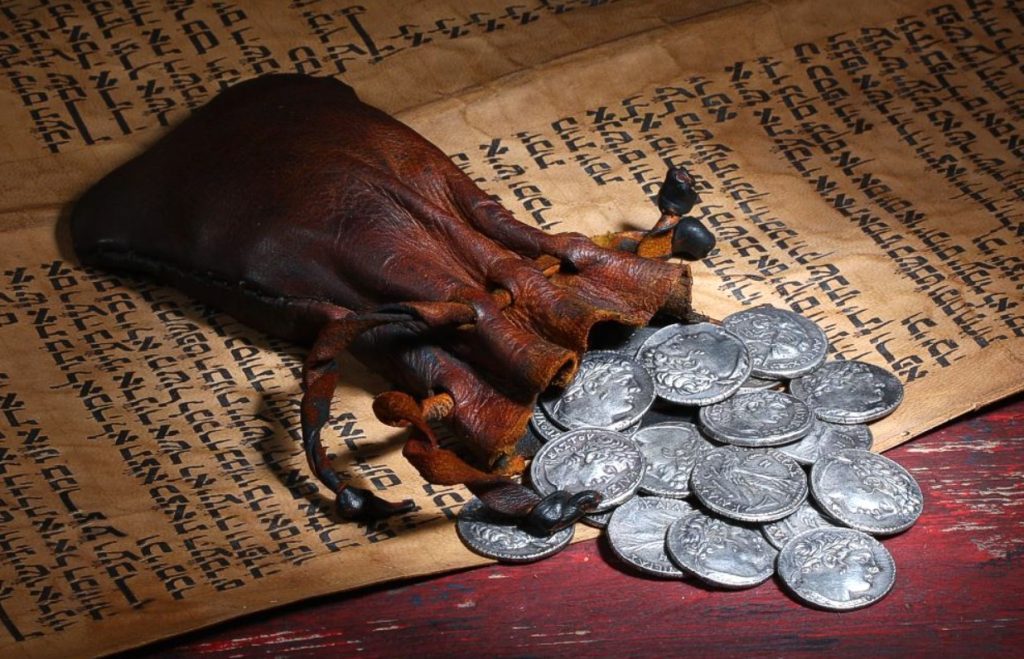
« Then I said to them: “If it seems good to you, give me my wages; but if not, withhold them.” And they paid my wages, 30 pieces of silver »
(Zechariah 11:12)
This prophecy of Zechariah alludes to the betrayal of Judas Iscariot, who delivered his master, Jesus Christ, into the hands of his adversaries, ultimately murdering him:
» Then I said to them: “If it seems good to you, give me my wages; but if not, withhold them.” And they paid my wages, 30 pieces of silver.
13 Then Jehovah said to me: “Throw it into the treasury—the magnificent value with which they valued me.” So I took the 30 pieces of silver and threw it into the treasury at the house of Jehovah » (Zechariah 11:12, 13).
The Gospel accounts of this event:
“Then one of the Twelve, the one called Judas Iscariot, went to the chief priests 15 and said: “What will you give me to betray him to you?” They stipulated to him 30 silver pieces. 16 So from then on, he kept looking for a good opportunity to betray him” (Matthew 26:14-16).
“And Judas Iscariot, one of the Twelve, went off to the chief priests in order to betray him to them. 11 When they heard it, they were delighted and promised to give him silver money. So he began seeking an opportunity to betray him” (Mark 14:10,11).
Judas Iscariot regretted his action, but too late, and here is what is written later in the story in connection with Zechariah’s prophecy:
“Then Judas, his betrayer, seeing that Jesus had been condemned, felt remorse and brought the 30 pieces of silver back to the chief priests and elders, 4 saying: “I sinned when I betrayed innocent blood.” They said: “What is that to us? You must see to it!” 5 So he threw the silver pieces into the temple and departed. Then he went off and hanged himself. 6 But the chief priests took the silver pieces and said: “It is not lawful to put them into the sacred treasury, because they are the price of blood.” 7 After consulting together, they used the money to buy the potter’s field as a burial place for strangers. 8 Therefore, that field has been called Field of Blood to this very day. 9 Then what was spoken through *Jeremiah the prophet was fulfilled: “And they took the 30 silver pieces, the price that was set on the man, the one on whom a price was set by some of the sons of Israel, 10 and they gave them for the potter’s field, according to what Jehovah had commanded me”” (Matthew 27:3-10). * This name is corrected in the margin: : Syh(marge): “Zechariah”.
***
Reading chapter 11 of the book of Zechariah is disconcerting because the overall context presents God as the one who appoints useless shepherds who feed themselves. It is important to understand why God allows wickedness and suffering in order to grasp the meaning of the statement (there is a very detailed study of this question on one page; please click on the link to access to the study: Why God Allowed Suffering and Wickedness ?).
While in chapter 10, God promises to appoint fine shepherds, in chapter 11, it is written that He appoints useless shepherds:
“Against the shepherds my anger has grown hot, and against the goatlike leaders I shall hold an accounting; for Jehovah of armies has turned his attention to his drove, the house of Judah, and has made them like his horse of dignity in the battle. 4 Out of him is the keyman, out of him is the supporting ruler, out of him is the battle bow; out of him goes forth every taskmaster, all together” (Zechariah 10:3,4).
“And Jehovah went on to say to me: “Take yet for yourself the implements of a useless shepherd. 16 For here I am letting a shepherd rise up in the land. To the [sheep] being effaced he will give no attention. The young one he will not seek, and the broken [sheep] he will not heal. The one stationing herself he will not supply [with food], and the flesh of the fat one he will eat, and the hoofs of the [sheep] he will tear off. 17 Woe to my valueless shepherd, who is leaving the flock! A sword will be upon his arm and upon his right eye. His own arm will without fail dry up, and his own right eye will without fail grow dim” (Zechariah 11:15-17).
When the Jews returned from captivity in Babylon to Jerusalem, God did indeed establish fine shepherds, such as Zerubbabel and Joshua (the two anointed ones), Nehemiah, Ezra, and the prophets Zechariah and Haggai, to encourage the people in the rebuilding of the city of Jerusalem and the temple.
From the period of these historical events until the coming of the Messiah Jesus Christ, a little over five hundred years passed. During this time, the Jewish people did not fall back into idolatry as it existed before the Babylonian deportation and the seventy years of exile (as described in the books of Isaiah, Jeremiah, and Ezekiel). Nevertheless, a situation developed that gave rise to a class of useless shepherds who neglected and despised the people. Chapter 11 seems to allude to this situation, in which Jesus Christ, the fine shepherd, found himself five hundred years later, among bad shepherds. Here is what is written in the Gospels to illustrate this situation:
“And Jesus set out on a tour of all the cities and villages, teaching in their synagogues and preaching the good news of the Kingdom and curing every sort of disease and every sort of infirmity. 36 On seeing the crowds, he felt pity for them, because they were skinned and thrown about like sheep without a shepherd. 37 Then he said to his disciples: “Yes, the harvest is great, but the workers are few. 38 Therefore, beg the Master of the harvest to send out workers into his harvest”” (Matthew 9:35-38).
“The apostles gathered around Jesus and reported to him all the things they had done and taught. 31 And he said to them: “Come, you yourselves, privately into an isolated place and rest up a little.” For there were many coming and going, and they had no leisure time even to eat a meal. 32 So they set off in the boat for an isolated place to be by themselves. 33 But people saw them going and many got to know it, and from all the cities they ran together on foot and got there ahead of them. 34 Well, on getting out, he saw a large crowd, and he was moved with pity for them, because they were as sheep without a shepherd. And he started to teach them many things” (Mark 6:30-34).
However, according to the prophecy of Zechariah, chapter 11, God allowed this situation to develop, allowing useless leaders to appear among the nations, not only within his own people, but also at the direct instigation of Satan the devil (Zechariah chapter 3, Satan at the right hand of Joshua). Why? Because God set a time for the nations to govern themselves, without his direct intervention. This period is referred to by Jesus Christ as the appointed time of the nations: « Jerusalem will be trampled on by the nations, until the appointed times of the nations are fulfilled » (Luke 21:24).
The incapable shepherds of the nations and those of God’s people would each have a staff: “And I proceeded to shepherd the flock [meant] for the killing, in your behalf, O afflicted ones of the flock. So I took for myself two staffs. The one I called Pleasantness, and the other I called Union, and I went shepherding the flock” (Zechariah 11:7).
God will decree that the staff called Pleasantness be broken, which will mean that, at the end of a set period, he will make the useless shepherds of the nations disappear:
“At length I said: “I shall not keep shepherding you. The one that is dying, let her die. And the one that is being effaced, let her be effaced. And as for the ones left remaining, let them devour, each one the flesh of her companion.” 10 So I took my staff Pleasantness and cut it to pieces, in order to break my covenant that I had concluded with all the peoples. 11 And it came to be broken in that day, and the afflicted ones of the flock who were watching me got to know in this way that it was the word of Jehovah” (Zechariah 11:9-11).
The disappearance of the useless shepherds who oppress the people will take place during the day of Jehovah, mentioned in the prophecy of Zechariah:
“And it must occur in that day [that] there will prove to be no precious light—things will be congealed. 7 And it must become one day that is known as belonging to Jehovah. It will not be day, neither will it be night; and it must occur [that] at evening time it will become light. 8 And it must occur in that day [that] living waters will go forth from Jerusalem, half of them to the eastern sea and half of them to the western sea. In summer and in winter it will occur. 9 And Jehovah must become king over all the earth. In that day Jehovah will prove to be one, and his name one” (Zechariah 14:6-9).
This special day is the great tribulation mentioned in the prophecies of Daniel, Jesus Christ, and the Book of Apocalypse (Daniel 12:1; Matthew 24:21-22; Apocalypse 7:9, 14; chapters 14 and 19).
Regarding the staff called Union, belonging to the useless shepherds who had infiltrated God’s people, it has been broken, following the mention of the price of betrayal in Zechariah chapter 11:
“Then I said to them: “If it is good in YOUR eyes, give [me] my wages; but if not, refrain.” And they proceeded to pay my wages, thirty pieces of silver.
13 At that, Jehovah said to me: “Throw it to the treasury—the majestic value with which I have been valued from their standpoint.” Accordingly I took the thirty pieces of silver and threw it into the treasury at the house of Jehovah.
14 Then I cut in pieces my second staff, the Union, in order to break the brotherhood between Judah and Israel” (Zechariah 11:12-14).
The fine shepherd has been struck down and killed by the useless shepherds, and his sheep have been temporarily scattered:
« O sword, awake against my shepherd, even against the able-bodied man who is my associate,” is the utterance of Jehovah of armies. “Strike the shepherd, and let those of the flock be scattered; and I shall certainly turn my hand back upon those who are insignificant » (Zechariah 13:7).
It is written regarding the fulfillment of this prophecy:
« And Jesus said to them: “YOU will all be stumbled, because it is written, ‘I will strike the shepherd, and the sheep will be scattered about’ » (Mark 14:27).
Because of the serious sins of the useless shepherds who plotted the assassination of the Son of God, Jesus Christ, God broke the staff of Union, that special relationship He had with Israel, Judah, and Jerusalem. This divine decision has been proclaimed by Jesus Christ shortly before His death:
» Jerusalem, Jerusalem, the killer of the prophets and stoner of those sent forth to her,—how often I wanted to gather your children together, the way a hen gathers her chicks together under her wings! But you people did not want it. 38 Look! youe house is abandoned to you. 39 For I say to you, you will by no means see me from henceforth until you say, ‘Blessed is he that comes in Jehovah’s name!’ » (Matthew chapter 23).
From this time, Israel is replaced by the spiritual Israel of God:
« Upon them be peace and mercy, even upon the Israel of God » (Galatians 6:16).
Jerusalem will be replaced by the Heavenly New Jerusalem:
« And I saw a new heaven and a new earth; for the former heaven and the former earth had passed away, and the sea is no more. 2 I saw also the holy city, New Jerusalem, coming down out of heaven from God and prepared as a bride adorned for her husband. 3 With that I heard a loud voice from the throne say: “Look! The tent of God is with mankind, and he will reside with them, and they will be his peoples. And God himself will be with them. 4 And he will wipe out every tear from their eyes, and death will be no more, neither will mourning nor outcry nor pain be anymore. The former things have passed away” » (Apocalypse 21:1-4).
* YHWH is the tetragrammaton, or four-letter for the Divine Name. In the New World Translation of the Bible, it appears with the vocalization commonly used for centuries as « Jehovah ». This vocalization is doubly inaccurate because it inserts the pronunciation J instead of I (i) or Y, and the V corresponding to W, which is pronounced « U » or « ou » (not V). The correct vocalization of the Tetragrammaton is YeHou(W)aH, Yehouah. The inaccurate vocalization « Jehovah » is retained in the Bible translation used, just as the inaccurate vocalization of « Jesus, » pronounced Yeshua or Yeshoua, because they are the most known to readers (click on the link to examine the study on the Divine Name in more detail: The Divine Name YHWH is pronounced as it is written).
***
The Prophecy of the Book of Zechariah
The prophecy of Zechariah and its prophetic riddles, explanations to know the future…
The Prophecy of Gog of Magog (Ezekiel 38 and 39)
Gog of Magog is a coalition of nations that are currently persecuting God’s people…
The Synopsis of the Study of the Prophecy of Daniel
The study of the Prophecy of Daniel is the analysis of current prophetic events in the Middle East and in the World…
In the question of Matthew 24:3, there are three important words that allow us to understand its meaning and the answer of Christ…
The Greek word translated as « presence, » mentioned in Matthew (24:3), is “πάρειμι”, “parousia” (Strong’s Concordance (G3952))…
The biblical account shows that the investiture of a king at the head of a kingdom occurs in two stages…
The verse 29, describes the signs before the « coming, » not the « presence, » of the Son of Man…
***
Reading the Bible daily, this table of contents contains informative Bible articles (Please click on the link above to view it)…
Table of languages of more than seventy languages, with six important biblical articles, written in each of these languages…
***