“Then I looked up again and saw four chariots coming from between two mountains, and the mountains were of copper. The first chariot had red horses, and the second chariot, black horses. The third chariot had white horses, and the fourth chariot, speckled and dappled horses”
(Zechariah 6:1-3)
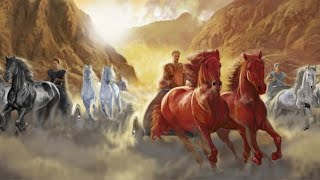
The vision of the four chariots emerging from between the two mountains of copper seems to conclude the series of visions that began in chapter 1. To understand this last vision, while remaining within the immediate context of Zechariah’s prophecy, it is important to consider that they reiterate a simple message, which should be recalled: God will help his people, returned from Babylon, to Jerusalem, in the tribe of Judah, to rebuild the city and its temple, through Zerubbabel, the royal prince, and Joshua, the high priest. The parallel historical accounts in the books of Ezra and Nehemiah show that God also used faithful servants and prophets to encourage his people in this rebuilding, such as Haggai, Zechariah, Ezra, and Nehemiah.
The second aspect of the message, is that God will hold accountable the nations that caused the ruin of Israel, the tribe of Judah, and Jerusalem. These hostile nations that destroyed Jerusalem, the tribe of Judah, and Israel are represented by the four horns in the vision at the end of chapter 1. This brief summary is to indicate that the last vision (in this series) of the four chariots must be connected to the vision of the red rider in the myrtle field in the other three visions, as well as to the vision of the four horns and God’s subsequent message concerning them. Without this connection, it is not possible to find coherence in the vision of the four chariots emerging from between the two mountains within the immediate context of the beginning of chapter 6 (it is necessary to read the preceding accounts to understand this):
“Then I looked up again and saw four chariots coming from between two mountains, and the mountains were of copper. 2 The first chariot had red horses, and the second chariot, black horses. 3 The third chariot had white horses, and the fourth chariot, speckled and dappled horses.
4 I asked the angel who was speaking with me: “What are these, my lord?”
5 The angel answered me: “These are the four spirits of the heavens that are going out after having taken their station before the Lord of the whole earth. 6 The one with the black horses is going out to the land of the north; the white ones are going out beyond the sea; and the speckled ones are going out to the land of the south. 7 And the dappled ones were eager to go out to walk about through the earth.” Then he said: “Go, walk about through the earth.” And they began walking about through the earth.
8 He then called out to me and said: “See, those going out to the land of the north have caused the spirit of Jehovah to rest in the land of the north”” (Zechariah 6:1-8).
What do the two copper mountains represent? The visions are particularly focused on the city of Jerusalem. The city is built on two hills or mountains. The more well-known one is Mount Zion, and the lesser-known one is Mount Moriah. Always taking into account the same historical context and biblical geography, the angel’s explanations help to solve this riddle. The solution seems to be found a little further on in the prophecy: “Jehovah will go out and war against those nations as when he fights in the day of a battle. In that day his feet will stand on the Mount of Olives, which faces Jerusalem on the east; and the Mount of Olives will be split in half, from east to west, forming a very great valley; and half of the mountain will move to the north, and half of it to the south” (Zechariah 14:3,4).
This prophecy foretells that these two mountains will be separated by a large valley: to the north, is Mount Moriah, where the temple of Jerusalem was built, and to the south, Mount Zion, where there was the royal residence of King David. Thus, Jerusalem, through these two mountains, symbolizes the sovereignty of Jehovah God through kingship (The Davidic dynasty being in the tribe of Judah), Mount Zion, and sovereignty through the priesthood, Mount Moriah (Jerusalem). The copper symbolizes the metal with which the utensils were made in the courtyard of the sanctuary temple, particularly the copper altar with the four horns (Exodus 27:2; 2 Kings 16:14).
The four chariots could correspond to the four horsemen of the first vision (chapter 1), in a different context: that of battle and divine vengeance against the four horns mentioned at the end of that first vision. The four chariots represent the four spirits of God.
The « four » chariots seem to evoke the expression of God’s sovereignty through war (the chariots) (against the four horns of the nations), positioned at three cardinal points with specific symbolism (north, west (the sea), and south), with the third circulating both in the south and throughout the earth (Zechariah 6:5-7). The fact that no explanation is given for the presence of the first chariot with the red horses suggests that it is the same horseman who is at the head of the chariot in the riddle of the myrtles (Zechariah 1:7-8). The two riddles are similar.
The three cardinal directions seem to indicate the source of misfortune upon Israel, Jerusalem, and the tribe of Judah: Assyria and Babylon came from the north to destroy the city of Jerusalem (the Babylonians), as this was the easiest way. Syria is also mentioned from the north in connection with a message of condemnation from God, in the prophecy of Zechariah (9:1) (Jeremiah 25:9 (Babylon); Ezekiel 26:7 (Babylon); Zechariah 10:10, 11 (Assyria)). The west and south could represent the cardinal directions where the nations that contributed to the destruction of Jerusalem by helping the Babylonians were located: Philistia, Sidon, and Tyre to the west (Ezekiel 26:1-6; Joel 3:4-8; Zechariah 9:2-8), and Egypt and Edom to the south (Joel 3:19-21; Zechariah 10:8-10). The east is not mentioned; at the same latitude as Jerusalem were tribes belonging to Israel (Reuben and Gad, further north). This region is now part of Jordan.
Of course, if this prophecy concerned only the past, it would no longer be a prophecy for our time; it would have only cultural value and nothing more. It is evident that it has an allegorical value that concerns our time, when God will hold accountable all the nations (the four horns) that are currently attacking and devastating God’s people, the spiritual Israel of God (Galatians 6:16).
This will be, according to the prophecy of Zechariah, the Day of *Jehovah (YHWH), which will correspond to the great tribulation mentioned in the prophecy of Daniel (12:1) and that of Jesus Christ (Matthew 24:21, 22):
“And it will become one day that is known as belonging to Jehovah. It will not be day, nor will it be night; and at evening time there will be light. In that day living waters will flow out from Jerusalem, half of them toward the eastern sea and half of them toward the western sea. It will happen in summer and in winter. And Jehovah will be King over all the earth. In that day Jehovah will be one, and his name one” (Zechariah 14:7-9).
* YHWH is the tetragrammaton, or four-letter for the Divine Name. In the New World Translation of the Bible, it appears with the vocalization commonly used for centuries as « Jehovah ». This vocalization is doubly inaccurate because it inserts the pronunciation J instead of I (i) or Y, and the V corresponding to W, which is pronounced « U » or « ou » (not V). The correct vocalization of the Tetragrammaton is YeHou(W)aH, Yehouah. The inaccurate vocalization « Jehovah » is retained in the Bible translation used, just as the inaccurate vocalization of « Jesus, » pronounced Yeshua or Yeshoua, because they are the most known to readers (click on the link to examine the study on the Divine Name in more detail: The Divine Name YHWH is pronounced as it is written).
***
The Prophecy of the Book of Zechariah
The prophecy of Zechariah and its prophetic riddles, explanations to know the future…
The Prophecy of Gog of Magog (Ezekiel 38 and 39)
Gog of Magog is a coalition of nations that are currently persecuting God’s people…
The Synopsis of the Study of the Prophecy of Daniel
The study of the Prophecy of Daniel is the analysis of current prophetic events in the Middle East and in the World…
In the question of Matthew 24:3, there are three important words that allow us to understand its meaning and the answer of Christ…
The Greek word translated as « presence, » mentioned in Matthew (24:3), is “πάρειμι”, “parousia” (Strong’s Concordance (G3952))…
The biblical account shows that the investiture of a king at the head of a kingdom occurs in two stages…
The verse 29, describes the signs before the « coming, » not the « presence, » of the Son of Man…
***
Reading the Bible daily, this table of contents contains informative Bible articles (Please click on the link above to view it)…
Table of languages of more than seventy languages, with six important biblical articles, written in each of these languages…
***