« And I will become to her,” declares Jehovah, “a wall of fire all around, and I will become the glory in her midst »
(Zechariah 2:5)
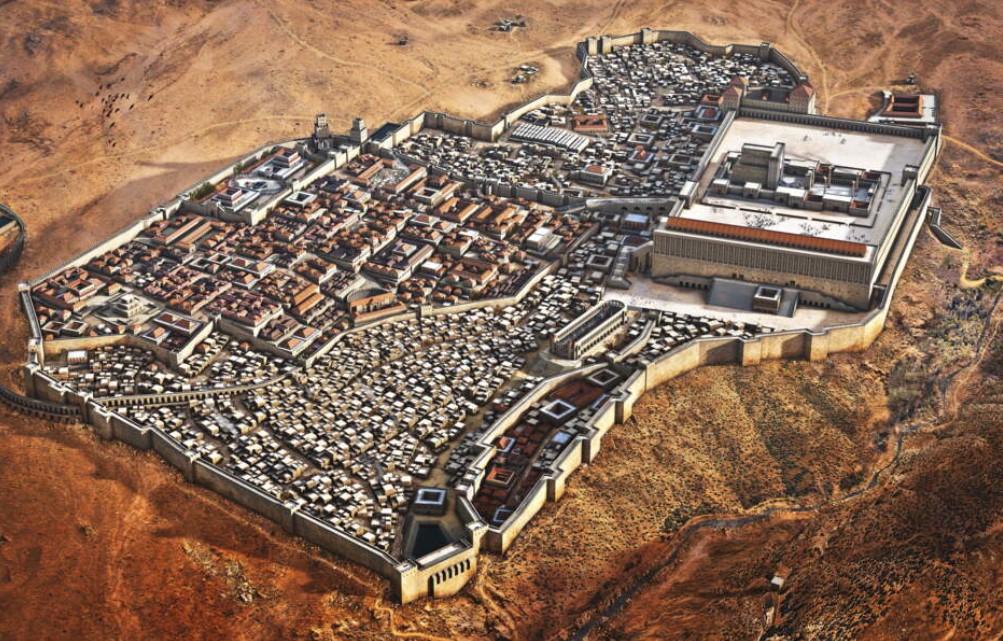
This New Jerusalem is the one that was rebuilt after the return from exile in Babylon, following Cyrus’s edict in 537 BCE (see the page on the historical context of Zechariah’s prophecy).
“And I looked up and saw a man with a measuring line in his hand. 2 So I asked: “Where are you going?”
He replied: “To measure Jerusalem, to see what is her width and what is her length.”
3 And look! the angel who was speaking with me went out, and another angel came to meet him. 4 Then he said to him: “Run over there and tell that young man, ‘“Jerusalem will be inhabited as open rural country, because of all the men and livestock within her. 5 And I will become to her,” declares Jehovah, “a wall of fire all around, and I will become the glory in her midst” (Zechariah 2:1-5).
It is written that this earthly new Jerusalem would be measured; the meaning of this statement is explained in Zechariah 1:16: « And a measuring line will be stretched out over Jerusalem » (Zechariah 1:16). The earthly new Jerusalem would be rebuilt, with its walls and its temple, and on the foundations of divine justice imbued with mercy.
It is written: « Jerusalem will be inhabited as open rural country, because of all the men and livestock within her » (Zechariah 2:4). Indeed, historically, when the Jews arrived in Jerusalem, the city was unwalled and had been abandoned for 70 years. During the time of the city’s reconstruction, the new inhabitants would need divine protection. That is why God made this promise: « And I will become to her,” declares Jehovah, “a wall of fire all around, and I will become the glory in her midst » (Zechariah 2:5).
This prophecy has been fulfilled in the time of Nehemiah, according to the historical account in the book that bears his name. Nehemiah was a Jew, a cupbearer at the court of the Persian king Artaxerxes. With his permission, Nehemiah went to Jerusalem to organize the rebuilding of the walls of Jerusalem (Nehemiah 1:1, 2, 11; 2:1; 5:14, 16). (The beginning of the rebuilding of the walls of Jerusalem is linked to the prophecy in Daniel chapter 9 concerning the coming of Christ to earth). This book recounts how this rebuilding has been accomplished, thanks to God’s protection and despite the hostility of the enemies (Nehemiah 6).
Through the encouragement of the prophet Zechariah, God addressed his words of comfort to the new inhabitants of Jerusalem, who were in a situation of discomfort and insecurity, facing the surrounding hostility of their enemies:
« Shout for joy, O daughter of Zion; for I am coming, and I will reside in your midst,” declares Jehovah. 11 “Many nations will join themselves to Jehovah in that day, and they will become my people; and I will reside in your midst.” And you will have to know that Jehovah of armies has sent me to you. 12 Jehovah will take possession of Judah as his portion on the holy ground, and he will again choose Jerusalem. 13 Be silent, all flesh, before Jehovah, for he is taking action from his holy dwelling » (Zechariah 2:10-13).
Why did this earthly new Jerusalem absolutely have to be rebuilt? Because, according to Zechariah’s prophecy, it would welcome the king from the line of David, chosen by God:
“Be very joyful, O daughter of Zion. Shout in triumph, O daughter of Jerusalem. Look! Your king himself comes to you. He is righteous, yes, saved; humble, and riding upon an ass, even upon a full-grown animal the son of a she-ass. 10 And I shall certainly cut off [the] war chariot from Ephraim and [the] horse from Jerusalem. And the battle bow must be cut off. And he will actually speak peace to the nations; and his rulership will be from sea to sea and from the River to the ends of [the] earth” (Zechariah 9:9,10).
This prophecy has been fulfilled approximately five hundred years later, in the person of King Jesus Christ, the Son of God, who entered this rebuilt Jerusalem, according to the Gospel accounts:
“So the disciples got on their way and did just as Jesus ordered them. 7 And they brought the ass and its colt, and they put upon these their outer garments, and he seated himself upon them. 8 Most of the crowd spread their outer garments on the road, while others began cutting down branches from the trees and spreading them on the road. 9 As for the crowds, those going ahead of him and those following kept crying out: “Save, we pray, the Son of David! Blessed is he that comes in Jehovah’s name! Save him, we pray, in the heights above!”” (Matthew 21:6-9).
Unfortunately, this earthly Jerusalem, five hundred years later, fell into a serious spiritual deviation, which led to the assassination of Jesus Christ by the Jewish religious leaders, using the Roman army (Matthew 27).
While King Jesus Christ inspected the city and its temple for three and a half years, this is the divine judgment he pronounced at the end of his earthly ministry against the religious leaders of his time and against this city, shortly before his death:
“Woe to you, scribes and Pharisees, hypocrites! because you shut up the kingdom of the heavens before men; for you yourselves do not go in, neither do you permit those on their way in to go in. 14 ——
15 “Woe to you, scribes and Pharisees, hypocrites! because you traverse sea and dry land to make one proselyte, and when he becomes one you make him a subject for Ge·henʹna twice as much so as yourselves.
16 “Woe to you, blind guides, who say, ‘If anyone swears by the temple, it is nothing; but if anyone swears by the gold of the temple, he is under obligation.’ 17 Fools and blind ones! Which, in fact, is greater, the gold or the temple that has sanctified the gold? 18 Also, ‘If anyone swears by the altar, it is nothing; but if anyone swears by the gift on it, he is under obligation.’ 19 Blind ones! Which, in fact, is greater, the gift or the altar that sanctifies the gift? 20 Therefore he that swears by the altar is swearing by it and by all the things on it; 21 and he that swears by the temple is swearing by it and by him that is inhabiting it; 22 and he that swears by heaven is swearing by the throne of God and by him that is sitting on it.
23 “Woe to you, scribes and Pharisees, hypocrites! because you give the tenth of the mint and the dill and the cumin, but you have disregarded the weightier matters of the Law, namely, justice and mercy and faithfulness. These things it was binding to do, yet not to disregard the other things. 24 Blind guides, who strain out the gnat but gulp down the camel!
25 “Woe to you, scribes and Pharisees, hypocrites! because you cleanse the outside of the cup and of the dish, but inside they are full of plunder and immoderateness. 26 Blind Pharisee, cleanse first the inside of the cup and of the dish, that the outside of it also may become clean.
27 “Woe to you, scribes and Pharisees, hypocrites! because you resemble whitewashed graves, which outwardly indeed appear beautiful but inside are full of dead men’s bones and of every sort of uncleanness. 28 In that way you also, outwardly indeed, appear righteous to men, but inside you are full of hypocrisy and lawlessness.
29 “Woe to you, scribes and Pharisees, hypocrites! because you build the graves of the prophets and decorate the memorial tombs of the righteous ones, 30 and you say, ‘If we were in the days of our forefathers, we would not be sharers with them in the blood of the prophets.’ 31 Therefore you are bearing witness against yourselves that you are sons of those who murdered the prophets. 32 Well, then, fill up the measure of your forefathers.
33 “Serpents, offspring of vipers, how are you to flee from the judgment of Gehenna? 34 For this reason, here I am sending forth to you prophets and wise men and public instructors. Some of them you will kill and impale, and some of them you will scourge in your synagogues and persecute from city to city; 35 that there may come upon you all the righteous blood spilled on earth, from the blood of righteous Abel to the blood of Zechariah son of Barachiah, whom you murdered between the sanctuary and the altar. 36 Truly I say to you, All these things will come upon this generation.
37 “Jerusalem, Jerusalem, the killer of the prophets and stoner of those sent forth to her,—how often I wanted to gather your children together, the way a hen gathers her chicks together under her wings! But you people did not want it. 38 Look! your house is abandoned to you. 39 For I say to you, you will by no means see me from henceforth until you say, ‘Blessed is he that comes in *Jehovah’s (YHWH) name!’” (Matthew 23:13-38).
« Look! your house is abandoned to you » (Matthew 23:38). King Jesus Christ announced the divine condemnation of this earthly Jerusalem and its future disappearance (Matthew 24), and it would be replaced this time by the heavenly New Jerusalem, mentioned in Apocalypse chapter 21:
“And I saw a new heaven and a new earth; for the former heaven and the former earth had passed away, and the sea is no more. 2 I saw also the holy city, New Jerusalem, coming down out of heaven from God and prepared as a bride adorned for her husband. 3 With that I heard a loud voice from the throne say: “Look! The tent of God is with mankind, and he will reside with them, and they will be his peoples. And God himself will be with them. 4 And he will wipe out every tear from their eyes, and death will be no more, neither will mourning nor outcry nor pain be anymore. The former things have passed away »” (Apocalypse 21:1-4).
* YHWH is the tetragrammaton, or four-letter for the Divine Name. In the New World Translation of the Bible, it appears with the vocalization commonly used for centuries as « Jehovah ». This vocalization is doubly inaccurate because it inserts the pronunciation J instead of I (i) or Y, and the V corresponding to W, which is pronounced « U » or « ou » (not V). The correct vocalization of the Tetragrammaton is YeHou(W)aH, Yehouah. The inaccurate vocalization « Jehovah » is retained in the Bible translation used, just as the inaccurate vocalization of « Jesus, » pronounced Yeshua or Yeshoua, because they are the most known to readers (click on the link to examine the study on the Divine Name in more detail: The Divine Name YHWH is pronounced as it is written).
***
The Prophecy of the Book of Zechariah
The prophecy of Zechariah and its prophetic riddles, explanations to know the future…
The Prophecy of Gog of Magog (Ezekiel 38 and 39)
Gog of Magog is a coalition of nations that are currently persecuting God’s people…
The Synopsis of the Study of the Prophecy of Daniel
The study of the Prophecy of Daniel is the analysis of current prophetic events in the Middle East and in the World…
In the question of Matthew 24:3, there are three important words that allow us to understand its meaning and the answer of Christ…
The Greek word translated as « presence, » mentioned in Matthew (24:3), is “πάρειμι”, “parousia” (Strong’s Concordance (G3952))…
The biblical account shows that the investiture of a king at the head of a kingdom occurs in two stages…
The verse 29, describes the signs before the « coming, » not the « presence, » of the Son of Man…
***
Reading the Bible daily, this table of contents contains informative Bible articles (Please click on the link above to view it)…
Table of languages of more than seventy languages, with six important biblical articles, written in each of these languages…
***