“Son of man, set your face against Gog of the land of Magog, the head chieftain of Meshech and Tubal, and prophesy against him”
(Ezekiel 38:2)
Who is Gog of Magog?
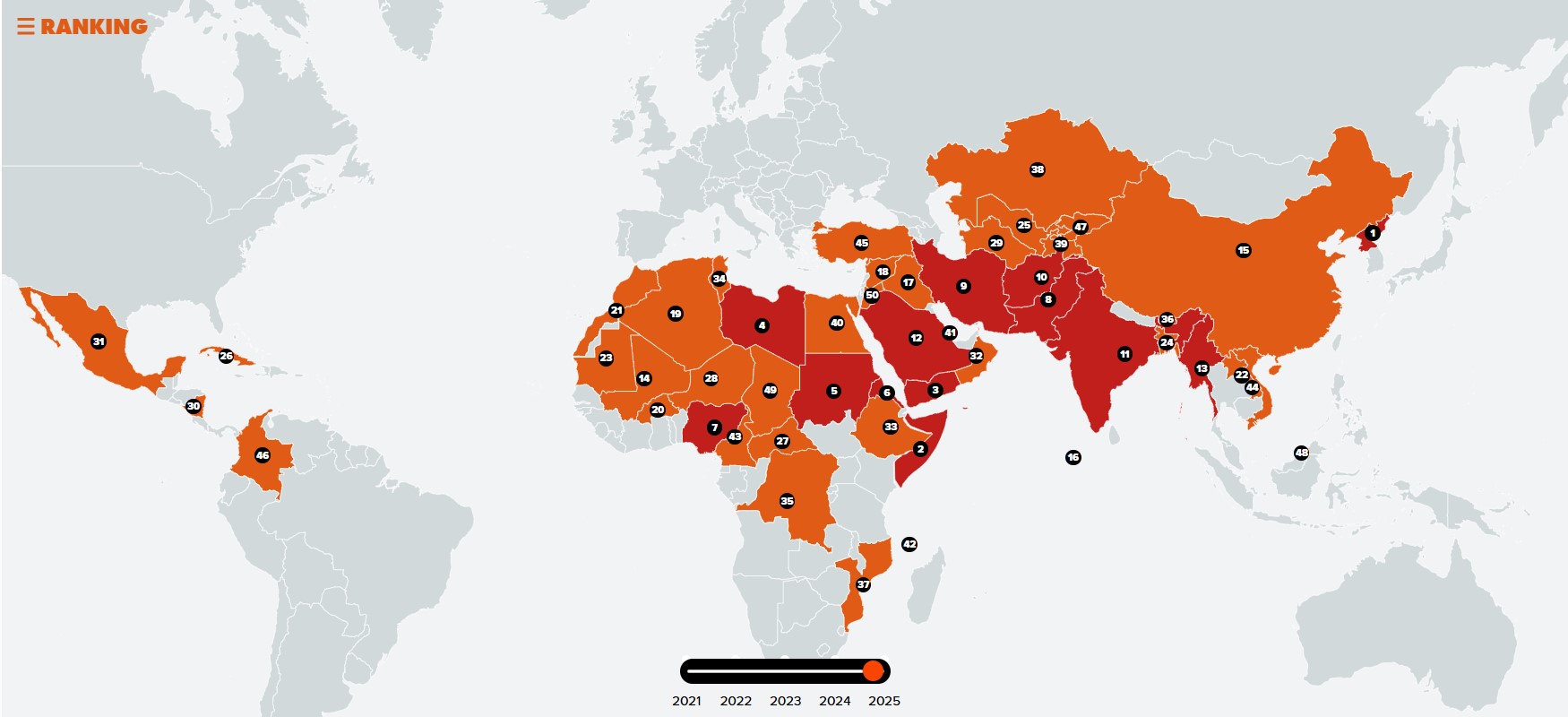
World Watch List 2025 of the 50 countries where Christians face the most extreme persecution: www.opendoors.org
« Gog of Magog », is a prophetic designation found in the prophecy of Ezekiel chapters 38 and 39 (not to be confused with the Gog and Magog of the Book of Apocalypse (Revelation) (20:8), which refers to the humans who will support the devil in his last massive rebellion at the end of the thousand years). This king, according to the prophecy, plans the extermination of God’s people before the Great Tribulation.
If the kingdom of Magog existed, it was part of the territory of Japheth (this generic term represents the territories, past and present, occupied by nations whose ancestry traces back to one of Noah’s sons, named Japheth). The name « Gog » does not directly refer to the existence of a king who bore that name (Genesis 10:2). “Gog” is an unknown name. It is cryptic name, a “play on words” as a biblical message from God, to the devil and his earthly military forces. Yes, the “cryptic or symbolic” expression of “Gog of the land of Magog”, in itself seems to be a simple message to Satan, that shows how God sees him as “serpent” and with his human posterity, as “crushed” (Genesis 3:15)…
The assonance of the expression (Gog of Magog) shows clearly that it is a play on words, a pun based on a real kingdom which existed (Magog), and a transformed name (as to respect the assonance) of a former name’s king with a similar pronunciation. Clearly, the expression « Gog of Magog » is alluding to a king who had a name similar to « Gog » and whose kingdom had the same goal of extermination, and then, by divine decree, completely disappeared.
What could be the name of this mysterious human king “Gog” behind this cryptic expression? “Gog” and “Magog”, and the intermediate shape between these two expressions which is « agog » that makes think to the king “Agag”, an Amalekite king… In Numbers 24:7 it is written: “Water keeps trickling from his two leather buckets, And his seed is sown by many waters. His king also will be greater than A′gag, And his kingdom will be exalted”.
It is interesting to know that in the manuscripts of MSyVg and SamLXX, instead of “Agag”, it is written as “Gog” that seems to support the idea according to which Gog is an assonance with Magog, would refer to “Agag » as “Gog”… Also, “The name or title “Agag” applied to more than one king of the Amalekites”. And we know that the common purpose of Amalekites kings was the same as the “Gog of Magog”, in Ezekiel 38, the extermination of the Israel of God, as People of God… Anyway, the term « Gog of Magog », is a qualifier as an expression of declaration of what Jehovah will do against his worst enemy: the destruction of Gog and his Kingdom, Magog (Ezekiel 39: 5)…
What does Gog of Magog symbolically represent?
By paying close attention to the mention of nations, it refers to the allied forces of Gog of Magog against the People of God, currently represented by the followers of Christ, the Christians (of all denominations (see John 17:20-21)) (Acts 11:26). This worldwide community of Christians is apparently referred to by the generic name of Israel in the prophecy of Ezekiel, chapters 38 and 39. The current community of Christ’s followers represents the (spiritual) Israel of God: « As for all those who walk orderly by this rule of conduct, peace and mercy be upon them, yes, upon the Israel of God » (Galatians 6:16).
The allied troops of Gog of Magog, against the followers of Christ, who appear in the prophecy of Ezekiel chapters 38 and 39, are composed of two main groups of kingdoms descended from two of Noah’s sons, Japheth and Ham:
“The word of Jehovah again came to me, saying: 2 “Son of man, set your face against Gog of the land of Magog, the head chieftain of Meshech and Tubal, and prophesy against him. 3 Say, ‘This is what the Sovereign Lord Jehovah says: “Here I am against you, O Gog, head chieftain of Meshech and Tubal. 4 I will turn you around and put hooks in your jaws and bring you out with all your army, horses and horsemen, all of them clothed in splendor, a vast assembly with large shields and bucklers, all of them wielding swords; 5 Persia, Ethiopia, and Put are with them, all of them with buckler and helmet; 6 Gomer and all its troops, the house of Togarmah from the remotest parts of the north, along with all its troops—many peoples are with you” (Ezekiel 38:1-6).
This text indicates that there are two important geographical areas from which the attacks of Gog of Magog originate: in the heart of the kingdom of Japheth, the « remotest parts of the north », that is, currently Kazakhstan (in the south of Russia), and further east, China and India to the south, and the different states neighboring these great nations that persecute the disciples of Christ.
The second geographical area is the mention of Ethiopia, symbolizing the territory of Ham (through his son Cush and Put (Genesis 10:6)), on the African continent. Indeed, Ethiopia and the region to the north, Eritrea, persecute Christians in these countries. It is worth mentioning the murder of several thousand Christians by Boko Haram jihadists, in Nigeria.
As we can see, this is exactly what is happening now regarding the persecution of Christians worldwide. Of course, the prophecy mentions the main locations of the persecution. Concerning the persecution of Christians in the Middle East, can the predominantly Arab population be considered of Hamitic descent (through its Cushite lineage)?
According to the Bible, the Arabs are Semites through Abraham, through Ishmael the son of Hagar, and later through Midian, the son of Keturah. However, they are also of Hamitic or African descent through their mothers: Hagar, the concubine, was Egyptian (Genesis 16:1-4), and through Abraham’s second wife (after the death of Sarah, his first wife), Keturah (Genesis 25:1), ancestors of the Midianites, who were considered Cushite.
For example, regarding the incident mentioned in Numbers 12:1 between Miriam and her brother Moses, she reproached him for having married a Cushite woman. Now, Moses’ father-in-law, Jethro, was a Midianite (Exodus 2:15-16), which indirectly indicates that Keturah was Cushite, with African origin. Thus, the Arab people have Hamitic ancestry, through Cush. All this to suggest that the persecution of Christians in the Middle East is also instigated by descendants of Ham, according to Ezekiel’s prophecy, and of Gog of Magog.
Abu Mohammed al-Joulani’s jihadist militias have massacred thousands of Christians, Alawite, and some Sunni civilians, for having « supported » the former regime of Bashar al-Assad, while the latter was only protecting these religious minorities. Abu Mohammed al-Joulani’s jihadist, former second-in-command of ISIS and former member of Al-Qaeda, formerly wanted by the United States for terrorism (with a $10 million reward), has been subsequently received by Western heads of state…
The kingdom of Shem is not mentioned because it is symbolized by the generic expression of Israel throughout the book of Ezekiel, particularly chapters 38 to 48.
A people of the land of unprotected settlements
« I will invade the land of unprotected settlements. I will come against those living in security, without disturbance, all of them living in settlements unprotected by walls, bars, or gates »
(Ezekiel 38:11)
This text shows that Christians who are part of the People of God are unarmed. They apply the commandment of Christ not to make war, and not to kill his neighbor: « Then Jesus said to him: “Return your sword to its place, for all those who take up the sword will perish by the sword » » (Matthew 26:52) The people of God have faith that the Kingdom of God will be established on earth only by means of the power of God (and not by the power of any human army): “This is the word of Jehovah to Zerubbabel: ‘“Not by a military force, nor by power, but by my spirit,” says Jehovah of armies » (Zechariah 4:6) « But I will show mercy to the house of Judah, and I will save them by Jehovah their God; I will not save them by bow or by sword or by war or by horses or by horsemen » (Hosea 1:7). « David replied to the Philistine: “You are coming against me with sword and spear and javelin, but I am coming against you in the name of Jehovah of armies, the God of the battle line of Israel, whom you have taunted » » (1 Samuel 17:45).
The attack of Gog of Magog is focused
on the “Mountains of Israel
« You will be given attention after many days. In the final part of the years you will invade the land whose people have been restored from the ravages of the sword, collected together out of many peoples onto the mountains of Israel, which had long been lying devastated. The inhabitants of this land were restored from the peoples, and all of them dwell in security. You will come against them like a storm, and you will cover the land like clouds, you and all your troops and many peoples with you.”’
“This is what the Sovereign Lord Jehovah says: ‘In that day thoughts will come into your heart, and you will devise an evil plan. You will say: “I will invade the land of unprotected settlements. I will come against those living in security, without disturbance, all of them living in settlements unprotected by walls, bars, or gates.” It will be to take much spoil and plunder, to attack the devastated places that are now inhabited and a people regathered from the nations, who are accumulating wealth and property, those who are living in the center of the earth » (Ezekiel 38:8-12).
“Dwelling on a high part of the land”
“To take a spoil, and to take a prey, To turn back thy hand on inhabited wastes, And on a people gathered out of nations, Making cattle and substance, Dwelling on a high part of the land” (Ezekiel 38:12 (Young’s Literal Translation)).
“to loot and plunder, to attack[a] the inhabited ruins and the people gathered from the nations, who are acquiring cattle and goods, who live at the center* of the earth” (Ezechiel 38:12 (New English Translation (NET). *Annotation for “center”: The Hebrew term occurs elsewhere only in Judg 9:37. Perhaps it means “high point, top”).
How is it that these two Bible translations of the Bible use the expression « occupying the high part of the land » and in the other translation they wrote that it could be « the top of the land » or « the high point of the land » , while in most of the others, it is written: « who are living in the center of the earth »?
According to the Strong’s Concordance (H2872), this word (translated either by « center » or « summit »), comes from the Hebrew (טַבּוּר) tabbuwr (transliteration), which means: « from an unused root meaning to pile up; properly, accumulated; ie (by implication) a summit: —middle, midst ».
Thus, the Hebrew word can have the meaning of « midst », but also of « summit ». The second meaning is much more in line with the immediate context of the prophecy of Ezekiel 34 to 39, regarding the place of the attack of Gog of Magog against the people of God, who are in the « top » or « high part » of the earth. Indeed, the prophecy repeatedly uses the expression « mountains of Israel », connected with the practice of a worship to Jehovah or either rival worship (Ezekiel 6: 1-6; 18:6,15; 19:9; 33:28 (In these biblical verses, there is the expression of « mountains of Israel », at the time when the nation did not worship according to the will of Jehovah)).
However, from chapters 34 to 37, it is written that Jehovah would restore his people Israel, particularly in true worship on the « mountains of Israel »: « I will bring them out from the peoples and collect them together from the lands and bring them into their land and feed them on the mountains of Israel, by the streams and by all the dwelling places of the land. In a good pasture I will feed them, and the land where they graze will be on Israel’s high mountains. They will lie down there in a good grazing land, and they will feed on choice pastures on the mountains of Israel » (Ezekiel 34:13,14). The « mountains of Israel » mentioned in the prophecy of Gog of Magog, in Ezekiel 38 and 39, are places consistent with the worship of God, they are the different Christian congregations or churches in the world.
Currently, the world Christian congregation represents the spiritual Israel of God: « As for all those who walk orderly by this rule of conduct, peace and mercy be upon them, yes, upon the Israel of God » (Galatians 6:16). In the prophecy of Ezekiel, « the mountains of Israel » of the people of God are places of worship, congregations, where all Christians are spiritually fed. Therefore, the « mountains of Israel » represent at the same time, the « top (or the high part) of the earth », where the current people of God is, mentioned in Ezekiel 38:12. The « mountains of Israel » and the « top of the earth » represent the places of worship to Jehovah (Compare Ezekiel 38:12 and 39:2-4 to see the equivalence of the two expressions).
The prophetic narrative of Ezekiel 38 and 39, is that of the last assault of Gog of Magog provoked indirectly, this time, by the will of God with the intention, to hold an accounting against this wicked king and to destroy him, during the great tribulation: « I will turn you around and put hooks in your jaws and bring you out with all your army, horses and horsemen, all of them clothed in splendor, a vast assembly with large shields and bucklers, all of them wielding swords » (Ezekiel 38: 4). The attack of Gog of Magog is on the « mountains of Israel », in the most visible parts, of the people of God, their places of worship, organized like « the land of unprotected settlements » and in « settlements unprotected by walls, bars, or gates » (Ezekiel 38:11). Gog of Magog rises against the mountains of Israel, confiscating all property by « looting » the members of the people of God, of Christian congregations (Ezekiel 38:12).
Is the attack of Gog of Magog, described in Ezekiel 38 and 39,
currently taking place?
It is undeniable that Gog of Magog is currently attacking millions of Christians worldwide, in dozens of countries. The question that arises is whether Gog of Magog’s assault against God’s people, as described in Ezekiel (38:4), has truly begun. Ezekiel 38:4 states that God is orchestrating Gog of Magog’s attack on His people, in order to settle accounts with this wicked king.
By putting this information in perspective with that of Revelation 17:17, where it is written that God puts in the heart of the wild beast to destroy Babylon the Great, we can understand, without mixing the two fulfillment, that the attack on Gog of Magog is in the framework of this same period of current world destruction: From the beginning of 1991, until the great tribulation.
Considering the analysis above, this is currently a hypothesis requiring caution, further observation and reflection, to determine whether the trap set for Gog of Magog by God was set in 1991, or will be set in a more spectacular fashion in the near future…
***
The Prophecy of Jesus Christ of the end of this system of things, with several preliminary signs…
The Prophecy of the Book of Daniel
The study of the Prophecy of Daniel is the analysis of current prophetic events in the Middle East and in the World…
The Prophecy of the Book of Daniel – The Last Hard-Faced King (Daniel 8:23-25)
This prophecy describes the face and attitude of the last king, of the last world power…
The Prophecy of the Book of Daniel – The Conflict Between the Two Kings (Daniel 11)
This prophecy foreshadows the conclusion of events in the Middle East…
We are, it seems, currently in the last stage of the fulfillment of this prophecy of Daniel, about the two kings…
The Prophecy of the Book of Daniel – The Conflict Between the Two Kings (Daniel 11)
This prophecy foretells the conclusion of events in the Middle East…
The Prophecy of the Book of Zechariah
The prophecy of Zechariah and its prophetic riddles, explanations to know the future…
Table of contents of the http://yomelyah.fr/ website
Reading the Bible daily, this table of contents contains informative Bible articles (Please click on the link above to view it)…
Table of languages of more than seventy languages, with six important biblical articles, written in each of these languages…
***