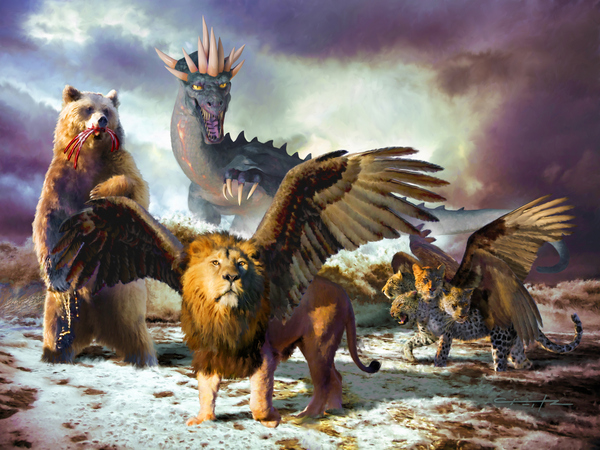
The visions of the four huge beasts coming out of the sea, as described by the prophet Daniel, have a similar interpretation to that of the dream of the statue made of four metals and its conclusion. For a better understanding of this study of the four beasts, you can read the study page on the statue beforehand (by clicking on the link).
The meaning of the vision of the four beasts is identical to that of the statue (in chapter 2), namely that the four metals, representing four world powers, correspond to the four beasts (in chapter 7). The first beast represents Babylon (the gold of the statue). The second beast represents the Medo-Persian power (the silver of the statue). The third beast represents the Greek empire (the copper of the statue). The fourth beast represents the Roman empire (the iron extending to its feet and toes). Here is the detailed description of the four wild beasts:
“In the first year of King Bel·shazʹzar of Babylon, Daniel saw a dream and visions of his head as he lay on his bed. Then he wrote down the dream; he recorded a complete account of the matters. 2 Daniel declared:
“I was watching in my visions during the night, and look! the four winds of the heavens were stirring up the vast sea. 3 And four huge beasts came out of the sea, each different from the others.
4 “The first one was like a lion, and it had the wings of an eagle. I watched until its wings were plucked out, and it was lifted up from the earth and was made to stand up on two feet like a man, and it was given the heart of a man.
5 “And look! another beast, a second one, like a bear. It was raised up on one side, and three ribs were in its mouth between its teeth; and it was told, ‘Get up, eat much flesh.’
6 “After this I kept watching, and look! another beast, like a leopard, but on its back it had four wings like those of a bird. And the beast had four heads, and it was given authority to rule.
7 “After this I kept watching in the visions of the night, and I saw a fourth beast, fearsome and terrifying and unusually strong, and it had large iron teeth. It was devouring and crushing, and what was left it trampled down with its feet. It was different from all the other beasts that were prior to it, and it had ten horns. 8 While I considered the horns, look! another horn, a small one, came up among them, and three of the first horns were plucked up from before it. And look! there were eyes like human eyes in this horn, and there was a mouth speaking arrogantly” (Daniel 7:1-8).
The third wild beast, like a leopard with four wings, aptly symbolizes the Greek empire at the time of Alexander the Great’s extremely rapid territorial conquests. A leopard symbolizes speed, accentuated in this vision by the presence of four wings. This leopard has four heads, signifying that these territorial conquests were divided among Alexander the Great’s four generals after his untimely death. Furthermore, there is another prophetic description illustrating this historical situation in the prophecy of Daniel, chapter 8:
“I saw it closing in on the ram, and it was filled with bitterness toward it. It struck down the ram and broke its two horns, and the ram was powerless to stand up to it. It threw the ram to the ground and trampled it down, and there was no one to rescue it from its power.
8 Then the male goat exalted itself exceedingly, but as soon as it became mighty, the great horn was broken; then four conspicuous horns came up instead of the one, toward the four winds of the heavens” (Daniel 8:7,8).
Here is the angel’s interpretation of this vision:
“The two-horned ram that you saw stands for the kings of Meʹdi·a and Persia. 21 The hairy male goat stands for the king of Greece; and the great horn that was between its eyes stands for the first king. 22 As for the horn that was broken, so that four stood up instead of it, there are four kingdoms from his nation that will stand up, but not with his power” (Daniel 8:20-22).
This text prophetically describes the military superiority of the Greek empire (the goat with one large horn) over the Medo-Persian empire (the ram with two horns, broken and then trampled). The goat’s horn breaks to announce the premature death of the conquering king (Alexander the Great), replaced by four other horns, representing the four generals who would inherit the territorial conquests. The goat’s four horns represent the four heads of the leopard with four wings (the third beast mentioned in chapter 7).
Regarding the fourth beast (of chapter 7), it represents the Roman Empire, up to the current day, with ten horns or kings embodying this later Romanization. The continuation of this late Roman antiquity to the present day is described in chapter 2, which mentions the statue with iron legs, feet, and toes made of iron mixed with clay. There is a special Bible study regarding the concrete significance of this late Roman antiquity in our time, in the study of the statue (Daniel 2), in the first part, and the study of the legs, feet and toes (Daniel 2), in the second part (click on the respective links to access these studies).
Next, the visions of the four beasts conclude with the establishment of a court presided over by the Heavenly Father himself, which will decide on the destruction of these wild beasts. This part of the prophetic vision is similar to the vision of the statue (Daniel 2), which was struck by a stone that destroyed it completely. Here is the narrative of the conclusion of these visions (Daniel 7):
“I kept watching until thrones were set in place and the Ancient of Days sat down. His clothing was white like snow, and the hair of his head was like clean wool. His throne was flames of fire; its wheels were a burning fire. 10 A stream of fire was flowing and going out from before him. A thousand thousands kept ministering to him, and ten thousand times ten thousand stood before him. The Court took its seat, and books were opened.
11 “I kept watching at that time because of the sound of the arrogant words that the horn was speaking; I watched until the beast was killed and its body was destroyed and it was given over to be burned in the fire. 12 But as for the rest of the beasts, their rulerships were taken away, and their lives were prolonged for a time and a season.
13 “I kept watching in the visions of the night, and look! with the clouds of the heavens, someone like a son of man was coming; and he gained access to the Ancient of Days, and they brought him up close before that One. 14 And to him there were given rulership, honor, and a kingdom, that the peoples, nations, and language groups should all serve him. His rulership is an everlasting rulership that will not pass away, and his kingdom will not be destroyed” (Daniel 7:9-14).
The last part of this vision mentions that a son of man receives a kingdom from his Heavenly Father. Jesus Christ himself referred to himself as this son of man who has been anointed as an offspring of king David, during his baptism (Matthew 12:40; 13:37; 24:27-31,36-44; 25:31-46; 26:1,24,45,64).
An important point to note: The biblical account shows that the investiture of a king at the head of a kingdom occurs in two stages. The first step is the anointing process, or designation by God, of the human who will be king. The second stage is when he receives a kingdom over which he will exercise his authority as king.
Jesus Christ has been anointed as King by his Heavenly Father, Jehovah God, at his baptism in 29 CE. Before the birth of the child Jesus, the angel Gabriel told Mary, his future mother, that her son would become king: « He will rule as King over the house of Jacob forever, and there will be no end to his Kingdom » (Luke 1:33). Thus, Jesus Christ became King anointed by his Father, at the beginning of his first visible presence on earth, in the year 29 CE.
When he ascended into Heaven to join his Heavenly Father, according to Psalms 110, he sat at the right hand of the Father expecting to receive the inheritance of the Kingdom of God, or the governance both in Heaven and on Earth: « Jehovah declared to my Lord: “Sit at my right hand Until I place your enemies as a stool for your feet »” (Psalms 110, compare with Luke 19:12). In 1914, according to the prophecy of Daniel chapter 4, and the book of Apocalypse, it would appear that King Jesus Christ was invested with this kingship with a kingdom.
The action of the Kingdom of God, will be the fulfillment of the request made in the Lord’s Prayer: « Our Father in the heavens, let your name be sanctified. Let your Kingdom come. Let your will take place, as in heaven, also on earth » (Matthew 6:9,10).
Let your Kingdom come: it is a heavenly government whose king is Jesus Christ, with 144,000 kings and priests, the New Jerusalem, according to the Book of Apocalypse (21:1-4).
The presence of these kings (the New Jerusalem), with the King Jesus Christ, is mentioned in Daniel chapter 7: « And the kingdom and the rulership and the grandeur of the kingdoms under all the heavens were given to the people who are the holy ones of the Supreme One. Their kingdom is an everlasting kingdom, and all rulerships will serve and obey them » (Daniel 7:27).
***
The Prophecy of the Book of Daniel
The study of the Prophecy of Daniel is the analysis of current prophetic events in the Middle East and in the World…
The Prophecy of the Book of Daniel – The Last Hard-Faced King (Daniel 8:23-25)
This prophecy describes the face and attitude of the last king, of the last world power…
The Prophecy of the Book of Daniel – The Conflict Between the Two Kings (Daniel 11)
This prophecy foreshadows the conclusion of events in the Middle East…
We are, it seems, currently in the last stage of the fulfillment of this prophecy of Daniel, about the two kings…
The Prophecy of the Book of Daniel – The Conflict Between the Two Kings (Daniel 11)
This prophecy foretells the conclusion of events in the Middle East…
The Prophecy of the Book of Zechariah
The prophecy of Zechariah and its prophetic riddles, explanations to know the future…
The Prophecy of Jesus Christ of the end of this system of things, with several preliminary signs…
Table of contents of the http://yomelyah.fr/ website
Reading the Bible daily, this table of contents contains informative Bible articles (Please click on the link above to view it)…
Table of languages of more than seventy languages, with six important biblical articles, written in each of these languages…
***