The administration of the Christian congregation
and the Spiritual Temple of Revelation
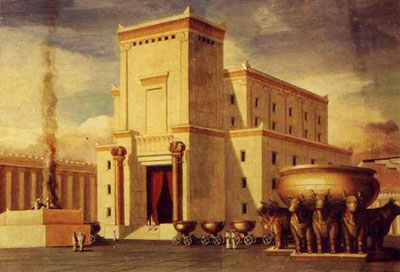
To understand how a Christian congregation or a Christian church should be organized, it is important to refer to the spiritual administration of the Temple that was in Jerusalem, in order to worship God: « For all the things that were written beforehand were written for our instruction, so that through our endurance and through the comfort from the Scriptures we might have hope » (Romans 15:4).
The Apostle Paul, in inspiration, wrote this, regarding the prophetic dimension of the Law given to Moses by God: « For since the Law has a shadow of the good things to come, but not the very substance of the things » (Hebrews 10:1); « Those things are a shadow of the things to come, but the reality belongs to the Christ » (Colossians 2:17). Moreover, in almost the last words of the prophecy of Malachi, it is written: « Remember the Law of my servant Moses, the regulations and judgments that I commanded at Hoʹreb for all Israel to obey » (Malachi 4:4). Why should such an exhortation be useful for us today, when we are no longer under the authority of the Law given through Moses? Also, Christ is the end of the Law: « For Christ is the end of the Law, so that everyone exercising faith may have righteousness » (Romans 10: 4).
We must make the difference between the fact that we are no longer, as disciples of Christ, under the authority of the Law and its prophetic dimension, because these are two fundamentally different ideas. The symbolism of the prophecies of Ezekiel (37-48) and the biblical book that echoes it most, the prophecies of Revelation (along with other prophetic books), is completely modeled on the symbolism of the prophetic dimension of the Mosaic law. So that, to use the expression of the prophecy of Malachi 4: 4, if one does not « remember the law of Moses », or if one did not read it, he will be in the absolute impossibility to understand or decipher them. So that to understand that the administration of the current Christian church, must be modeled on the symbolism of the Law given to Moses, is an important biblical truth that even the first disciples of Christ understood.
The law given to Moses by God has a prophetic dimension
THE TEMPLE AND ITS ADMINISTRATION
Understanding the prophetic fulfillment of the Mosaic Law within the Christian congregation requires a basic knowledge of the layout of the Tabernacle—which would later become the Temple built in Jerusalem. Following this simplified overview, we will examine the spiritual interpretation provided by the book of Revelation—specifically, where the Christian congregation is currently situated within this sacred space, in light of the symbolism surrounding the presence of God (in the Most Holy) and His Son, Jesus Christ (in the Holy). To facilitate the understanding, a video and illustrations of the Great Temple and the Temple Sanctuary will be provided (for those unable to access the video, the accompanying illustrations will suffice for a clear descriptive understanding).
The Tabernacle or Tent of Meeting
(before the construction of Solomon’s Temple)
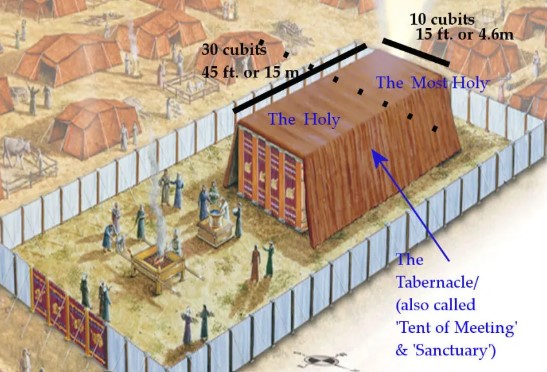
The Tabernacle prefigured what would become the Temple-Sanctuary—first in Solomon’s Temple, and later in Herod’s Temple. In the Sanctuary there are the Holy and the Most Holy. In front of the Sanctuary lies the enclosed courtyard.
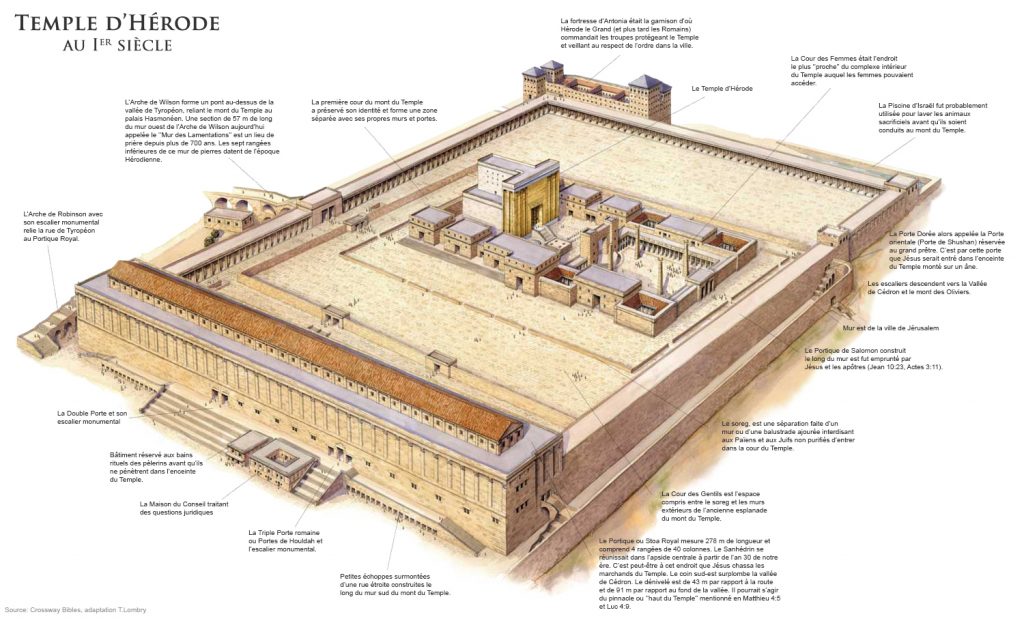
The temple is a place where we worship God. The Great Temple had two major parts (see the photo of the Temple of King Herod, at the time Jesus Christ ministered on earth, comments are written in French):
1 – The Outer Courtyard of the Gentiles (or nations), surrounded by external fortifications, constitutes the « great temple ».
2 – The temple sanctuary is the tall T-shaped building, with the small inner courtyard in front of its large porch where there was the large copper sea of water and the sacrificial altar.
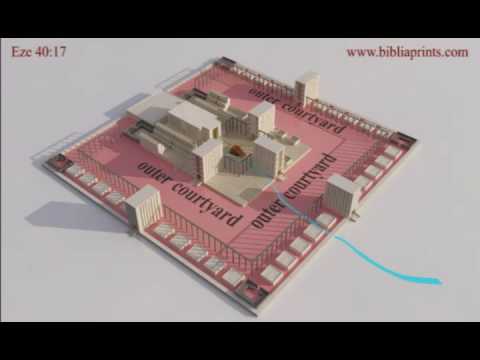
In the representation of the temple, seen in vision by the prophet Ezekiel, modeled in broad outline on the plans of the tabernacle and later the temple of Solomon, allows us to have a more simplified view to better visualize the explanations that follow. The red section (Outer Courtyard) represents the courtyard of the great temple. The white section represents the temple-sanctuary itself, with the inner courtyard and the sanctuary.
THE TEMPLE SANCTUARY
SOLOMON’S TEMPLE VIDEO
1 KINGS Chapter 6
(PLEASE, CLICK ON THE LINK TO SEE THE VIDEO)
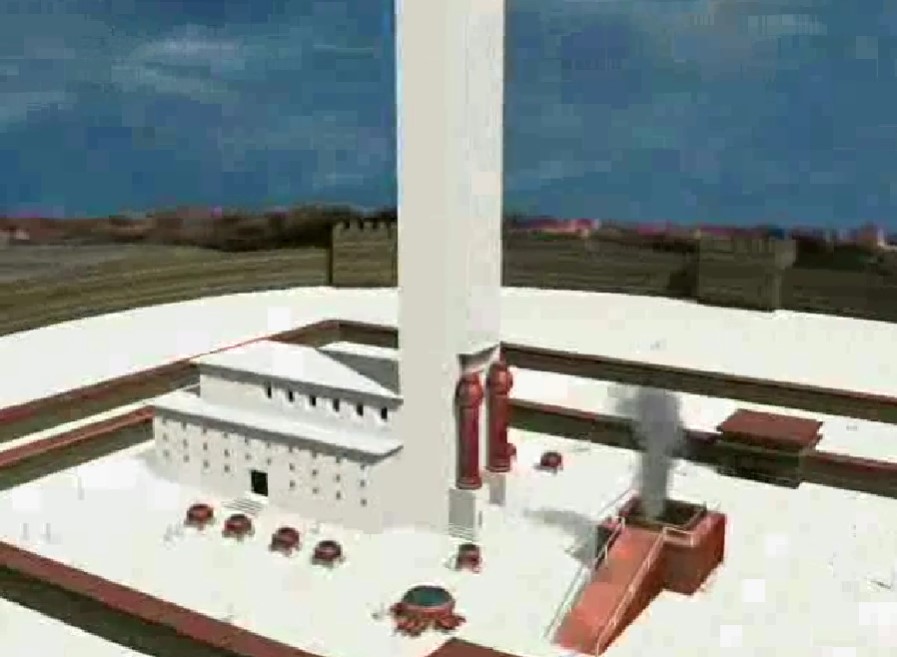
Video explanation
Freeze-frame at 1 minute: General view of Solomon’s Temple. The large, walled courtyard corresponds to the main temple complex. This large courtyard was known as the Court of the Gentiles, because Gentiles—people from the nations—were permitted to enter it. In the top-left corner stands the Temple Sanctuary itself, with the small inner courtyard and the sanctuary building. The video provides a graphic description of the Temple Sanctuary and the inner courtyard.
Freeze-frame at 1 minute 14 seconds: General view of the Temple Sanctuary. There is a circular copper water basin. Next is the altar—also made of copper—situated in front of the Sanctuary entrance. The Sanctuary entrance is the white building.
Freeze-frame at 2 minutes 26 seconds: Entrance to the Sanctuary, opening directly into the Holy. The furnishings—consisting of the lampstands and the incense altar—were made of gold.
Freeze-frame at 3 minutes 18 seconds: Opening to the Most Holy Place, which housed the Ark of the Covenant—a gold-covered chest topped by two cherubim (the incense altar is depicted facing the entrance to the Most Holy Place).
Freeze-frame at 3 minutes 28 seconds: General view of the Most Holy, featuring the Ark of the Covenant. On the left stands the High Priest; he was the only person permitted to enter the presence of the Ark of the Covenant, and only once a year—on the 10th of Ethanim (Tishri), the Day of Atonement (Yom Kippur).
Freeze-frame at 3 minutes 45 seconds: Close-up view of the Ark of the Covenant, with the two cherubim on its lid. Acacia wood poles were attached to each side to allow for its transport.
Freeze-frame at 3 minutes and 58 seconds: Opening of the Ark of the Covenant, containing the two tablets of the Ten Commandments.
***
The Book of Revelation enables us to fully understand the symbolism of the Temple built in Jerusalem. In Chapter 1, the glorified Jesus Christ is described as standing among seven golden lampstands. Clearly, He is in the Holy of the temple-sanctuary, dressed in priestly garments:
“I turned to see who was speaking with me, and when I turned, I saw seven golden lampstands, 13 and in the midst of the lampstands someone like a son of man, clothed in a garment that reached down to the feet and wearing a golden sash around his chest. 14 Moreover, his head and his hair were white as white wool, as snow, and his eyes were like a fiery flame, 15 and his feet were like fine copper when glowing in a furnace, and his voice was like the sound of many waters. 16 And he had in his right hand seven stars, and out of his mouth a sharp, long, two-edged sword was protruding, and his countenance was like the sun when it shines at its brightest. 17 When I saw him, I fell as dead at his feet. (…) As for the sacred secret of the seven stars that you saw in my right hand and of the seven golden lampstands: The seven stars mean the angels of the seven congregations, and the seven lampstands mean the seven congregations” (Revelation 1:12–17, 20).
The seven lampstands represent the seven congregations, and the seven stars represent the angels or overseers of the congregations. Thus, the whole Christian congregations is situated in the Holy Place of the spiritual temple-sanctuary. The overseers or local administrators of the Christian congregations are in Christ’s right hand. Consequently, no human religious organization should interpose itself between Christ and the local congregations administered by the overseers, because Christ is the only mediator between God and men: “For there is one God, and one mediator between God and men, a man, Christ Jesus” (1 Timothy 2:5).
God and His Son Jesus Christ have no need for a globalized religious organization—the kind that inevitably becomes corrupted over time. The messages to the seven local congregations demonstrate this. Imagine for a moment a globalized Christian organization managing hundreds, or even thousands, of local congregations, all sharing the same flaws found in the congregations of Sardis and Laodicea; a flaw in a single local congregation would escalate into a worldwide deviation. The history of spiritual deviations within major European and American global churches bears this out. The evidence reveals serious deviation: the assimilation of pagan religious rites by major European churches, and—in the case of globalized churches of American origin—a form of prostitution within the financial world (a matter left to the reader’s discernment).
What should be done if a local congregation finds itself under the completely wayward authority of an international religious organization that claims to be Christian? The exhortation to flee Babylon the Great applies to these globalized religious organizations that shamelessly prostitute themselves with paganism and finance:
“And I heard another voice out of heaven say: “Get out of her, my people, if you do not want to share with her in her sins, and if you do not want to receive part of her plagues. For her sins have massed together clear up to heaven, and God has called her acts of injustice to mind” (Revelation 18:4,5).
The local overseers of these congregations must break away from these apostate globalized organizations that illegitimately place themselves between local congregations and Christ.
What do we think about the sale of the Kingdom Halls dedicated to God?
Article rédigé en français
Artículo escrito en español
Artigo escrito em português
***
The Measuring of the Temple-Sanctuary by the Apostle John
and the Administration of the Christian Congregation
“And a reed like a rod was given to me as he said: “Get up and measure the temple sanctuary of God and the altar and those worshipping in it. But as for the courtyard that is outside the temple sanctuary, leave it out and do not measure it, because it has been given to the nations, and they will trample the holy city underfoot for 42 months”
(Revelation 11:1, 2)
The angel’s precise instructions are that the apostle John, in a vision, is to measure only the Temple-Sanctuary—that is, the inner court with the copper basin and the copper altar, as well as the sanctuary itself, with the Holy and the Most Holy. The Temple-Sanctuary is the place where those who worship God are found. Thus, Christian congregations are located only within the Holy Place of the Temple-Sanctuary, where the seven lampstands are situated (Revelation chapters 1 to 3).
The angel instructs the apostle John not to measure the court outside the Temple-Sanctuary—namely, the Court of the Gentiles belonging to the great temple (see the explanations and photos above)—because it has been given to the nations. We can readily infer that the court of the great temple represents the earthly realm occupied by the nations that govern without God’s intervention; for this reason, they are not “measured” according to God’s standard by the apostle John.
The measuring of the Temple-Sanctuary represents a form of administration—that of God acting through His Son, Jesus Christ, the High Priest. Christ Himself uses the seven stars in His right hand to administer local Christian congregations by means of local overseers or administrators (1 Timothy 2:5 and chapter 3). The very fact that it is the apostle John who performs the measuring—an apostle appointed by Christ—demonstrates that the application of biblical principles within local congregations (represented by the measuring reed) is carried out by humans serving as local administrators or overseers, just as the apostle did.
When reading about the measuring of the New Jerusalem (in Revelation 21:15–21), we observe that it is no longer a human doing the measuring, but an angel, and that the reed is made of gold. This signifies that after the Great Tribulation—when the whole earth comes fully under the governance of the New Jerusalem, the Kingdom of God—it is the angels who will step in to enforce the new heavenly standards (the golden reed) upon all of humanity; these standards derive from the new scrolls mentioned in Revelation chapter 20.
***
THE TEMPLE OF THE BODY OF CHRIST
The spiritual temple sanctuary (The Holy), is symbolized by the body of Christ, according to the Apostle John: « The Jews then said: “This temple was built in 46 years, and will you raise it up in three days?” But he was talking about the temple of his body. When, though, he was raised up from the dead, his disciples recalled that he used to say this, and they believed the scripture and what Jesus had spoken » (John 2:20-22).
This means that the spiritual sanctuary is the pattern of the human body when he worships Jehovah. The spiritual body of Jesus Christ, represents the spiritual temple sanctuary, the Christian congregation administered to worship Jehovah. This is what the Apostle Paul explained in 1 Corinthians 12: « Now you are Christ’s body, and each of you individually is a member. And God has assigned the respective ones in the congregation: first, apostles; second, prophets; third, teachers; then powerful works; then gifts of healings; helpful services; abilities to direct; different tongues. Not all are apostles, are they? Not all are prophets, are they? Not all are teachers, are they? Not all perform powerful works, do they? Not all have gifts of healings, do they? Not all speak in tongues, do they? Not all are interpreters, are they? But keep striving for the greater gifts. And yet I will show you a surpassing way » (1 Corinthians 12:27-31).
The administration of the Christians congregation, with their different spiritual gifts, given by God, together represent the spiritual body of Christ and the spiritual temple sanctuary.
Jesus Christ is the only way to everlasting life
THE TEMPLE OF THE HUMAN BODY
Nevertheless, the Apostle Paul and also the Apostle Peter emphasized that on an individual level, the human body of the Christian who worships God, may also represent the spiritual temple sanctuary made to worship God:
« Do you not know that you yourselves are God’s temple and that the spirit of God dwells in you? » (1 Corinthians 3:16).
« But I consider it right, as long as I am in this tabernacle, to stir you with reminders, knowing as I do that my tabernacle is soon to be removed, just as also our Lord Jesus Christ made clear to me » (2 Peter 1:13,14).
The Holy represents the symbolic heart where Christ must symbolically live: « and that through your faith you may have the Christ dwell in your hearts with love. May you be rooted and established on the foundation » (Ephesians 3:17). The human symbolic heart represents the spiritual inner part of the human being.
This symbolic heart must have a spiritual circumcision, that is to say, to remove the symbolic « prepuce », the bad reasonings that can make impure: « However, whatever comes out of the mouth comes from the heart, and those things defile a man. For example, out of the heart come wicked reasonings, murders, adulteries, sexual immorality, thefts, false testimonies, blasphemies. These are the things that defile a man; but to take a meal with unwashed hands does not defile a man » (Matthew 15:18-20). « But he is a Jew who is one on the inside, and his circumcision is that of the heart by spirit and not by a written code. That person’s praise comes from God, not from people » (Romans 2:29; Deuteronomy 10:16).
The lampstand that illuminates the inner part of the human body, the spiritual heart, the spiritual Holy, according to Jesus Christ, are the eyes: « The lamp of the body is the eye. If, then, your eye is focused, your whole body will be bright. But if your eye is envious, your whole body will be dark. If the light that is in you is really darkness, how great that darkness is! » (Matthew 6:22,23).
The altar and the offerings, made in the spiritual courtyard of the temple sanctuary, represents the lips (altar) and the words that come out of it (spiritual offerings): « And we will offer the praise of our lips as we would young bulls » (Hosea 14:2). « Through him let us always offer to God a sacrifice of praise, that is, the fruit of our lips that make public declaration to his name » (Hebrews 13:15).
The conclusion regarding the administration
of the Christian congregation
In the prophecy of Revelation, it represents the worldwide Christian congregation. But what does it mean that the Apostle John measures the spiritual temple sanctuary, and not the outer courtyard given to the nations. The « Measuring » is a judgment, or an authority that does not exceed the limits of the spiritual sanctuary temple (Amos 7:7-9).
The fact that God asks the apostle John to measure shows that this authority was given to a man, the apostle John, who was probably the last apostle still alive. More generally, the measuring of the spiritual sanctuary, symbolizes the authority on earth, within this spiritual temple sanctuary, the Christian congregation, would be entrusted to men (and not in the outer courtyard of this Sanctuary): « They are no part of the world, just as I am no part of the world » (John 17:16)) ((Revelation 11: 1,2). It is again the Apostle Paul who showed how a congregation should be administered.
By remembering the texts of Hebrews 10:1 and Colossians 2:17, which show that the Law is the prophetic shadow of the fulfillment in the Christian congregation, makes it possible to better understand its administration. For example, the Elders represent the Priests in the Holy of the Temple Sanctuary. These Elders represent the Human Angels or Messengers of God and his Son Jesus Christ (1 Timothy 3:1-7; Tite 1:5-9; Apocalypse 2 and 3). While Ministerial Servants represent the Nonpriestly Levites which mainly help the Elders in the material administration of the Christian congregation (1 Timothy 3:8-10,12,13).
***
The answer will be based on the Bible (Sola Scriptura) and, specifically, on the context of early Christianity as described in the Acts of the Apostles and the diferent letters written by Christ’s apostles and disciples…
As suggested by the glorified Jesus Christ, the Christian congregation must be administered by at least one « angel », a « messenger » or a « priest » who transmits to the congregation the sacred declarations of God, through the Bible…
Still proceeding from the important premise that the Mosaic Law is a prophetic pattern of the Christian congregation belonging to Christ, we will examine what corresponds to the role of ministerial servants…
The elders are teachers, those who represent the congregation with prayers and if necessary, they judge in the congregation. The ministerial servants are primarily working in the material stewardship of the Christian congregation…
Should a Christian congregations be administered on a global or a local level?
Jesus Christ speaks of this slave in the singular, meaning that it could be a single person or a group of people? When does He identify and reward this slave? Shortly after 1914, or shortly before the Great Tribulation?
The messages of Jesus Christ to the seven congregations are indications on the administration of the Christian Congregation…
***
Table of contents of the http://yomelyah.fr/ website
Reading the Bible daily, this table of contents contains informative Bible articles
Table of languages of more than seventy languages, with six important biblical articles, written in each of these languages…
***