Still proceeding from the important premise that the Mosaic Law is a prophetic pattern of the Christian congregation belonging to Christ, we will examine what corresponds to the role of ministerial servants, as mentioned in Paul’s first letter to Timothy (Colossians 2:17; Hebrews 10:1):
« Ministerial servants should likewise be serious, not double-tongued, not giving themselves to a lot of wine, not greedy of dishonest gain, holding the sacred secret of the faith with a clean conscience. Also, let these be tested as to fitness first, then let them serve as ministers, as they are free from accusation. Women should likewise be serious, not slanderous, moderate in habits, faithful in all things. Let ministerial servants be husbands of one wife, presiding in a fine manner over children and their own households. For the men who minister in a fine manner are acquiring for themselves a fine standing and great freeness of speech in the faith in connection with Christ Jesus » (1 Timothy 3:8-10,12,13).
The word « likewise » shows that the conditions required to be ministerial servant, are exactly the same as for the « elders ». The only difference is the teaching requirement, which is not mentioned directly. However, the expression « great freeness of speech in the faith that is in Christ Jesus », suggests a verbal declaration or a public declaratin of his faith in Jesus Christ (« παρρησία » « parrhesia » (Strong’s Concordance G3954)). In the framework of Christian meetings, the servant ministerial may speak out, to express his faith in Christ with freeness.
The Greek word used for « ministerial servant », is « διάκονος » (« diakonos » Strong’s Concordance (G1249)): « an attendant, i.e. (genitive case) a waiter (at table or in other menial duties); specially, a Christian teacher and pastor (technically, a deacon or deaconess):—deacon, minister, servant ». Concretely, the ministerial servants help the elders of the congregation. How? Their christian minister allows to the overseers to focus fully on their spiritual minister of prayer and teaching, to spiritually build the Christian congregation. More concretely, the ministerial servants are attendants for the material stewardship activities of the congregation, whether to help Christian brothers and sisters, or stewardship in relation to the building that houses the congregation, if it exists.
In the book of Acts we find a situation in which this division of labor is described between the elders and the ministerial servants: « Now in those days when the disciples were increasing, the Greek-speaking Jews began complaining against the Hebrew-speaking Jews, because their widows were being overlooked in the daily distribution. So the Twelve called the multitude of the disciples together and said: “It is not right for us to leave the word of God to distribute food to tables. So, brothers, select for yourselves seven reputable men from among you, full of spirit and wisdom, that we may appoint them over this necessary matter; but we will devote ourselves to prayer and to the ministry of the word.” What they said was pleasing to the whole multitude, and they selected Stephen, a man full of faith and holy spirit, as well as Philip, Prochʹo·rus, Ni·caʹnor, Tiʹmon, Parʹme·nas, and Nic·o·laʹus, a proselyte of Antioch. They brought them to the apostles, and after praying, they laid their hands on them » (Acts 6:1-6).
This does not mean that the appointed men, in this circumstance were ministerial servants, nevertheless, they did a material assistance work to allow the apostles to focus fully in their spiritual activities (In Acts 7, if Stephen was appointed for this food distribution activity, his speech shortly before his death in martyrdom, denotes a great spiritual maturity that could have been that of a Christian overseer).
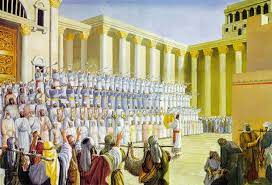
What activity in the temple corresponds to the function of ministerial servant? To that of the non-priestly Levites who were serving the priesthood. The tribe of Levi, in its non-priestly part, were material stewards of the tabernacle (Numbers 1:47-53), and later of the temple (1 Kings 8:1-6). The non-priestly Levites were in the material service of the Aaronic Priesthood (Numbers 3: 9,10: « You are to give the Levites to Aaron and his sons. They are given ones, given to him from the Israelites. You should appoint Aaron and his sons, and they are to carry out their priestly duties, and any unauthorized person who comes near should be put to death »).
What should be the minimum age requirement for the appointment of ministerial servants? Twenty years, according to the Mosaic Law pattern: « In the second year after they came to the house of the true God at Jerusalem, in the second month, Ze·rubʹba·bel the son of She·alʹti·el, Jeshʹu·a the son of Je·hozʹa·dak and the rest of their brothers, the priests and the Levites, and all those who had come to Jerusalem out of the captivity started the work; they appointed the Levites from 20 years old and up to serve as supervisors over the work of the house of Jehovah » (Ezra 3:8).
Can a ministerial servant later be appointed as an overseer or elder? Under the Mosaic Law, the status of a non-priestly Levite—and also that of a priest—was determined by membership in the tribe of Levi and, for priests, the house of Aaron. Consequently, both roles were permanent or fixed. Thus, the Mosaic Law model has its limitations, as appointments of elders and ministerial servants are not tied to ethnic background but rather to aspiring to these roles within the congregation (1 Timothy 3). It is therefore logical to conclude that a young ministerial servant can later become a congregation overseer, provided he aspires to that role. Returning to the example of the disciple Stephen in the book of Acts, it is possible that he was an elder, given his good reputation and the content of his speech in Acts chapter 7 (Acts 6:8). This implies that a congregation overseer can fulfill the role of a ministerial servant.
***
The Administration of the Christian Congregation, According to the Bible (Colossians 2:17)
Christ and the apostles give specific instructions for administering the Christian Congregation…
Jesus Christ first commends this congregation for its endurance and vigilance, but then warns it against its lack of love…
Jesus Christ does not reproach this courageous congregation, but encourages them by showing them the extraordinary reward that awaits them…
Jesus Christ commends this congregation for its courage in the face of trials, but he reproaches it for its spiritual deviation regarding teaching and sexual morality…
Jesus Christ commends this congregation for its good deeds, but reproaches it for tolerating the presence of a woman who behaves like Jezebel…
Regarding the congregation of Sardis, Jesus Christ says something terrible: it is spiritually dead…
Jesus Christ expresses his « brotherly affection » toward the members of this congregation…
The message addressed to the congregation of Laodicea is particularly harsh: « you are miserable and pitiful and poor and blind and naked »…
The messages of Jesus Christ to the seven congregations are indications on the administration of the Christian Congregation…
***
Table of contents of the http://yomelyah.fr/ website
Reading the Bible daily, this table of contents contains informative Bible articles
Table of languages of more than seventy languages, with six important biblical articles, written in each of these languages…
***