“Their faces had this appearance: Each of the four had a man’s face with a lion’s face on the right, a bull’s face on the left, and each of the four had an eagle’s face”
(Ezekiel 1:10)
EZEKIEL’S VISION VIDEO
THE CELESTIAL CHARIOT
(EZEKIEL CHAPTER 1)
(PLEASE, CLICK ON THE LINK TO SEE THE VIDEO)
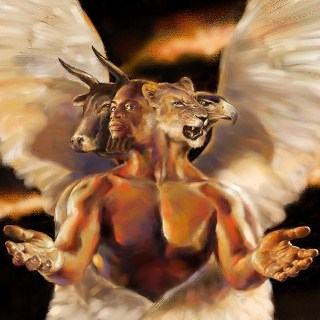
The four faces of the qualities of God
(Isaiah 6:1-4)
The context of this vision is the description of the presence of God, surrounded by the four spiritual creatures with four different faces. To understand precisely the symbolism of the four faces, we must know their role. According to a parallel view in Isaiah chapter 6: 1-4, where the prophet is describing the presence of Jehovah, where there are four seraphs (seraphim) who proclaim the holiness of Jehovah: « Holy, holy, holy is Jehovah of armies. The whole earth is filled with his glory » (Isaiah 6: 3). In Revelation chapter 4: 8, these four creatures proclaim the holiness of God: « And continuously, day and night, they say: “Holy, holy, holy is Jehovah God, the Almighty, who was and who is and who is coming » » (Revelation 4: 8). Nevertheless, unlike the vision of Ezekiel, in Revelation the four spiritual each have a different face: « The first living creature was like a lion, and the second living creature was like a young bull, and the third living creature had a face like a man’s, and the fourth living creature was like a flying eagle » (Revelation 4: 7).
The descriptions are anthropomorphic, that is to say that one describes these spiritual creatures with human either animal characteristics. For example, in Revelation (4:7,8), in Isaiah (6:2), it is written that they have 6 wings, to make us understand that they have the ability to move at an extremely fast speed ( Psalms 104:3 « the wings of the wind »). It is interesting to note that in Ezekiel (1: 6) these same spiritual creatures are described with only two pairs of wings, which demonstrates that this is an anthropomorphic description of the ability to move extremely quickly (either by four wings or six wings). It is written that they are full of eyes to explain that their constant visual acuity is 360 degrees, that is to say there is no position where they could not see.
What do symbolically represent the four different faces? The central point of understanding is in what they constantly say: « Holy, holy, holy is Jehovah God, the Almighty, who was and who is and who is coming » (Revelation 4:8, Isaiah 6: 3). The four faces represent four ways that Jehovah uses to maintain the holiness in all his creation, visible and invisible. They represent the four ways in which Jehovah exercises his sovereignty.
The face of a man represents the exercise of Jehovah’s sovereignty, through the love which desires to redeem the human race from the law of sin which leads to death: « For the wages sin pays is death, but the gift God gives is everlasting life by Christ Jesus our Lord » (Romans 6:23). God wants to give life, because He is love. Jesus Christ summarized the meaning of the Law given to Israel by means Moses, in the following way: « You have disregarded the weightier matters of the Law, namely, justice and mercy and faithfulness » (Matthew 23:23 ).
The lion’s face represents the exercise of Jehovah’s sovereignty through kingship, glory and beauty. The reign of King Solomon showed this symbolism of the majesty of the kingship of Jehovah, of which he was the representative: « The king also made a great ivory throne and overlaid it with refined gold. 19 There were six steps to the throne, and the throne had a round canopy behind it, and there were armrests on both sides of the seat, and two lions were standing beside the armrests. 20 And there were 12 lions standing on the six steps, one at each end of the six steps. No other kingdom had made anything like it » (1 Kings 10:18-20) .
The bull’s face represents the exercise of Jehovah’s sovereignty by power and warfare to remove all rivalry for his dominion: « Jehovah will go out and war against those nations as when he fights in the day of a battle » (Zechariah 14:3).
The eagle face represents the exercise of Jehovah’s sovereignty through wisdom and keen eyesight to anticipate and foresee the future: « As for the four living creatures, each one of them had six wings; they were full of eyes all around and underneath » (Revelation 4:8).

The man’s face
The man’s face (Ezekiel 1: 5; Revelation 4: 7): It represents the most important characteristic of God because man has been created in the spiritual image of God (Genesis 1: 26-28). This is why, unlike other faces, man is not an animal because he has a spirituality, a relationship with God. As the apostle Paul wrote, under inspiration, the man without this spirituality, is described as animal-man, while the man who has a spiritual relationship with God, is a spiritual man, devoid of any animality (1 Corinthians 2: 14-16 « the physical man » = animal man without spirituality the opposite of « the spiritual man »). The face of man represents that God is love: « God is love » (1 John 4: 8,16).
According to the Bible, the human being is spiritual because he has been created in the image of God, like the angels in the heavens (the word « man » in most cases applies to both man and woman). In the book of Revelation, the glorified Jesus Christ speaks to the seven angels, each responsible for one of seven congregations. They are obviously men or messengers, because sometimes, Jesus Christ reproaches them serious faults, not attributable to heavenly angels (Revelation 2 and 3). In Malachi 2:7, the priests or teachers of the nation of Israel had the status of angels or messengers: « For the lips of a priest should safeguard knowledge, and people should seek the law from his mouth, because he is the messenger of Jehovah of armies ». The word « messenger » refers to the word « angel ».
In Hebrews 2:5-9, the apostle Paul writes that God created man a little lower than the angels: « For it is not to angels that he has subjected the inhabited earth to come, about which we are speaking. But in one place a certain witness said: “What is man that you keep him in mind, or a son of man that you take care of him? You made him a little lower than angels; you crowned him with glory and honor, and appointed him over the works of your hands. All things you subjected under his feet.” By subjecting all things to him, God left nothing that is not subject to him. Now, though, we do not yet see all things in subjection to him. But we do see Jesus, who was made a little lower than angels, now crowned with glory and honor for having suffered death, so that by God’s undeserved kindness he might taste death for everyone ».
Therefore, given these biblical texts, the human being is fundamentally spiritual in origin, and he is not a « social animal ». Man can have close relationships with his Creator, he has the capacity to manifest faith in invisible realities: « Faith is the assured expectation of what is hoped for, the evident demonstration of realities that are not seen. For by means of it, the men of ancient times had witness borne to them. By faith we perceive that the systems of things were put in order by God’s word, so that what is seen has come into existence from things that are not visible” (Hebrews 11:1-3). He has a capacity for understanding abstract concepts, such as time: « He has made everything beautiful in its time. He has even put eternity in their heart; yet mankind will never find out the work that the true God has made from start to finish » (Ecclesiastes 3:11). This intellectual faculty allows him to look back in the past, to live the present and to project himself into the future. This God-given mental capacity, which ranges from deduction induction, allowed him to discover the mathematical laws which are the basis of chemistry, biology, physics, astronomy and many other scientific applications and technical processes… He has the capacity to appreciate what is beautiful in creation, and he is able to reproduce this beauty in an artistic way, with the prism of his own sensitivity…
These capacities, both spiritual and intellectual, make a man a being exceptional, who is not part of the animal life, but rather as administrator of the planet, according to Genesis 1:26-28, and Hebrews 2:5-9. In biblical context of symbolism, the human face represents the main quality of God: love (Genesis 1:26-28; Ezekiel 1:5; Revelation 4:7; 1 John 4:8,16). This is why, unlike other faces (the lion, the bull and the eagle), man is not an animal because he has a spirituality, a relationship with God. As the apostle Paul wrote, under inspiration, the man without this spirituality, is described as animal-man, while the man who has a spiritual relationship with God, is a spiritual man, devoid of any animality (1 Corinthians 2:14-16 « the physical man » = animal man without spirituality the opposite of « the spiritual man »). The face of man represents that « God is love » (1 John 4:8,16).
The lion’s face
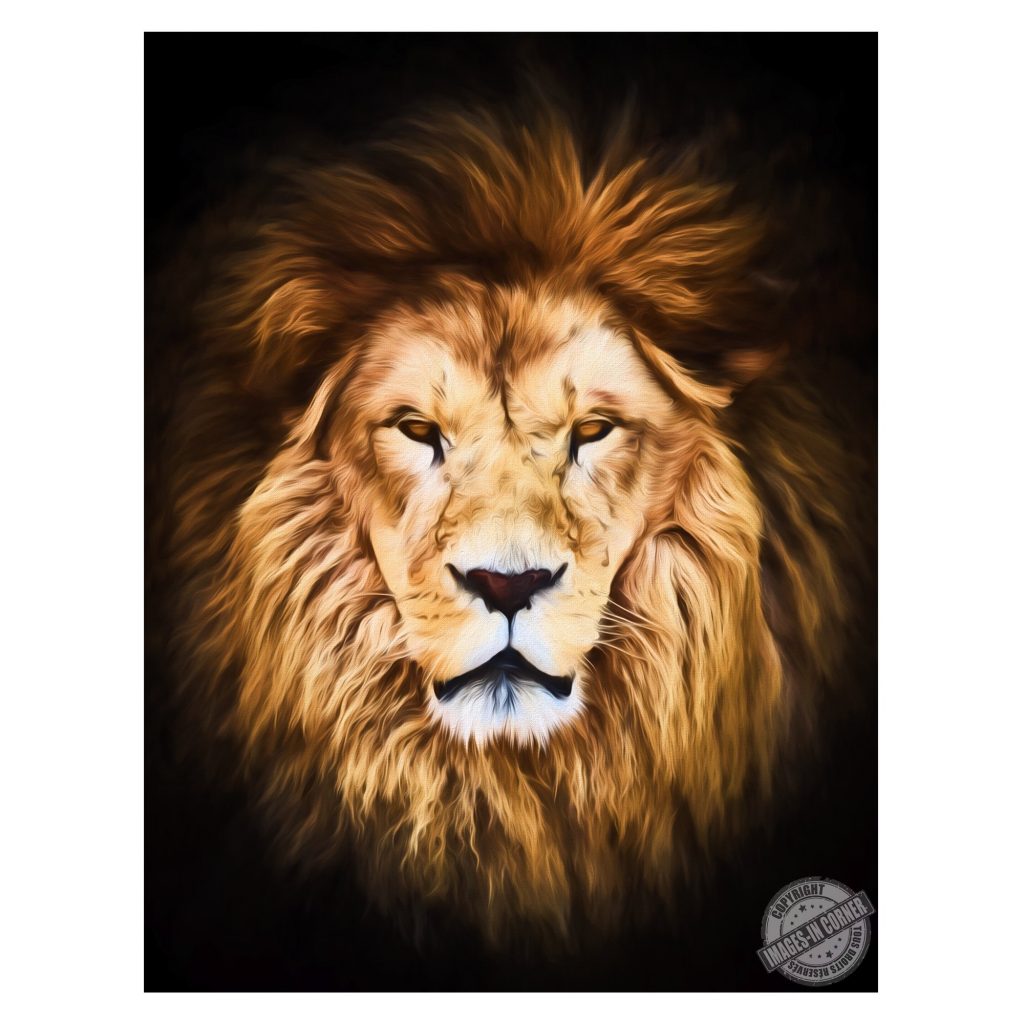
The lion’s face (Ezekiel 1: 10; Revelation 4: 7): The lion, with its abundant crown-shaped fur around his face, symbolizes in the Bible, the kingship as the sovereignty of Jehovah. The tribe of Judah, from which the representative of Jehovah’s royal sovereignty would come, his son Jesus Christ, was called lion cub or lion: « Judah is a lion cub. From the prey, my son, you will certainly go up. He has crouched down and stretched himself out like a lion, and like a lion, who dares rouse him? The scepter will not depart from Judah, neither the commander’s staff from between his feet, until Shiʹloh comes, and to him the obedience of the peoples will belong » (Genesis 49: 9,10). King Solomon understood the symbolism of the lion representing Jehovah’s kingship (2 Chronicles 9: 17-19 « two lions were standing beside the armrests » (of the throne), « And there were 12 lions standing on the six steps » (giving access to the royal throne)).
The bull’s face
« Is the wild bull willing to serve you? Will it spend the night in your stable? Will you hold a wild bull to the furrow with a rope, Or will it follow you to plow the valley? »
(Job 39:9,10)
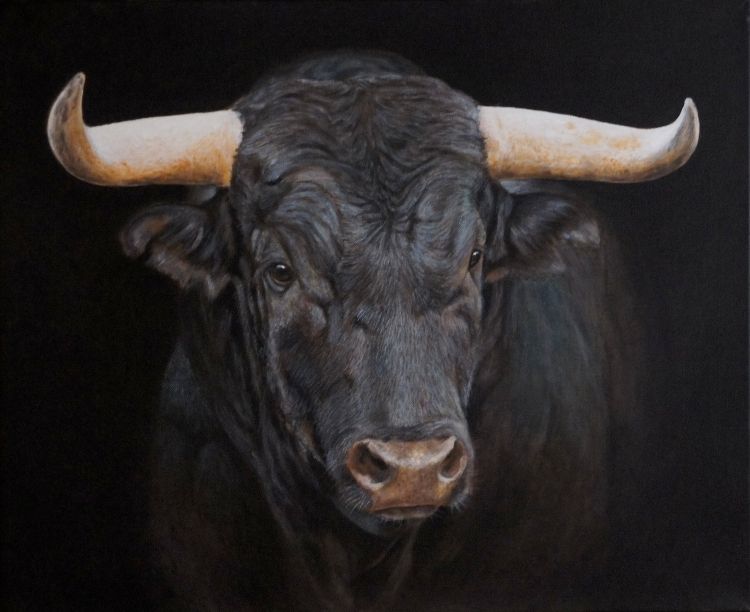
The bull’s face: it corresponds to the face of a cherub. In Ezekiel (1:10), these four creatures with four faces, are designated by that of a man, a lion, a bull and an eagle. While in Ezekiel 10:14, the face of the bull is designated by that of a cherub. What is the function of a cherub? The first mention of the cherubim is in Genesis (Bible): « So he drove the man out, and he posted at the east of the garden of Eʹden the cherubs and the flaming blade of a sword that was turning continuously to guard the way to the tree of life’ (Genesis 3:24). We understand that cherubim are powerful guardians with a symbolic sword. If the lion is the representation of Jehovah’s sovereignty by the glory and authority of kingship, the bull is an expression of Jehovah’s sovereignty by his almighty. Jehovah God, if necessary, imposes his sovereignty by war, the sword of the cherub, or the terrible power the symbolic horns of the bull. The horns are the symbols of the powerful sovereignty of Jehovah. The facts that two cherubim were on the ark of the covenant show that the cherubim are the guardians of Jehovah’s holiness, through battle or war (if any) (Exodus 25: 17-22). The fact that the Jehovah’s altar, from which the animals were sacrificed, had four horns, one for each angle, demonstrates that the bull’s horns also symbolize the maintenance of the holiness of Jehovah’s creatures by force or war (where applicable) (Leviticus 4: 7,18). It is therefore logical to think that the bull, in the context of sacrifices, whether atonement sacrifice or burnt offerings, is the representation of the righteous and pure human being (Exodus 29:11).
The eagle’s face
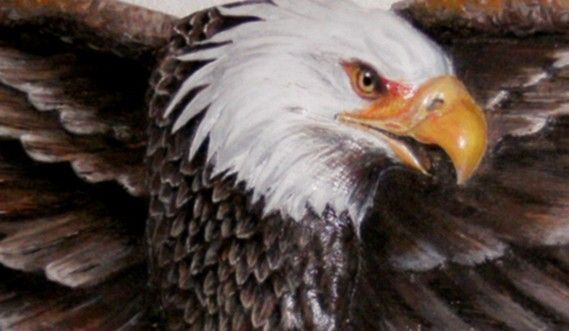
The eagle’s face: this animal symbolizes visual acuity: « From there it searches for food; Its eyes look far into the distance » (Job 39: 29). The ability to move and live in inaccessible places (or difficult to access) for man: « Or is it at your order that an eagle flies upward And builds its nest high up, Spending the night on a cliff, Dwelling in its stronghold on a rocky crag? » (Job 39: 27-28) These two exceptional abilities of the four spiritual creatures of God symbolized by the eagle’s face, are simply described by their pairs of wings and the fact that they are covered with eyes: « As for the four living creatures, each one of them had six wings; they were full of eyes all around and underneath » (Revelation 4: 8). Also these two exceptional abilities of visual acuity and movement speed, are symbolically described in the Jehovah’s celestial chariot, in Ezekiel’s vision: This celestial chariot has « wheels », one of them on the earth. These wheels have an extremely fast movement capacity and on all angles with the ability to lift up from the earth. These wheels have eyes, which represent an extraordinary visual acuity:
“As I was watching the living creatures, I saw one wheel on the earth beside each of the living creatures with four faces. The wheels and their structure appeared to glow like chrysʹo·lite, and the four of them looked alike. Their appearance and structure looked as though a wheel were within a wheel. When they moved, they could go in any of the four directions without turning as they went. Their rims were so high that they inspired awe, and the rims of all four were full of eyes all around. Whenever the living creatures moved, the wheels would move along with them, and when the living creatures were lifted up from the earth, the wheels would also be lifted up. They would go where the spirit inclined them to go, wherever the spirit went. The wheels would be lifted up together with them, for the spirit operating on the living creatures was also in the wheels. When they moved, these would move; and when they stood still, these would stand still; and when they were lifted up from the earth, the wheels would be lifted up together with them, for the spirit operating on the living creatures was also in the wheels” (Ezekiel 1:15-21).
These four-faced spiritual creatures represent the expression of Jehovah’s holy sovereignty, based on four fundamental qualities: love (the man’s face), royal authority (the lion’s face), the almighty sovereignty (the bull’s face) and the wisdom, insight and action, anywhere and anytime (the eagle’s face (the celestial chariot seen by the prophet Ezekiel)). However, the greatest of these qualities is love: « God is love, and the one who remains in love remains in union with God and God remains in union with him » (1 John 4:8, 16).
The symbolic creatures in the prophecy of Daniel
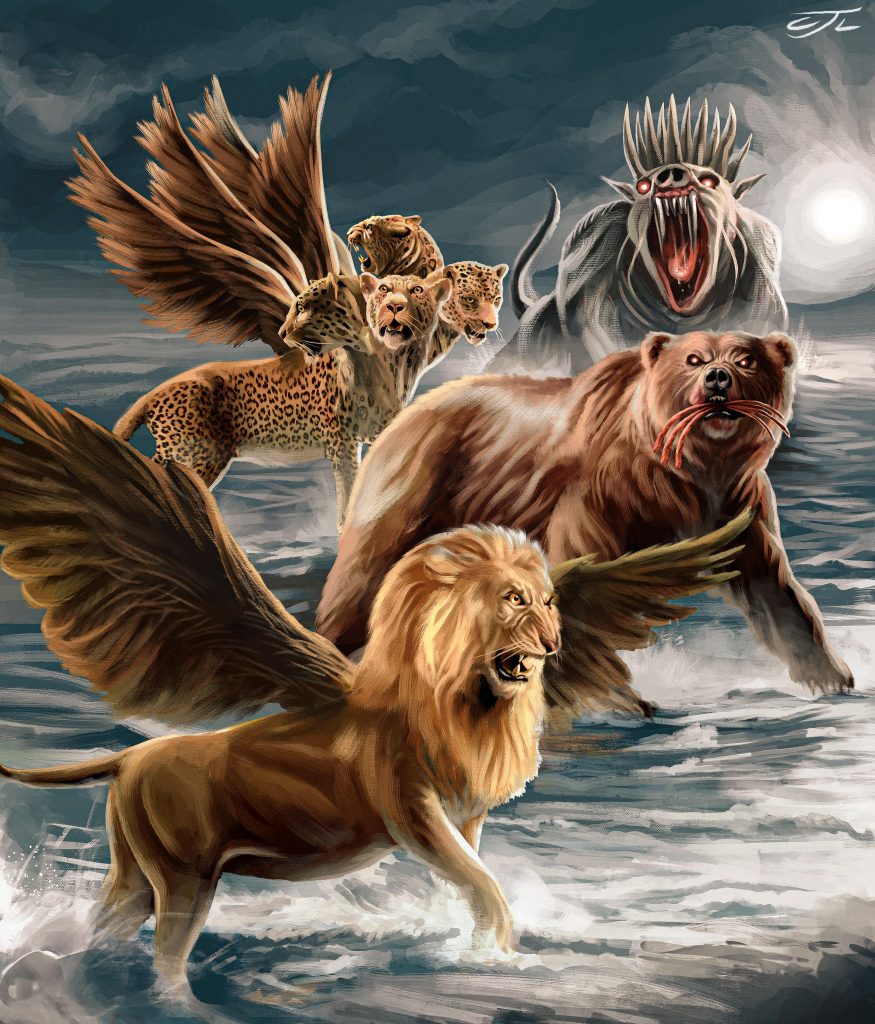
The visions of the four huge beasts coming out of the sea, as described by the prophet Daniel, have a similar interpretation to that of the dream of the statue made of four metals and its conclusion. For a better understanding of this study of the four beasts, you can read the study page on the statue beforehand (by clicking on the link).
The meaning of the vision of the four beasts is identical to that of the statue (in chapter 2), namely that the four metals, representing four world powers, correspond to the four beasts (in chapter 7). The first beast represents Babylon (the gold of the statue). The second beast represents the Medo-Persian power (the silver of the statue). The third beast represents the Greek empire (the copper of the statue). The fourth beast represents the Roman empire (the iron extending to its feet and toes). Here is the detailed description of the four wild beasts:
“In the first year of King Bel·shazʹzar of Babylon, Daniel saw a dream and visions of his head as he lay on his bed. Then he wrote down the dream; he recorded a complete account of the matters. 2 Daniel declared:
“I was watching in my visions during the night, and look! the four winds of the heavens were stirring up the vast sea. 3 And four huge beasts came out of the sea, each different from the others.
4 “The first one was like a lion, and it had the wings of an eagle. I watched until its wings were plucked out, and it was lifted up from the earth and was made to stand up on two feet like a man, and it was given the heart of a man.
5 “And look! another beast, a second one, like a bear. It was raised up on one side, and three ribs were in its mouth between its teeth; and it was told, ‘Get up, eat much flesh.’
6 “After this I kept watching, and look! another beast, like a leopard, but on its back it had four wings like those of a bird. And the beast had four heads, and it was given authority to rule.
7 “After this I kept watching in the visions of the night, and I saw a fourth beast, fearsome and terrifying and unusually strong, and it had large iron teeth. It was devouring and crushing, and what was left it trampled down with its feet. It was different from all the other beasts that were prior to it, and it had ten horns. 8 While I considered the horns, look! another horn, a small one, came up among them, and three of the first horns were plucked up from before it. And look! there were eyes like human eyes in this horn, and there was a mouth speaking arrogantly” (Daniel 7:1-8).
The third wild beast, like a leopard with four wings, aptly symbolizes the Greek empire at the time of Alexander the Great’s extremely rapid territorial conquests. A leopard symbolizes speed, accentuated in this vision by the presence of four wings. This leopard has four heads, signifying that these territorial conquests were divided among Alexander the Great’s four generals after his untimely death. Furthermore, there is another prophetic description illustrating this historical situation in the prophecy of Daniel, chapter 8:
“I saw it closing in on the ram, and it was filled with bitterness toward it. It struck down the ram and broke its two horns, and the ram was powerless to stand up to it. It threw the ram to the ground and trampled it down, and there was no one to rescue it from its power.
8 Then the male goat exalted itself exceedingly, but as soon as it became mighty, the great horn was broken; then four conspicuous horns came up instead of the one, toward the four winds of the heavens” (Daniel 8:7,8).
Here is the angel’s interpretation of this vision:
“The two-horned ram that you saw stands for the kings of Meʹdi·a and Persia. 21 The hairy male goat stands for the king of Greece; and the great horn that was between its eyes stands for the first king. 22 As for the horn that was broken, so that four stood up instead of it, there are four kingdoms from his nation that will stand up, but not with his power” (Daniel 8:20-22).
This text prophetically describes the military superiority of the Greek empire (the goat with one large horn) over the Medo-Persian empire (the ram with two horns, broken and then trampled). The goat’s horn breaks to announce the premature death of the conquering king (Alexander the Great), replaced by four other horns, representing the four generals who would inherit the territorial conquests. The goat’s four horns represent the four heads of the leopard with four wings (the third beast mentioned in chapter 7).
Regarding the fourth beast (of chapter 7), it represents the Roman Empire, up to the current day, with ten horns or kings embodying this later Romanization. The continuation of this late Roman antiquity to the present day is described in chapter 2, which mentions the statue with iron legs, feet, and toes made of iron mixed with clay. There is a special Bible study regarding the concrete significance of this late Roman antiquity in our time, in the study of the statue (Daniel 2), in the first part, and the study of the legs, feet and toes (Daniel 2), in the second part (click on the respective links to access these studies).
Next, the visions of the four beasts conclude with the establishment of a court presided over by the Heavenly Father himself, which will decide on the destruction of these wild beasts. This part of the prophetic vision is similar to the vision of the statue (Daniel 2), which was struck by a stone that destroyed it completely. Here is the narrative of the conclusion of these visions (Daniel 7):
“I kept watching until thrones were set in place and the Ancient of Days sat down. His clothing was white like snow, and the hair of his head was like clean wool. His throne was flames of fire; its wheels were a burning fire. 10 A stream of fire was flowing and going out from before him. A thousand thousands kept ministering to him, and ten thousand times ten thousand stood before him. The Court took its seat, and books were opened.
11 “I kept watching at that time because of the sound of the arrogant words that the horn was speaking; I watched until the beast was killed and its body was destroyed and it was given over to be burned in the fire. 12 But as for the rest of the beasts, their rulerships were taken away, and their lives were prolonged for a time and a season.
13 “I kept watching in the visions of the night, and look! with the clouds of the heavens, someone like a son of man was coming; and he gained access to the Ancient of Days, and they brought him up close before that One. 14 And to him there were given rulership, honor, and a kingdom, that the peoples, nations, and language groups should all serve him. His rulership is an everlasting rulership that will not pass away, and his kingdom will not be destroyed” (Daniel 7:9-14).
The last part of this vision mentions that a son of man receives a kingdom from his Heavenly Father. Jesus Christ himself referred to himself as this son of man who has been anointed as an offspring of king David, during his baptism (Matthew 12:40; 13:37; 24:27-31,36-44; 25:31-46; 26:1,24,45,64).
An important point to note: The biblical account shows that the investiture of a king at the head of a kingdom occurs in two stages. The first step is the anointing process, or designation by God, of the human who will be king. The second stage is when he receives a kingdom over which he will exercise his authority as king.
Jesus Christ has been anointed as King by his Heavenly Father, Jehovah God, at his baptism in 29 CE. Before the birth of the child Jesus, the angel Gabriel told Mary, his future mother, that her son would become king: « He will rule as King over the house of Jacob forever, and there will be no end to his Kingdom » (Luke 1:33). Thus, Jesus Christ became King anointed by his Father, at the beginning of his first visible presence on earth, in the year 29 CE.
When he ascended into Heaven to join his Heavenly Father, according to Psalms 110, he sat at the right hand of the Father expecting to receive the inheritance of the Kingdom of God, or the governance both in Heaven and on Earth: « Jehovah declared to my Lord: “Sit at my right hand Until I place your enemies as a stool for your feet »” (Psalms 110, compare with Luke 19:12). In 1914, according to the prophecy of Daniel chapter 4, and the book of Apocalypse, it would appear that King Jesus Christ was invested with this kingship with a kingdom.
The action of the Kingdom of God, will be the fulfillment of the request made in the Lord’s Prayer: « Our Father in the heavens, let your name be sanctified. Let your Kingdom come. Let your will take place, as in heaven, also on earth » (Matthew 6:9,10).
Let your Kingdom come: it is a heavenly government whose king is Jesus Christ, with 144,000 kings and priests, the New Jerusalem, according to the Book of Apocalypse (21:1-4).
The presence of these kings (the New Jerusalem), with the King Jesus Christ, is mentioned in Daniel chapter 7: « And the kingdom and the rulership and the grandeur of the kingdoms under all the heavens were given to the people who are the holy ones of the Supreme One. Their kingdom is an everlasting kingdom, and all rulerships will serve and obey them » (Daniel 7:27).
The Prophecy of the Book of Daniel
The study of the Prophecy of Daniel is the analysis of current prophetic events in the Middle East and in the World…
***
The symbolic creatures of the Book of Apocalypse (Revelation)
The four wild beasts of the Apocalypse
– The dragon and the serpent, which represent Satan the devil (Revelation 12:2,3,7-9,13,15-17).
– The wild beast with seven heads and ten horns, with diadems (Revelation 13:1-8).
– The wild beast with two lamb horns, which speaks with the voice of dragon (Revelation 13:11-13).
– There is the image of the first wild beast that is mentioned in Revelation 13:14. This image of the beast seems to be described in detail at Revelation 17:3,9-11.
The wild beast with seven heads and ten horns, with diadems
“And I saw a wild beast ascending out of the sea, with ten horns and seven heads, and upon its horns ten diadems, but upon its heads blasphemous names. Now the wild beast that I saw was like a leopard, but its feet were as those of a bear, and its mouth was as a lion’s mouth. And the dragon gave to the beast its power and its throne and great authority.
And I saw one of its heads as though slaughtered to death, but its death-stroke got healed, and all the earth followed the wild beast with admiration. And they worshiped the dragon because it gave the authority to the wild beast, and they worshiped the wild beast with the words: “Who is like the wild beast, and who can do battle with it?” And a mouth speaking great things and blasphemies was given it, and authority to act forty-two months was given it. And it opened its mouth in blasphemies against God, to blaspheme his name and his residence, even those residing in heaven. And there was granted it to wage war with the holy ones and conquer them, and authority was given it over every tribe and people and tongue and nation. And all those who dwell on the earth will worship it; the name of not one of them stands written in the scroll of life of the Lamb who was slaughtered, from the founding of the world” (Revelation 13:1-8).
This wild beast represents the entire sovereignty of nations throughout the world which exercise their dominion apart from the sovereignty of God. The fact that this beast rises from the sea means that it is the result of the earth’s population (Revelation 17:15). The seven heads represent all of the past and current world powers that constitute human sovereignty. While the horns represent all of the past and present kings who rule over these world powers. The biblical word « king » is generic, it can apply to any form of government, headed by kings, princes, presidents, prime ministers…
The fact that this wild beast wears diadems on each of the horns means that they each exercise effective power over the peoples they dominate. The blasphemous names are the different patriotic names of nations or entities that claim to be globalists, which replace, the True Name, of the True Sovereign and Father of Nations (Matthew 23:9 “Moreover, do not call anyone your father on earth, for one is your Father, the heavenly One », the word fatherland (Patriotic), which etymologically means, land of the ancestors, comes from the Latin term « Pater » (Patriotic), which means « Father »). The slaughter and healing of one of the heads, seems to allude, to the first world war, that is the first great industrial war, which caused millions of deaths. This world war was, in fact, the beginning of a world war of more than a hundred years, which will end at the great tribulation (Revelation 19:11-21).
The wild beast with two lamb horns, which speaks
with the voice of dragon
“And I saw another wild beast ascending out of the earth, and it had two horns like a lamb, but it began speaking as a dragon. And it exercises all the authority of the first wild beast in its sight. And it makes the earth and those who dwell in it worship the first wild beast, whose death-stroke got healed. And it performs great signs, so that it should even make fire come down out of heaven to the earth in the sight of mankind” (Revelation 13:11-13).
This wild beast represents the current world power, because « it exercises all the authority of the first wild beast in its sight ». Therefore, it represents United States power. The fact that it is mentioned that it has two horns resembling those of a lamb, suggests that it gives the friendly appearance of a lamb, or even worse, that it wants to be itself as some kind of messianic lamb, but unfortunately for it, when it opens its mouth, there are words of dragon (that of the devil). This wild beast has the power to send down a deluge of fire from the sky.
The image of the first wild beast
“And it misleads those who dwell on the earth, because of the signs that were granted it to perform in the sight of the wild beast, while it tells those who dwell on the earth to make an image to the wild beast that had the sword-stroke and yet revived. (…) And he carried me away in the power of the spirit into a wilderness. And I caught sight of a woman sitting upon a scarlet-colored wild beast that was full of blasphemous names and that had seven heads and ten horns. (…) Here is where the intelligence that has wisdom comes in: The seven heads mean seven mountains, where the woman sits on top. And there are seven kings: five have fallen, one is, the other has not yet arrived, but when he does arrive he must remain a short while. And the wild beast that was but is not, it is also itself an eighth [king], but springs from the seven, and it goes off into destruction” (Revelation 13:14 ; 17:3,9-11).
The link between Revelation 13, where the image of the wild beast is mentioned, and the description in chapter 17, is found in the expression regarding to the beast with seven heads and ten horns, « that was but is not » (which is the definition of the image, which represents graphically or in the form of a statue, but which object or support, is not intrinsically what it represents). This beast, has the same appearance as the first beast, but does not have diadems on each horn. Which logically, as an image, suggests that this beast has the role that the two-horned beast wants it to play. The world political body closest to the description of the Revelation, is the current UN (United Nations). This Organization represents the globalist ideology of human sovereignty. It is written in the book of Revelation, that the beast with two horns (the current United States world power), gave the idea of creating an image, after the healing, of the wound of the first beast. After the First World War, there was the creation of the SDN (The League of Nations (January 10, 1920)). At the end of the Second World War, there was the creation of the United Nations (October 24, 1945). According to the Revelation, even if this image has only the role that the whole that the nations, want it to play, it is in fact an eighth king, which represents a globalized government.
The image of the wild beast and its number 666
« Here is where wisdom comes in: Let the one that has intelligence calculate the number of the wild beast, for it is a man’s number; and its number is six hundred and sixty-six » (Revelation 13:18).
The creation of the image of the wild beast, represents the bases of a new ideology and a globalist cult around this idolatrous image. According to the book of Revelation, this number 666 is a historical marker, being the beginning of the concrete application of the globalist ideology. However, the book of Revelation, gives a very precise detail, to know the meaning of the number 666: « And it puts under compulsion all persons, the small and the great, and the rich and the poor, and the free and the slaves, that they should give these a mark in their right hand or upon their forehead, and that nobody might be able to buy or sell except a person having the mark, the name of the wild beast or the number of its name. Here is where wisdom comes in: Let the one that has intelligence calculate the number of the wild beast, for it is a man’s number; and its number is six hundred and sixty-six » (Revelation 13:16-18). The « calculation » of this number 666, is in fact, an understanding of its meaning, and not a simple arithmetic operation.
The previous verses of the same chapter 13, inform us that it is the two-horned beast who brings to life its image of the wild beast and that he puts to death those who do not worship it (Revelation 13:14,15). There is a last point before revealing the exact meaning of these information, it is written: « The ten horns that you saw mean ten kings who have not yet received a kingdom, but they do receive authority as kings for one hour with the wild beast » (Revelation 17:12). By this verse, we have the confirmation that this image of the wild beast has no power. However, at a historical moment, this image would have, in the space of « one hour », a crucial global role. When did this happen? To get the answer, you have to start from the number 666 and the information from Revelation 13, regarding to a right to buy and to sell.
The Book of Apocalypse (Revelation) and The Meaning For Us
The Apocalypse is a divine Revelation made to be understood in order to perceive the future that awaits us…
***